


Supply chain management (SCM) plays a critical role in how organisations plan, source, produce, and deliver goods and services. In an increasingly global and interconnected business environment, effective supply chain management helps organisations improve efficiency, manage risks, and respond more effectively to market changes.
This article provides an overview of supply chain management, including its key components, benefits, common approaches, and emerging trends shaping the future of supply chains.
What is Supply Chain Management?
Supply chain management refers to the coordination and management of activities involved in the flow of goods, services, information, and finances from suppliers to end customers. It covers the entire lifecycle of a product, from raw material sourcing and production to distribution and returns.
Effective supply chain management focuses on integrating processes across suppliers, manufacturers, distributors, and customers to ensure products are delivered in the right quantity, at the right time, and at the right cost.
Why is Supply Chain Management Important?
Supply chain management is essential for organisations seeking to remain competitive, resilient, and responsive to customer needs.
Key reasons why supply chain management is important include:
- Supporting cost control and operational efficiency
- Improving service levels and customer satisfaction
- Enhancing visibility across suppliers and partners
- Strengthening resilience against disruptions and risks
- Enabling data-driven decision-making
As supply chains become more complex, organisations increasingly rely on structured supply chain management practices to maintain continuity and performance.
Key Elements of Supply Chain Management
Supply chain management consists of several interconnected elements that work together to support end-to-end operations.
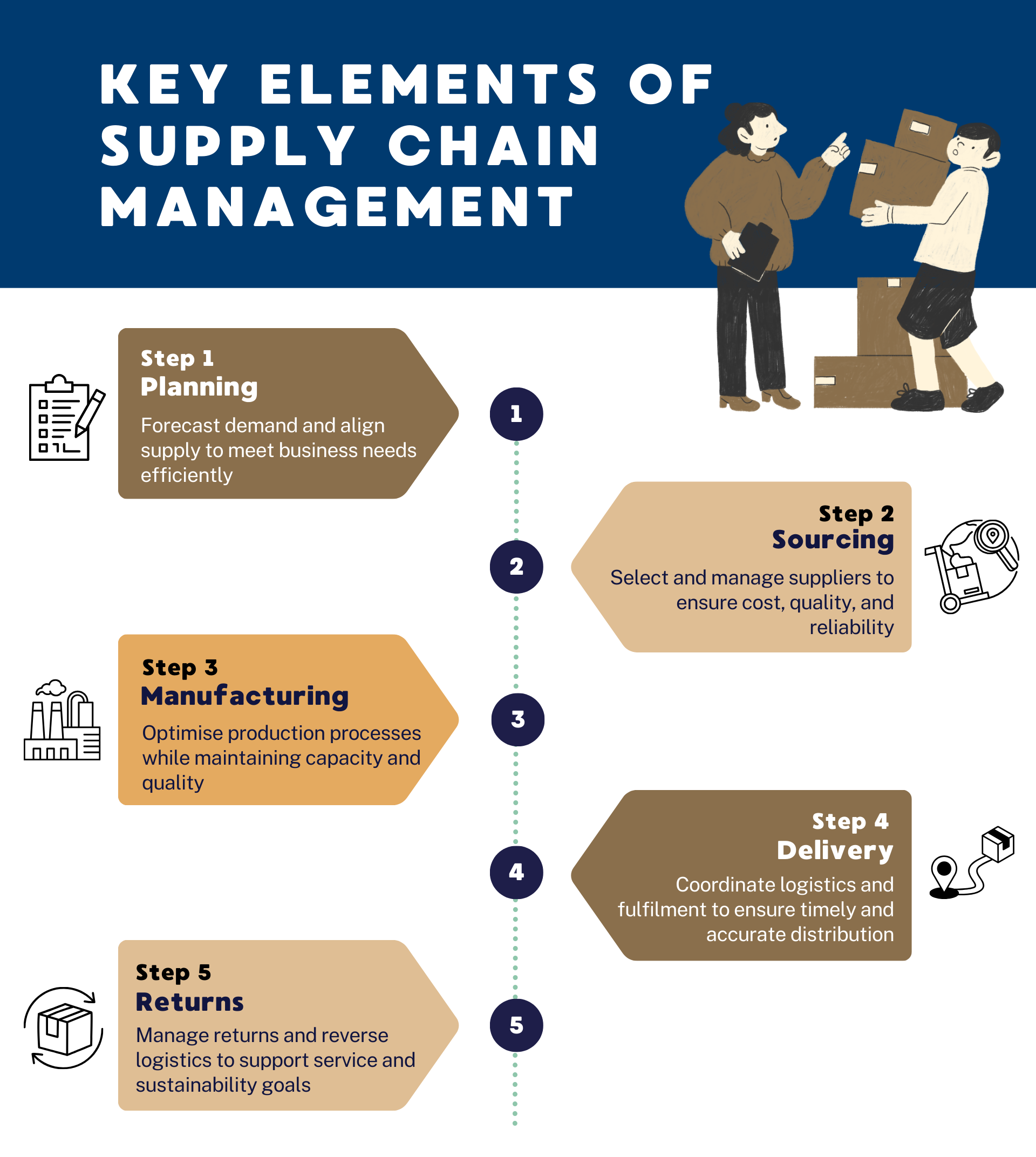
Step 1: Planning
Planning involves forecasting demand, aligning supply with business objectives, and determining inventory levels. Effective planning helps organisations balance customer demand with available resources while minimising excess inventory and shortages.
Step 2: Sourcing
Sourcing focuses on selecting, managing, and collaborating with suppliers. This includes procurement, contract management, and supplier performance evaluation to ensure reliability, quality, and cost-effectiveness.
Step 3: Manufacturing
Manufacturing covers production processes, capacity planning, and quality control. In this stage, organisations aim to optimise production efficiency while maintaining consistency and meeting customer requirements.
Step 4: Delivery
Delivery involves logistics, transportation, warehousing, and order fulfilment. Efficient distribution ensures products reach customers on time and in good condition, while controlling transportation and storage costs.
Step 5: Returns
Returns management addresses product returns, repairs, recycling, and disposal. This area of supply chain management plays an increasingly important role in supporting sustainability efforts, customer service, and regulatory compliance.
Benefits of Effective Supply Chain Management
An effective supply chain management contributes to improved organisational performance in several key areas:
- Cost optimisation: Improved planning, sourcing, and inventory control help organisations reduce procurement, production, and logistics cost
- Increased operational efficiency: Streamlined processes across suppliers, production, and distribution improve productivity and resource utilisation
- Risk management: Greater visibility across the supply chain helps organisations identify, assess, and mitigate disruptions more effectively
- Improved decision-making: Access to accurate, timely data supports faster and more informed operational and strategic decisions
- Customer satisfaction: Reliable product availability and delivery performance enhance customer trust and long-term relationships
Professionals working in logistics, procurement, operations, and supply chain roles may consider structured training to strengthen capabilities in areas such as supply chain analytics, digital transformation, and end-to-end planning.
Relevant programmes include SMU Academy’s Advanced Certificate in Supply Chain Intelligence and Advanced Certificate in Digital Supply Chain, which focus on building applied knowledge for modern supply chain environments.
Key Trends in Supply Chain Management for 2026
Supply chain management continues to evolve as organisations respond to increased complexity, disruption risks, and growing expectations around visibility and resilience. In 2026, several technology-driven and operating trends are shaping how supply chains are designed and managed.
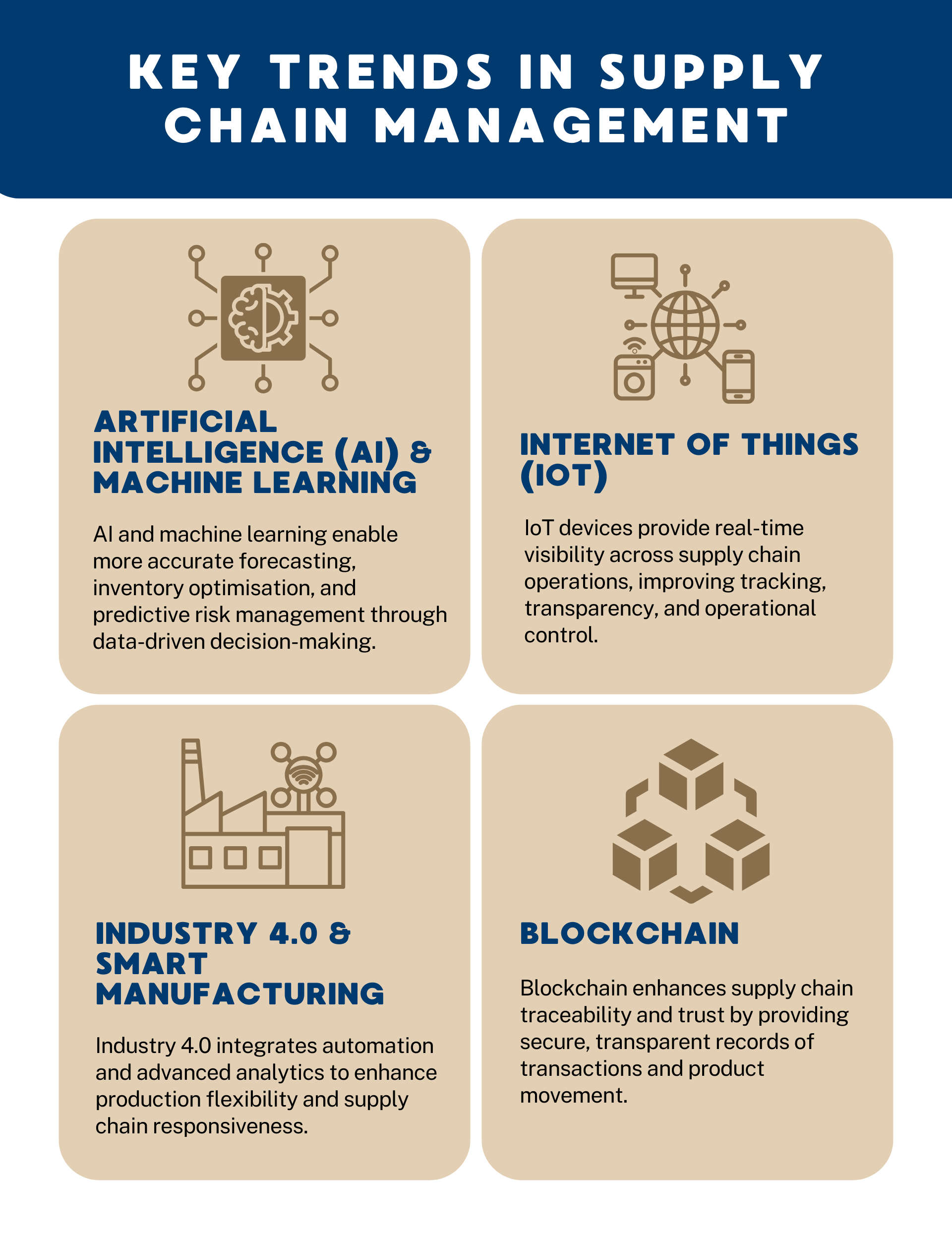
Artificial Intelligence (AI) and Machine Learning
Artificial intelligence (AI) and machine learning are increasingly embedded into supply chain planning and decision-making processes. These technologies are used to improve demand forecasting accuracy, optimise inventory levels, and identify potential disruptions before they occur.
By analysing large volumes of historical and real-time data, AI-enabled systems support more proactive and data-driven supply chain decisions, particularly in volatile or uncertain environments.
As these technologies become more widely adopted, professionals may also look to build applied skills through programmes such as SMU Academy’s Professional Certificate in Supply Chain Innovation.
Internet of Things (IoT)
The use of IoT devices enables real-time data collection across supply chain activities, including transportation, warehousing, and production. Sensors and connected devices provide visibility into shipment locations, environmental conditions, equipment performance, and inventory status.
This increased transparency supports better tracking, faster issue resolution, and improved operational control across end-to-end supply chains.
As organisations redesign processes to improve digital visibility and systems integration, supply chain professionals are increasingly expected to understand how innovation and transformation are put into practice. Structured programmes such as the Advanced Certificate in Supply Chain Innovation and Transformation provide applied perspectives on redesigning supply chain operations in digitally enabled environments.
Industry 4.0 and Smart Manufacturing
Industry 4.0 refers to the integration of digital technologies such as automation, robotics, advanced analytics, and connected systems within manufacturing and supply chain operations.
Smart manufacturing environments allow organisations to improve production flexibility, reduce downtime, and align manufacturing more closely with demand signals. These capabilities support faster response times and closer coordination between production and downstream supply chain activities.
Blockchain
Blockchain technology is being explored as a way to enhance traceability and trust across supply chains. By providing a shared and tamper-resistant record of transactions, blockchain can help organisations track the movement and provenance of goods more reliably.
This is particularly relevant in industries with regulatory requirements, complex supplier networks, or sustainability and ethical sourcing considerations.
The Future of Supply Chain Management
The future of supply chain management is expected to be shaped by greater digital integration, data-driven decision-making, and increased emphasis on resilience and sustainability. As supply chains become more interconnected and globally distributed, organisations are placing a stronger focus on visibility, risk preparedness, and cross-functional coordination.
At the same time, rising expectations around transparency and environmental responsibility are influencing supply chain strategies. Many organisations are exploring circular economy principles, responsible sourcing, and sustainable supply chain practices as part of long-term capability building.
As market conditions continue to evolve, organisations that invest in adaptable systems, digital capabilities, and skilled professionals will be better positioned to navigate uncertainty.
If you are looking to deepen your expertise in supply chain management and elevate your career, explore SMU Academy's digital supply chain programmes to support your professional growth.
FAQs About Supply Chain Management
What is inventory management in a supply chain?
Inventory management in the supply chain refers to tracking and controlling stock as it moves from suppliers through warehouses and into customer hands. Its goal is to make sure the right products are in the right place at the right time, helping organisations avoid excess inventory and stockouts while keeping costs under control.
Effective inventory management improves operational efficiency and customer satisfaction by reducing waste, optimising stock levels, and supporting timely fulfilment.
What supply chain management software are there?
Supply chain management software is typically used across four main areas: planning, execution, coordination, and performance monitoring.
Common software categories include:
- Planning and forecasting
- Demand planning software
- Supply chain analytics software
- Order and inventory execution
- Inventory management software
- Order management systems (OMS)
- Warehousing and transport
- Warehouse management systems (WMS)
- Transportation management systems (TMS)
- Supplier and enterprise integration
- Supplier relationship management (SRM) software
- Enterprise resource planning (ERP) systems
- Visibility and control
- Supply chain visibility software
What does a supply chain management software do?
Supply chain management software provides a suite of integrated tools that oversee and automate supply chain processes such as inventory tracking, order management, demand planning, transportation, and supplier relationships.
By centralising these functions, SCM software improves visibility, supports data-driven decisions, enhances collaboration across partners, and helps organisations respond more rapidly to disruptions.
What do supply chain managers do?
A supply chain manager oversees the end-to-end flow of materials, products, and information within an organisation’s supply chain. Typical responsibilities include planning procurement, coordinating logistics and distribution, managing inventory, forecasting demand, negotiating with suppliers, and optimising operations to balance cost, quality, and delivery performance.
How much do supply chain management jobs pay?
The salary for supply chain roles in Singapore varies based on experience, industry, and level of responsibility. According to data cited from the Economic Development Board (EDB), supply chain management professionals earn a median monthly salary of approximately $5,900, with senior roles typically commanding higher compensation.