


Artificial intelligence (AI) is becoming an increasingly important part of how organisations operate and make decisions. As organisations generate increasing volumes of data, many are exploring how AI can be applied to enhance processes and deliver more efficient outcomes.
In Singapore, AI adoption is closely linked to the growth of the digital economy. According to The Business Times, the digital economy contributed 18.6% of Singapore’s GDP in 2024. Many professionals and business leaders are therefore seeking to understand how these technologies can be applied effectively within organisations.
This article explains how AI is used in business, the benefits it can bring, and the challenges organisations may face when adopting it.
Key Takeaways
- AI helps organisations automate processes, analyse large datasets, and make faster decisions.
- AI adoption can improve productivity, reduce costs, and uncover insights that support better business strategies.
- Organisations adopting AI must address challenges such as data quality, skills gaps, and ethical considerations.
What Is AI for Business?
AI for business refers to the use of artificial intelligence technologies to improve business operations and decision-making. It involves applying tools such as machine learning, automation, and data analytics to streamline processes, enhance productivity, and uncover insights that would otherwise be difficult to detect.
In practice, AI can support a wide range of business functions, including automating routine tasks, personalising marketing efforts, demand forecasting and risk detection. Rather than replacing human roles, AI is often used to improve productivity and enable teams to focus on more strategic work.
Key Benefits of AI for Business
AI can help organisations improve operational efficiency, support data-driven decisions, and enhance customer experiences. As AI adoption increases, many businesses are exploring how these capabilities can improve performance and support more responsive operations.
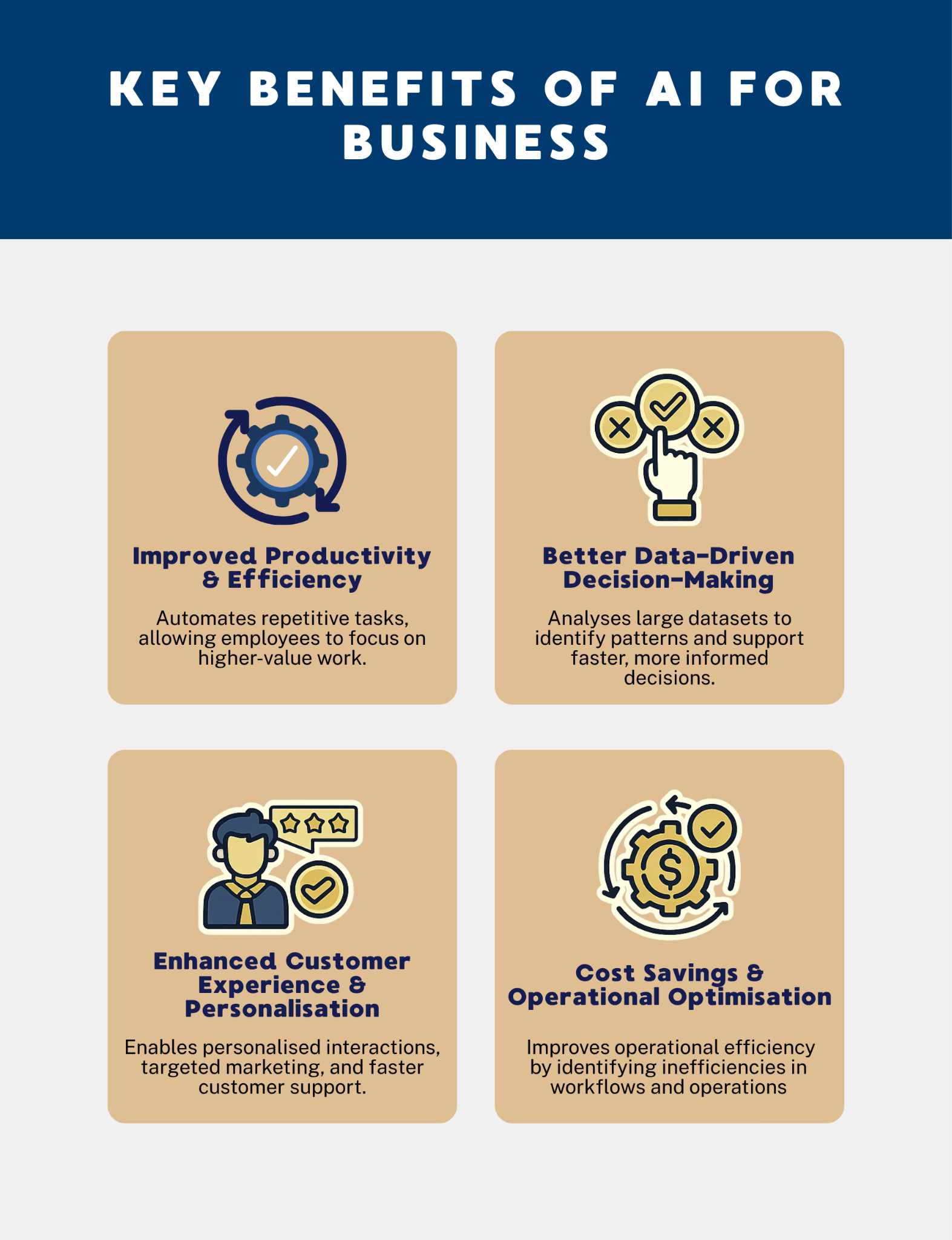
Improved Productivity and Efficiency
Repetitive tasks such as data processing, scheduling, and routine analysis can be automated using AI systems. This reduces time spent on manual work and allows employees to focus on higher-value tasks.
In Singapore, governments and organisations increasingly recognise the role of AI in supporting productivity growth. According to the Ministry of Digital Development and Information (MDDI), AI adoption is important for businesses in Singapore seeking to improve productivity and remain competitive in the digital economy.
Better Data-Driven Decision-Making
AI tools analyse large volumes of data quickly and identify patterns or trends that may be difficult to detect through manual analysis.
As a result, decisions rely less on intuition and more on evidence, improving accuracy and responsiveness in areas such as planning, risk management, and forecasting.
Enhanced Customer Experience and Personalisation
Organisations use AI to improve customer interactions by analysing data to generate personalised recommendations, support targeted campaigns, and provide faster responses to enquiries.
This enables more consistent, responsive, and personalised customer experiences across different touchpoints.
Cost Savings and Operational Optimisation
Businesses can reduce operational costs by using AI to improve efficiency and identify inefficiencies in workflows and operations. Automated systems also minimise errors, helping organisations reduce waste and avoid unnecessary expenses.
These improvements contribute to more efficient use of resources and better overall operational performance.
Applications of AI for Business
AI can be applied across a wide range of business functions, with each application designed to address specific operational or analytical needs.
| Business Function | Example AI Applications |
|---|---|
| Marketing | Customer segmentation, personalised recommendations, campaign optimisation |
| Finance | Financial forecasting, fraud detection, risk analysis |
| Customer Service | AI chatbots, virtual assistants, automated support systems |
| Operations | Demand forecasting, inventory optimisation, logistics planning |
Marketing
In marketing, AI is used to analyse customer data and support campaign execution. The use of AI in marketing enables businesses to improve customer segmentation, campaign targeting, and performance optimisation.
According to a McKinsey Global Survey on AI, marketing and sales is one of the most widely adopted functions for AI across organisations. For example, e-commerce platforms such as Amazon use AI-driven recommendation systems to suggest products based on browsing and purchase behaviour.
Finance
AI tools support financial analysis and forecasting by processing large volumes of data efficiently. Machine learning models analyse historical data to identify trends that support planning and risk assessment.
For instance, banks use AI systems to monitor transactions in real time and flag suspicious activity, helping reduce fraud losses and improve compliance with regulatory requirements.
Customer Service
Businesses deploy AI-powered chatbots and virtual assistants to improve customer service. These systems respond to common enquiries, guide users through processes, and provide support outside of working hours.
Gartner predicts that by 2028, at least 70% of customers will use a conversational AI interface to start their customer service journey.
Operations
AI technologies are also applied to demand forecasting, inventory management, and logistics planning. Businesses analyse operational data to improve coordination across supply chains and allocate resources more effectively.
For example, retailers use AI to forecast demand and optimise stock levels, while logistics companies apply AI to optimise delivery routes. Amazon uses AI in its fulfilment network to predict demand and improve warehouse efficiency.
Challenges of AI for Business
Businesses may encounter several challenges when implementing AI systems, including data quality limitations, workforce skills gaps, and governance considerations. Addressing these issues is essential for businesses seeking to adopt AI effectively and responsibly.
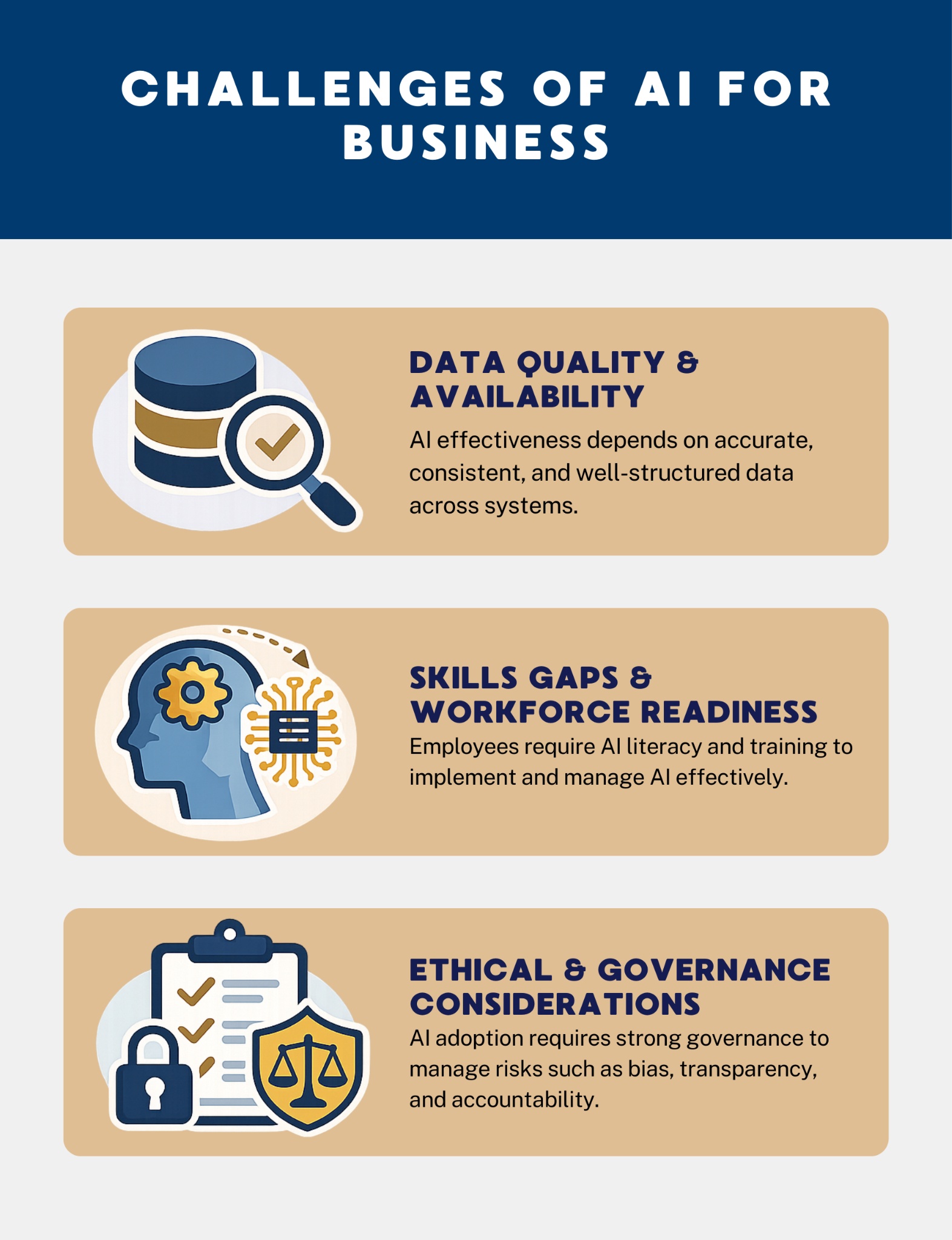
Data Quality and Availability
AI systems rely on large volumes of accurate and well-structured data. If the data used to train or operate AI models is incomplete or inconsistent, the outputs produced by these systems may be inaccurate or unreliable.
Maintaining high-quality data can be challenging because business data is often stored across multiple systems and formats. This fragmentation can make it difficult to consolidate datasets or ensure consistency. Before implementing AI solutions, organisations may therefore need to strengthen their data management practices and ensure that datasets are reliable and accessible.
Common data challenges include:
- Incomplete datasets that limit model accuracy
- Inconsistent data formats across different systems
- Outdated information that affects predictions and analysis
Skills Gaps and Workforce Readiness
Adopting AI requires employees who can understand, manage, and apply these tools effectively. As a result, roles in AI, data science, and analytics have become some of the most in-demand jobs in Singapore, though many businesses still face a shortage of skilled professionals in these areas.
To address this gap, organisations are investing in training programmes that build AI literacy and practical skills within the workforce. Upskilling initiatives help professionals understand how such tools support decision-making, automation, and data analysis.
Professionals can explore structured AI courses in Singapore to develop these capabilities. SMU Academy’s Artificial Intelligence (AI) for Entrepreneurs: Harnessing AI for Business Transformation introduces business leaders to practical AI applications and strategies for integrating AI into organisational processes.
Ethical and Governance Considerations
AI systems raise ethical and governance concerns, particularly when they influence decisions that affect individuals or organisations. Organisations must manage risks such as algorithmic bias, transparency, and accountability when deploying AI systems.
In Singapore, responsible AI development has been emphasised through initiatives such as the National AI Strategy, which promotes innovation while maintaining strong governance frameworks. Clear governance practices help organisations reduce operational and ethical risks while maintaining trust in AI-driven decisions.
The Future of AI for Business
AI adoption in business is expected to accelerate as organisations increasingly rely on data-driven technologies to improve operations, decision-making, and customer engagement. As artificial intelligence capabilities continue to evolve, more businesses are integrating AI tools into everyday workflows and strategic planning.
For professionals seeking to better understand how AI can be applied in business environments, SMU Academy offers AI courses that explore practical applications of artificial intelligence and responsible AI adoption.
FAQs About AI for Business
How can AI be used in business?
AI can be used in business to support tasks such as customer service, forecasting, fraud detection, and marketing personalisation. Organisations apply AI across functions to streamline workflows, improve responsiveness, and generate insights from operational data.
What industries benefit most from AI implementation?
Industries that rely on large datasets and complex processes benefit most from AI implementation. This includes sectors such as finance, healthcare, retail, and manufacturing, where AI supports activities like risk analysis, diagnostics, demand forecasting, and predictive maintenance.
Can AI replace the workforce in the future?
AI is unlikely to completely replace the workforce, but it will change how many jobs are performed. Most organisations use AI to automate repetitive tasks while employees focus on higher-value work such as problem-solving, decision-making, and strategic planning. According to McKinsey & Company, around 60% of occupations have at least 30% of tasks that could be automated, indicating that AI is more likely to reshape roles rather than replace them entirely.
As AI adoption increases, many professionals are developing skills in areas such as AI literacy, data analysis, and prompt engineering. SMU Academy’s generative AI courses cover practical ways generative AI tools can be applied in business contexts.
How does AI improve operational efficiency in businesses?
AI improves operational efficiency by streamlining workflows and reducing manual processes. It enables organisations to monitor operations, forecast demand, and optimise resource allocation more effectively.
What are the ethical concerns with AI for business?
The main ethical concerns with AI in business include data privacy, bias, transparency, and accountability. Organisations must manage these risks through strong governance frameworks and responsible data practices to ensure fair and reliable outcomes.