


Communication skills refer to how effectively you share information, ideas, and intentions with others, as well as how well you listen, interpret, and respond. In the workplace, communication goes beyond speaking confidently. It includes writing clearly, understanding non-verbal signals, choosing the right tone, and tailoring messages to different audiences and situations.
Strong communication skills are consistently highlighted as a top hiring priority. According to the National Association of Colleges and Employers (NACE), more than 75% of recruiters say they actively look for clear evidence of good communication skills when assessing candidates. This applies across roles, from entry-level positions to senior leadership. Jobs in management, sales, marketing, customer service, healthcare, education, and project-based roles all rely heavily on clear and effective communication to function well.
This article explores why communication skills matter at work, the benefits they bring, what effective communication looks like, examples of essential communication skills, and practical ways to improve and demonstrate them.
Key Takeaways
- Communication skills are consistently ranked among the top skills employers look for across industries, job functions, and seniority levels.
- Strong communication improves productivity, collaboration, and workplace relationships while reducing misunderstandings.
- Effective communication involves clarity, active listening, appropriate tone, and awareness of non-verbal cues.
- Communication skills can be developed through practice, feedback, continuous learning, and structured strategies.
Why Are Communication Skills Important in the Workplace?
Communication skills are a foundational category of soft skills that play a central role in how work gets done. They affect how clearly expectations are set, how smoothly teams collaborate, and how effectively problems are resolved. When communication is strong, employees are better aligned with goals, decisions are understood more quickly, and work progresses with fewer disruptions.
Clear communication also helps prevent common workplace issues such as duplicated work, misinterpretation of instructions, and unnecessary conflict. Over time, consistent and effective communication builds trust, strengthens working relationships, and supports a more positive and productive work environment.
What Are Some Key Benefits of Strong Communication?
Strong communication creates meaningful advantages for both individuals and organisations. These benefits extend beyond smoother conversations and directly influence performance, morale, and outcomes.
- Improved collaboration
Clear communication helps team members understand their roles, share ideas openly, and work together more effectively towards shared objectives. - Higher productivity
When information is communicated clearly and efficiently, teams spend less time clarifying instructions or correcting errors. In fact, the 2024 State of Business Communication report shared that 64% of the surveyed business leaders believed that effective communication improved their overall productivity. - Better workplace relationships
Open and respectful communication encourages trust and reduces tension, making it easier to resolve disagreements constructively. - Stronger leadership and influence
Strong communication strengthens leadership qualities by helping individuals articulate vision, guide teams, and build trust. - Reduced misunderstandings and conflict
Clear expectations and timely feedback help prevent small issues from escalating into larger problems.
What Does Effective Communication Look Like?
Effective communication focuses on delivering the right message, to the right people, at the right time, and in the right way. It requires clarity, intention, and awareness of how messages are received, not just how they are delivered.
While communication is essential, more communication does not always mean better outcomes. Research from Gallagher’s State of the Sector 2024 report highlights that excessive or unnecessary communication can overwhelm employees and negatively affect productivity. This makes thoughtful, well-structured communication especially important.
Key elements of effective communication include:
- Clarity and structure: Messages are organised, concise, and easy to follow, helping recipients quickly understand what is expected or required.
- Active listening: The communicator listens attentively, acknowledges what is being said, and responds in a way that shows understanding.
- Appropriate tone: Tone matches the context, whether formal or conversational, and reflects respect and professionalism.
- Non-verbal cues and body language: Eye contact, posture, facial expressions, and gestures reinforce spoken messages and help convey confidence and openness.
- Consistency across channels: Verbal, written, and non-verbal communication align to avoid confusion or mixed signals.
Examples of Essential Communication Skills
Communication skills are not one-dimensional. They fall into different categories, each serving a distinct purpose in how people exchange information, build relationships, and work together. Developing a balanced mix of these skills allows individuals to communicate more effectively across situations and audiences.
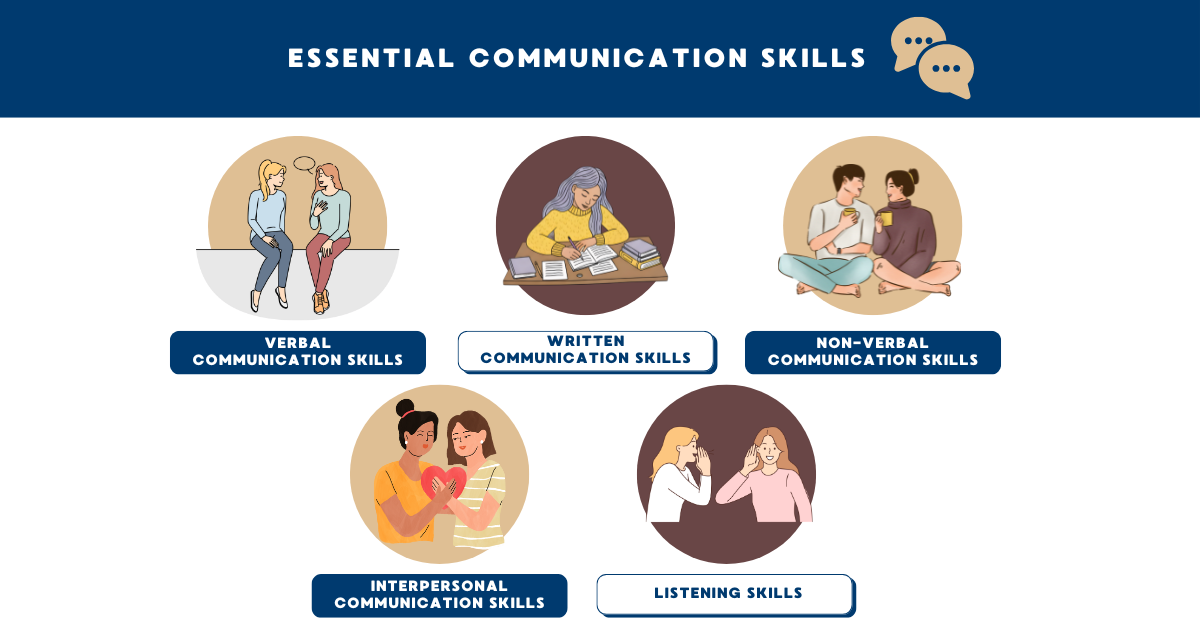
Verbal Communication Skills
1. Clear speaking
The ability to express ideas logically and confidently in conversations, meetings, and presentations, ensuring messages are easy to understand.
2. Tone and articulation
Tone plays a critical role in how messages are perceived. A calm, respectful tone can encourage cooperation, while an abrupt or unclear tone may cause defensiveness or confusion. Clear articulation also ensures that ideas are communicated accurately, especially in high-stakes discussions.
Written Communication Skills
3. Professional writing
Writing emails, reports, and documents in a structured and concise manner helps convey information efficiently and reduces misinterpretation.
4.Digital communication
With many workplaces relying on emails, messaging platforms, and virtual meetings, the ability to communicate clearly and professionally online is essential for maintaining clarity and collaboration.
Non-Verbal Communication Skills
5. Body language awareness
Knowing how to use body language to reinforce messages, such as maintaining eye contact or open posture, while also interpreting others’ body language to gauge reactions, engagement, or discomfort.
Albert Mehrabian's 7-38-55 rule states that communication consists of 7% words, 38% tone and 55% body language, highlighting that non-verbal cues are as important as, or more important than verbal cues.
Listening Skills
6. Active listening
This involves giving full attention, asking thoughtful questions, paraphrasing key points, and responding appropriately, rather than simply waiting for your turn to speak.
Interpersonal Communication Skills
7. Empathy
Understanding and acknowledging others’ perspectives helps create more respectful and productive conversations.
8. Relationship building
Strong communication supports relationship building by encouraging open dialogue, mutual respect, and trust over time.
How Can You Improve Your Communication Skills?
Improving communication skills takes intention, practice, and reflection. By following a structured approach, you can gradually build confidence and effectiveness in how you communicate at work.
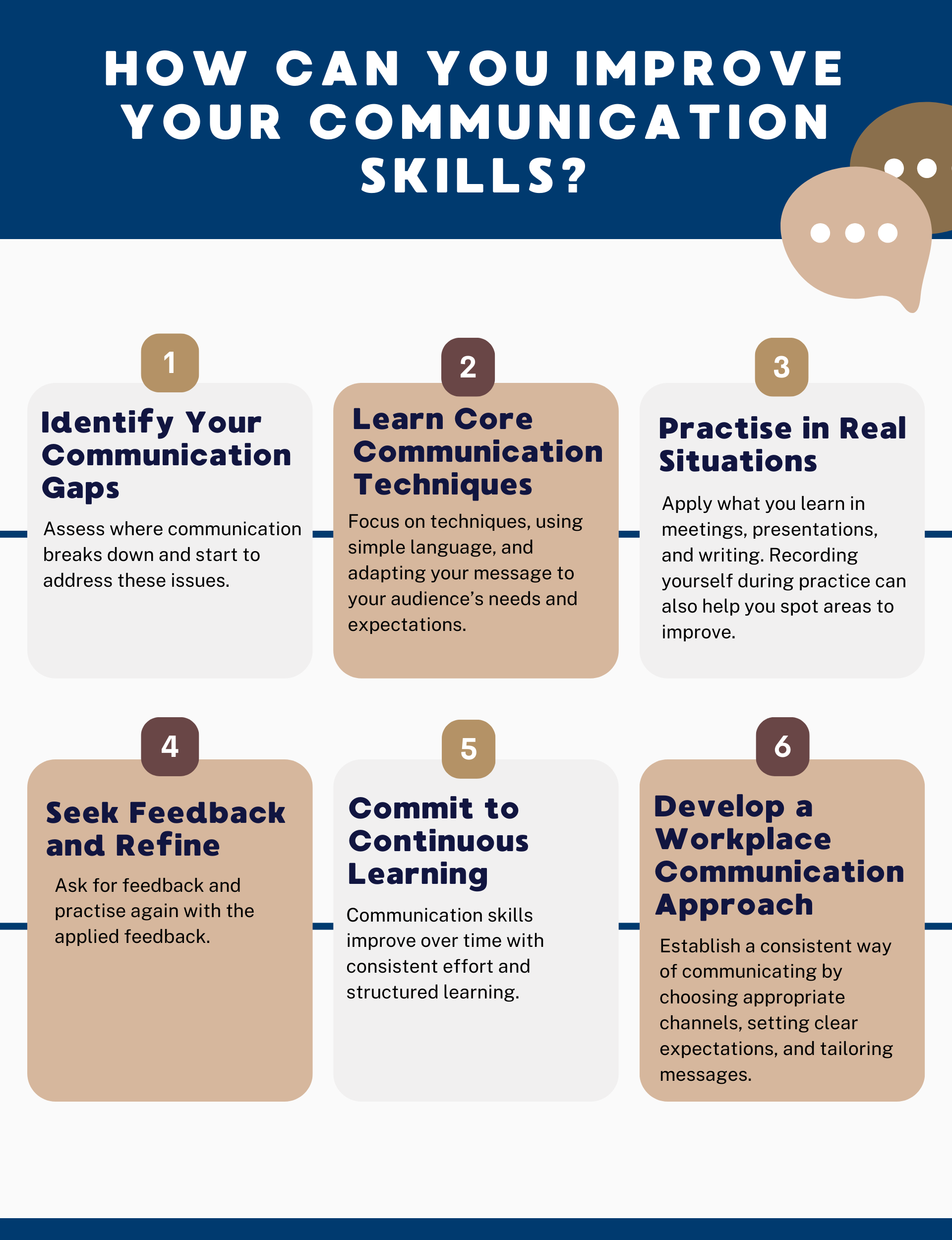
Step 1: Identify Your Communication Gaps
Begin by assessing where communication breakdowns occur, such as misinterpreted emails, inefficient meetings, or unclear feedback conversations. Address these gaps by clarifying your message structure, asking follow-up questions, or preparing key points in advance.
Step 2: Learn Core Communication Techniques
Focus on techniques such as organising your thoughts before speaking, using simple language, and adapting your message to your audience’s needs and expectations.
Step 3: Practise in Real Situations
Apply what you learn during meetings, presentations, or written communication. Recording yourself during presentations or practice sessions can help you identify areas for improvement in tone, clarity, and pacing.
Step 4: Seek Feedback and Refine
Ask for feedback from managers, colleagues, or trusted peers. Practise communicating with the same individuals again, apply their feedback, and check if your improvements are noticeable.
Step 5: Commit to Continuous Learning
Communication skills improve over time with consistent effort and structured learning. Consider taking professional presentation skill courses offered by SMU Academy such as:
- Advanced Certificate in Communication Management
- Clearly Speak: A Course on Effective Speaking for Corporate Leaders, Professionals and Executives
- Writing Effectively for the Digital Age
In addition to upskilling via attending courses, read widely to expand your vocabulary, observe how effective communicators phrase ideas, and learn common expressions to sound more natural and fluent.
Step 6: Develop a Workplace Communication Approach
Establish a consistent way of communicating at work by choosing appropriate channels, setting clear expectations, and tailoring messages for different stakeholders. Harvard Business Review highlights that having a deliberate communication approach helps improve clarity, alignment, and outcomes across teams.
How to Demonstrate Good Communication Skills on a Resume?
Strong communication skills mean little to employers if they are not clearly demonstrated on your resume. Since hiring managers cannot observe how you communicate directly, your resume must provide concrete evidence that you can communicate clearly and effectively.
Use clear and concise language
For example, well-structured bullet points and straightforward phrasing show that you can communicate efficiently without unnecessary complexity.
Highlight communication-focused achievements
Mention experiences such as presenting to senior stakeholders, leading cross-functional meetings, or managing client communications.
Use action-oriented verbs
Words like “presented”, “facilitated”, “collaborated”, and “negotiated” show active involvement in communication.
Tailor examples to the role
For instance, highlight client communication for customer-facing roles or report writing and presentations for analytical or leadership positions.
Include relevant training or certifications
Communication-related courses demonstrate ongoing commitment to developing this skill.
Build Your Communication Skills For Long-Term Success
Communication skills underpin nearly every aspect of professional success. They influence how ideas are shared, how teams collaborate, and how relationships are built over time. By understanding the different types of communication skills, practising them intentionally, and adopting a structured approach to improvement, individuals can become more confident and effective communicators.
As workplaces continue to evolve, strong communication remains a lasting advantage that supports career growth, leadership, and long-term employability.
SMU Academy offers a range of professional communication courses designed to support workplace communication, leadership development, and long-term career growth.
FAQs about Communication Skills
What are the most important communication skills for work?
The most important communication skills for work are those that support clarity, collaboration, and professional relationships, including:
- Clear verbal communication
- Professional writing
- Active listening
- Empathy
- Non-verbal communication such as body language
These skills help employees share ideas clearly, collaborate effectively, and build strong workplace relationships. In many roles, communication skills are also closely linked to leadership qualities, as they support decision-making, influence, and team alignment.
Can communication skills be learned?
Yes, communication skills can be learned and improved through practice, feedback, and structured learning over time.
While some people may feel more naturally confident communicating, communication is a set of soft skills that can be developed over time. through practice, feedback, and structured learning. Techniques such as active listening, message structuring, and tone management can be learned by anyone willing to invest time and effort.
How long does it take to improve communication skills?
Noticeable improvement in communication skills can often be seen within a few weeks with consistent practice and feedback. The time it takes to improve communication skills varies depending on the individual and the skills being developed. With consistent practice and feedback, noticeable improvement can often be seen within a few weeks.
The exact timeframe varies depending on the individual and the specific skills being developed. More advanced communication skills, such as persuasive speaking or leadership communication, typically develop over several months through continuous practice, reflection, and learning.
How do employers assess communication skills?
Employers assess communication skills through multiple stages of the hiring process. This includes:
- How clearly candidates express themselves in resumes and cover letters,
- How they respond to interview questions, and
- How well they listen and engage in conversations.
In some roles, employers may also use presentations, group discussions, or written tasks to evaluate communication skills in real-world scenarios.
How can introverts improve communication skills?
Introverts can improve communication skills by focusing on preparation, structure, and active listening. listening strengths. Some actionable steps to take include:
- Preparing key points before conversations
- Practising in smaller groups
- Using written communication where appropriate can build confidence
Many introverts excel at active listening and thoughtful responses, which are valuable communication skills that support strong professional relationships and leadership qualities.