


Digital marketing strategies help businesses reach the right audience, build brand awareness, and drive measurable results online. These strategies involve developing creative campaigns that are driven by data insights across multiple channels. Establishing a strong digital marketing strategy is important for companies to attract, engage, and convert prospects effectively.
In this guide, we explore the key components of a digital marketing strategy, the main types of marketing channels, and real-world examples to inspire your campaigns.
Key Takeaways
- A digital marketing strategy aligns online efforts with business goals using data and audience insights.
- It combines key channels like SEO, content, social media, paid ads, email, and influencer marketing.
- Success depends on clear goals, audience understanding, valuable content, and continuous optimisation.
- Real-world campaigns show how content, creativity, and personalisation drive engagement and results.
What is a Digital Marketing Strategy?
A digital marketing strategy is a well-defined plan that outlines how a business uses online channels to achieve its marketing and business goals. It provides guidance on connecting with the right audience, promoting offerings effectively, and tracking results across digital platforms.
A strong strategy ensures that marketing efforts are aligned with wider organisational objectives, allowing businesses to focus on the channels and tactics that deliver the most impact.
Core components of a digital marketing strategy often include:
- Gaining clear insights into the target audience and their behaviours
- Choosing suitable digital platforms, such as search, social media, or email
- Setting specific goals alongside measurable key performance indicators (KPIs)
- Developing content, messaging, and campaign plans
- Analysing performance data to assess effectiveness and guide improvements
With a strategy in place, organisations can streamline their marketing activities, optimise resource allocation, and make data-driven decisions to improve outcomes.
Types of Effective Digital Marketing Strategies
Digital marketing strategies can take many forms depending on a business’s goals, target audience, and available channels. Below are some of the most widely used and proven digital marketing strategies.
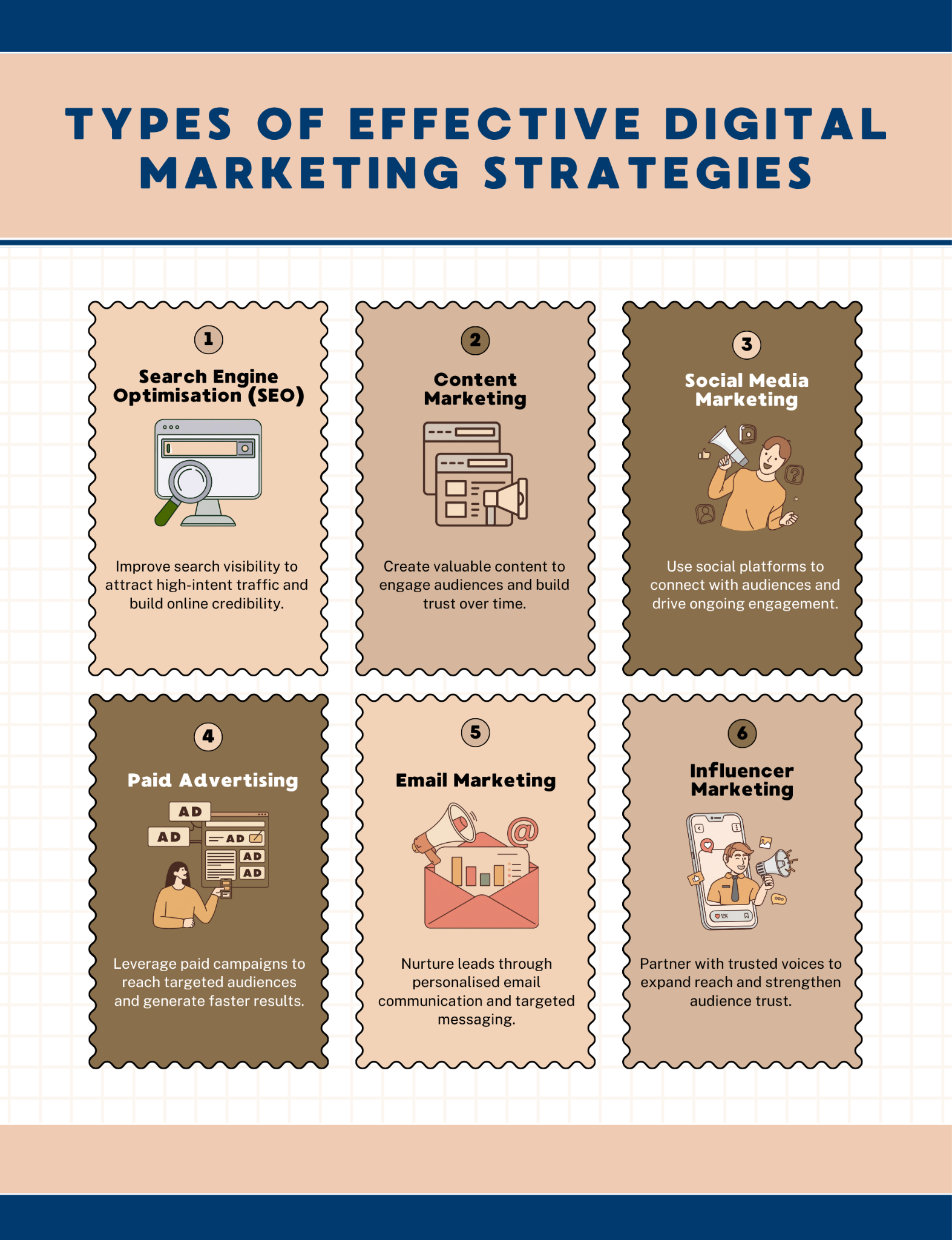
Search Engine Optimisation (SEO)
Improving visibility on search engines is a key objective for many organisations seeking to attract relevant online traffic. SEO focuses on optimising website elements such as keywords, backlinks, site structure, meta descriptions, and images to improve search rankings.
Higher visibility allows businesses to reach users who are actively searching for related products, services, or information. Over time, effective SEO can increase organic traffic, enhance user experience, and strengthen online credibility.
For those looking to build practical SEO skills and understand how search engines rank content, enrolling in a Digital Marketing – Search Engine Marketing course provides structured guidance on keyword research and optimisation.
Content Marketing
Building trust with audiences often requires more than direct promotion. Content marketing focuses on creating and distributing informative and engaging materials that address audience needs and interests.
Common content formats include:
- Blog articles
- Videos
- E-books and downloadable guides
- Webinars
- Infographics
Developing strong content creation and communication skills is an important part of effective content marketing. Programmes like Digital Marketing – Creating and Curating Video Content introduce techniques for planning and producing engaging video content.
Social Media Marketing
Online platforms such as Instagram, Facebook, LinkedIn, TikTok and Xiao Hong Shu play an important role in how organisations communicate with their audiences. Social media marketing focuses on using these platforms to share content, promote offerings, and build ongoing engagement.
Many platforms provide advanced targeting features, allowing marketers to reach specific audiences based on demographics, location, and interests.
A strong social media presence is built on far more than consistent posting. It requires a disciplined approach to content planning, audience engagement, and performance analysis. For those looking to develop these competencies, courses like Digital Marketing – Social Media Marketing and TikTok Marketing and Ads for Business offer structured pathways to understanding how modern platforms operate and how to leverage them strategically for measurable business impact.
Paid Advertising
When faster results or broader reach are required, paid advertising provides a more immediate approach. This strategy includes search engine ads, pay-per-click (PPC) campaigns, and sponsored social media placements.
Marketers can allocate budgets strategically while monitoring campaign performance in real time. In addition, different messages, visuals, and calls to action can be tested to identify the approach that resonates most with their audience.
Email Marketing
Email marketing remains an effective way to communicate with audiences who have already shown interest in a brand. It allows businesses to share updates, promote offers, and nurture leads over time.
Email lists are typically built through newsletter sign-ups, downloadable resources, webinars, or events. Modern tools also support segmentation, allowing messages to be tailored based on user behaviour or preferences.
Effective email marketing is as much a craft as it is a science, one that demands precision in audience targeting, fluency in persuasive communication, and a working command of automation tools. The course Digital Marketing – Persuasive Copywriting, Chatbots, and Email Marketing Essentials provides a rigorous and practical grounding in each of these disciplines, equipping learners with the strategic and technical capabilities needed to design campaigns that engage, nurture, and convert.
Influencer Marketing
Reaching niche communities often involves collaboration with individuals who have established credibility within specific audiences. Influencer marketing focuses on partnering with these individuals to extend reach and build trust.
Collaborations may include product reviews, giveaways, event promotions, or sponsored social media content. When used strategically, influencer marketing can help brands reach new audiences and build stronger connections with online communities.
How to Create a Digital Marketing Strategy?
Developing a digital marketing strategy involves aligning marketing activities with clearly defined business objectives. A structured approach allows organisations to prioritise efforts, allocate resources effectively, and measure outcomes more consistently.
The following steps outline how businesses can build a strategy that is both practical and results-oriented.
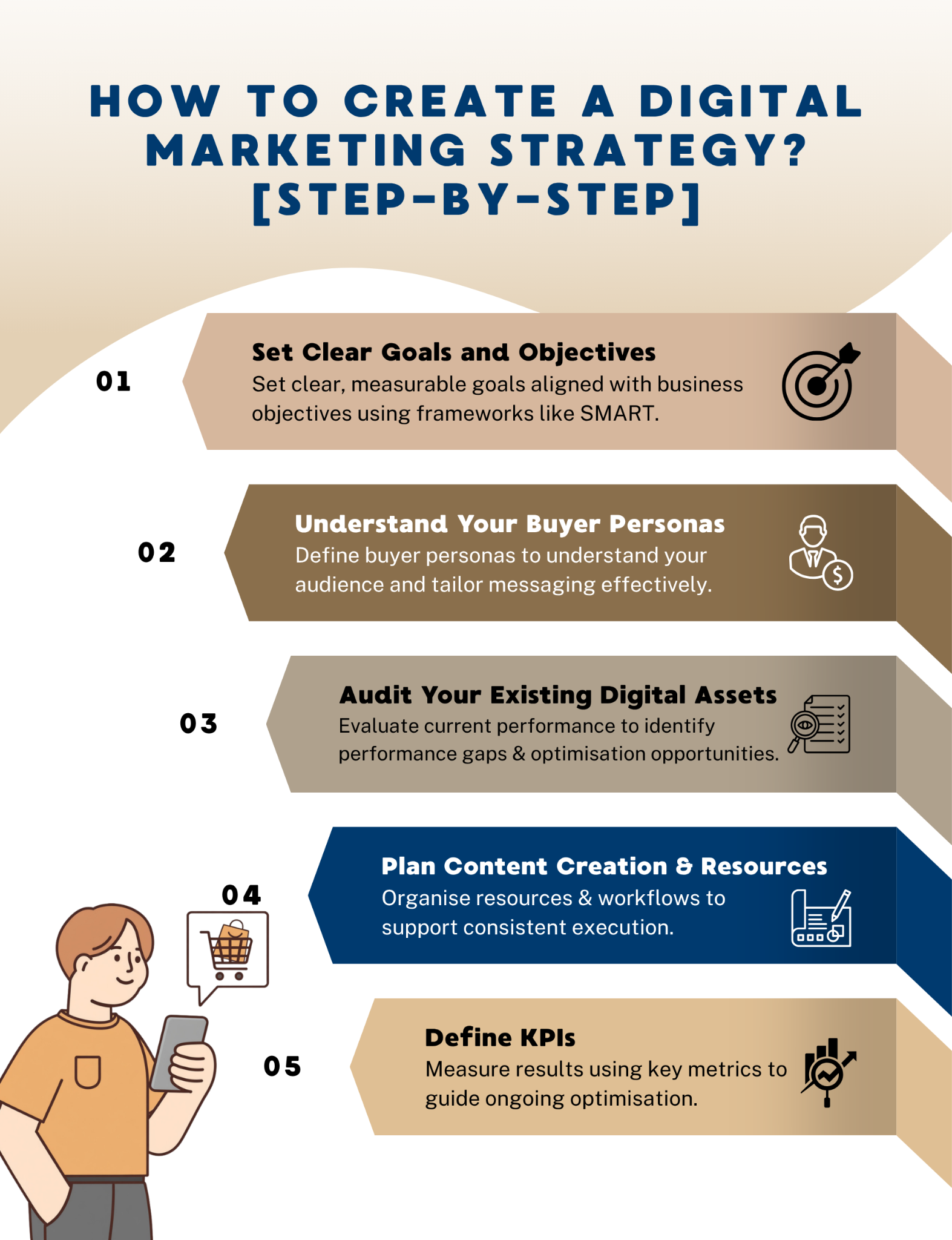
Step 1: Set Clear Goals and Objectives
A well-defined strategy begins with clear and measurable objectives. These goals should align with broader business priorities and provide direction for all marketing activities.
Frameworks such as SMART (Specific, Measurable, Achievable, Relevant, and Time-bound) are commonly used to ensure clarity and accountability. For example, an organisation aiming to increase brand awareness through content marketing may define a goal to grow its email subscriber base by 20% within 6 months using existing channels.
Step 2: Understand Your Buyer Personas
A successful strategy begins with a clear understanding of your target audience. Developing detailed buyer personas based on research and data helps you to tailor your messaging, content, and marketing channels more effectively.
A buyer persona typically includes:
- Location: Where your audience lives or commonly makes online purchases
- Income or occupation: Their earning capacity, job roles, and spending behaviour
- Interests and goals: Hobbies, motivations, and pain points identified through research or feedback
Step 3: Audit Your Existing Digital Assets
Before launching new campaigns, it is important to assess the performance of existing digital assets to identify content gaps and optimisation opportunities. This typically involves crawling the website to review existing content, identifying missing or underdeveloped areas, and evaluating SEO performance to uncover keyword opportunities and assess how well current pages are performing.
Step 4: Plan Content Creation and Resources
Once priorities have been established, determine how content will be produced and managed. Effective content planning ensures marketing efforts remain consistent and achievable.
Key considerations include:
- Budget: Financial resources available for content production
- Resource allocation: Whether tasks will be handled in-house or outsourced
- Technology: Tools required for design, collaboration, and project management
- Timelines: Realistic deadlines to support consistent execution
Step 5: Define Key Performance Indicators (KPIs)
Measuring performance is essential for understanding the effectiveness of a digital marketing strategy. KPIs provide quantifiable metrics that reflect whether objectives are being achieved.
Common KPIs include:
- Conversion rates
- Cost per lead
- Returning website visitors
- Engagement rates
- Click-through rates
- Marketing qualified leads (MQLs) and sales qualified leads (SQLs)
- Customer lifetime value
Regularly reviewing these metrics helps businesses understand what is working and where adjustments are needed to improve performance.
Successful Digital Marketing Strategy Examples
Real-world campaigns provide useful insight into how digital marketing strategies are applied across different contexts. By examining how organisations execute these strategies, it becomes easier to understand what drives engagement and measurable outcomes.
1. Salesforce+
When the COVID-19 pandemic brought traditional marketing to a halt, Salesforce did not pause, but it pivoted. Within days of global lockdowns in March 2020, the company launched Salesforce+, a dedicated streaming platform offering live and on-demand business content spanning leadership, technology, and industry innovation.
At the heart of this initiative was its flagship series, "Leading Through Change," which reached more than 600 million viewers across owned and social channels, averaging 10 million views per episode. In the first month alone, organic prospect traffic to the Salesforce website increased by 47%, form completions through webinars grew 80 times, and the brand's blog newsletter audience expanded by over 70%. Rather than focusing on direct product promotion, Salesforce positioned itself as a source of valuable industry knowledge. By prioritising educational content, the brand strengthened its authority and increased engagement among its target audience.
2. CeraVe
CeraVe turned an absurd premise into one of the most talked-about marketing moments of 2024. Built around the fictional idea that actor Michael Cera was secretly the founder of the skincare brand, the campaign unfolded gradually across platforms. Influencers shared staged sightings, dermatologists weighed in, and brand channels played along, sustaining curiosity long before any official reveal. The campaign culminated in a Super Bowl advertisement that brought the narrative full circle.
The results were staggering: the campaign generated over 32 billion earned impressions, sparked more than 2,000 media articles, and secured the highest share of voice during the Super Bowl broadcast, outperforming brands that spent significantly more on traditional advertising. For a skincare label competing against household names, it showed how a well-executed, multi-platform social media strategy can manufacture cultural relevance and drive outsized visibility at a fraction of the cost.
3. Adidas
Adidas has developed a highly effective email marketing strategy built on data-driven personalisation and AI. Instead of sending identical emails to all subscribers, the brand used AI-powered dynamic content to tailor messages based on individual behaviour and preferences. Emails are customised using data points like language, location, product interests, and previous purchases.
The commercial impact was immediate and significant. Adidas achieved a 40% reduction in costs compared to its standard email process, while dynamic newsletters recorded an 8% year-on-year increase in channel contribution for key markets. The case illustrates a broader truth about AI in marketing: the brands that invest in personalisation as a system, rather than a tactic, are the ones that turn email from a broadcast channel into a consistent driver of revenue.
Develop Stronger Digital Marketing Capabilities
Building an effective digital marketing strategy requires more than understanding individual channels. It involves analysing data, selecting the right platforms, and continuously refining campaigns to achieve better results. With the right soft skills and tools, professionals can create strategies that improve online visibility, engagement, and conversions.
SMU Academy offers a range of digital marketing courses to equip professionals with practical knowledge in search marketing, social media, content strategy, and analytics.
FAQs About Digital Marketing Strategy
How to improve my digital marketing strategy?
Improving your digital marketing strategy involves analysing audience data, refining campaign performance, and creating more relevant customer experiences across channels. AI can further enhance this process by providing deeper insights, automating tasks, and enabling more personalised engagement at scale. Some practical ways to enhance your strategy include:
- Use customer data and AI-driven insights to understand behaviours and preferences
- Personalise experiences through targeted content, emails, and recommendations
- Use social media to engage and educate audiences about your brand
- Leverage social media and partnerships to expand reach and engagement
- Explore AI-powered chatbots and automation to maintain consistent engagement across channels
Professionals looking to deepen their understanding of digital marketing strategies may consider programmes such as the Professional Certificate in Digital Marketing, which teaches how to leverage various platforms to enhance digital marketing strategy.
Why have a digital marketing strategy?
A digital marketing strategy provides a structured framework for reaching and engaging target audiences across online channels. It helps ensure that marketing activities are aligned with broader business objectives and remain consistent across campaigns.
Having a clear strategy enables organisations to target specific audience segments more precisely and track performance in real time. This makes it easier to measure results and refine strategies based on data.
What are the most effective digital marketing channels?
Effective digital marketing strategies typically combine both organic and paid channels to balance long-term growth with immediate reach. Organic channels such as search and social media help build visibility over time, while electronic direct mail (EDM) marketing supports ongoing engagement with existing audiences.
Paid channels, on the other hand, are often used to increase reach more quickly and drive targeted traffic to campaigns.
The most suitable mix depends on factors such as business goals, audience behaviour, and industry context. In practice, most organisations adopt an integrated approach by combining multiple channels to ensure consistent messaging.