


Data engineers are specialists who design, build, and maintain systems that transform raw data into usable formats for analysis and decision making. Data engineering refers to the process of collecting, storing, processing, and optimising data to support data scientists, analysts, and business stakeholders with reliable data infrastructure.
In Singapore, the demand for data engineers has grown rapidly as organisations become increasingly data driven, with thousands of job openings listed across leading job portals, reflecting sustained hiring activity in this field.
This role is critical across industries including finance, healthcare, logistics, e-commerce, and government, where data infrastructure underpins strategic initiatives and operational efficiency. This article explores key skills required for data engineering, major industry trends, typical tools used, and salary expectations in Singapore.
Key Takeaways
- Data engineering is a critical function in modern organisations that enables robust data infrastructure and supports data-driven decision making.
- Demand for data engineers in Singapore is high, with competitive salary packages reflecting the strategic importance of these roles.
- Core skills for data engineers include both technical expertise in data systems and soft skills for cross-functional collaboration.
- Understanding related roles such as data analyst, data scientist, and data architect helps clarify career pathways.
Rise of Data Driven Decision Making
Organisations today are increasingly adopting data-driven decision making, which means using insights derived from data to guide strategic and operational choices rather than relying solely on intuition. Data engineering plays a crucial role in this trend because it ensures that high-quality data is available when and where it is needed.
Companies that adopt big data and analytics into their operations tend to perform better in productivity and profitability, with improvements reported in real-world studies on digital operations transformation.
Advantages of Being Data-Driven
Organisations that embrace data-driven decision making gain a range of benefits that extend beyond simple reporting. By using data to guide decisions, companies can identify trends early, reduce waste, and allocate resources more effectively. Data-driven cultures also foster better alignment between business strategy and operational execution, helping teams across functions make more informed choices.
- Better customer insight: Data analysis reveals customer preferences and behaviour patterns
- Enhanced strategic planning: Historical and predictive data support long-term decision making
- Improved operational efficiency: Processes can be monitored and optimised using real-time data
- Increased competitiveness: Organisations that make decisions backed by evidence adapt more quickly
- Risk mitigation: Data models help anticipate and prevent potential issues before they escalate
Key Trends in Data Driven Decision Making
Several trends are shaping how organisations use data to support decision making. These developments highlight the intersection between technology, analytics, and organisational strategy.
Data volumes are growing rapidly as businesses collect information from internal operations, customer interactions, sensors, and digital platforms. This requires scalable infrastructure and advanced analytic tools.
Artificial Intelligence and Machine Learning
AI and machine learning are increasingly embedded into analytics workflows, automating the extraction of insights and enabling predictive and prescriptive analytics. As of 2025, around 78% of companies now use or are actively testing AI tools in at least one business function, reflecting rapid adoption across sectors.
Big Data Analytics
Organisations are processing massive datasets that traditional tools cannot handle. This enables deeper insights, pattern detection, and more accurate forecasting from disparate sources of structured and unstructured data.
Cloud-Based Data Platforms
Cloud computing has become foundational for data strategy, offering flexible and scalable storage, processing, and analytics capabilities without heavy upfront investment.
Data Governance and Compliance
As data use expands, organisations must ensure robust frameworks for data privacy, security, quality, and compliance with regulations such as those enforced by Singapore’s Personal Data Protection Commission (PDPC) and other authorities.
Real-Time Data Processing
Technologies such as streaming analytics allow organisations to analyse data as it arrives, enabling immediate insights that support time-sensitive decisions in areas like fraud detection, logistics, or customer engagement.
Roles and Responsibilities of a Data Engineer
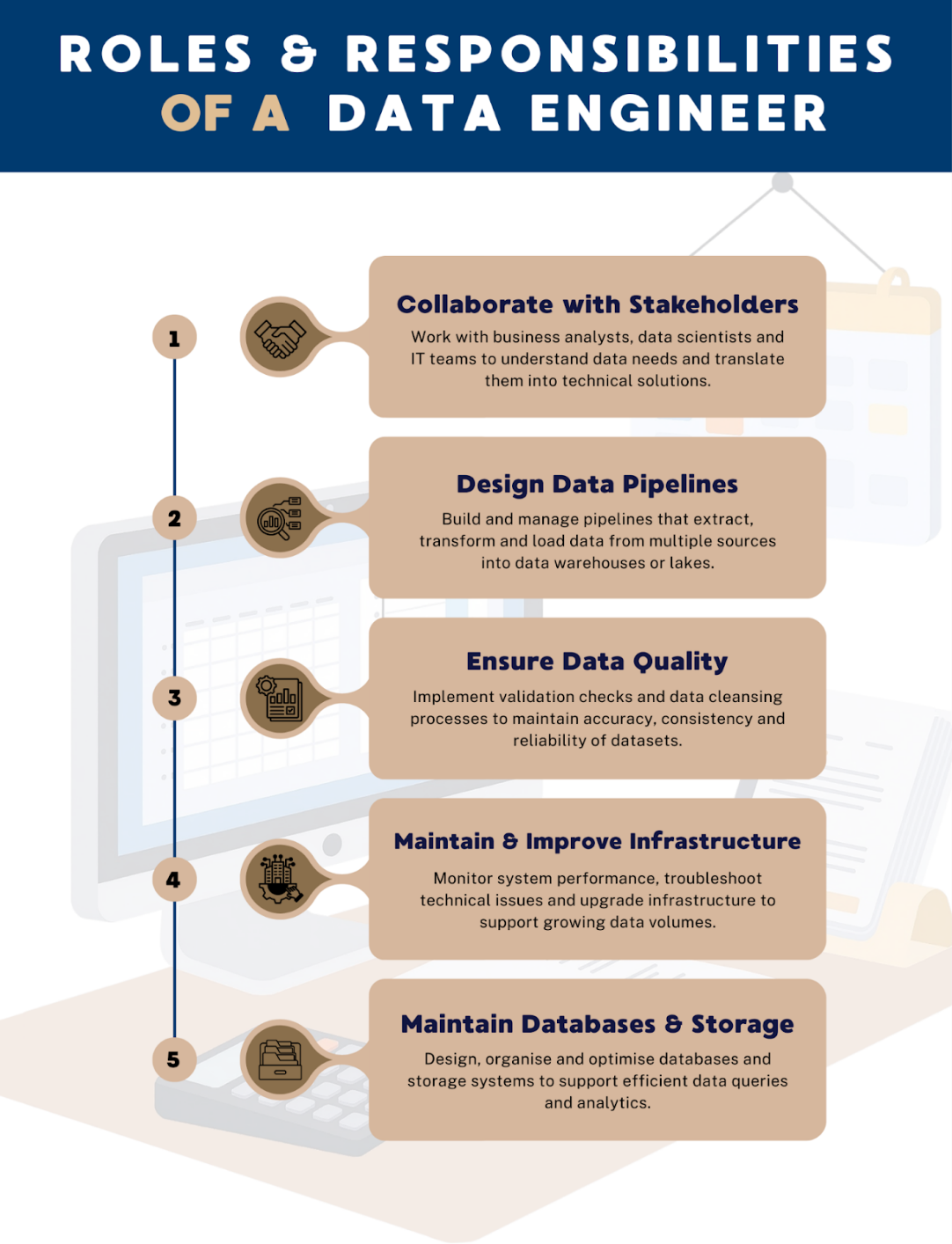
Data engineers build and maintain the systems that allow data to flow from source systems to analytics platforms. They ensure that data is organised, consistent, secure, and accessible.
Collaborate with Stakeholders
They work closely with business analysts, data scientists, and IT teams to understand data needs and translate requirements into technical solutions that support reporting and advanced analytics.
Design Data Pipelines
Data engineers architect and implement pipelines that extract data from various sources, transform it to meet business and technical requirements, and load it into target systems such as data warehouses or lakes.
Ensure Data Quality
They implement validations, checks, and cleansing processes to detect and correct errors, ensuring data integrity for downstream consumption by analysts and data scientists.
Maintain and Improve Infrastructure
Data engineers monitor system performance, troubleshoot issues, and upgrade infrastructure to handle evolving data volumes and complexity.
Manage Databases and Storage
Data engineers design, build, and optimise databases and storage solutions to ensure data is organised for efficient queries and analytics.
What Is the Difference Between a Data Analyst, Data Architect, Data Engineer, and Data Scientist?
The data landscape includes several key roles. Understanding the differences helps organisations build effective teams and helps professionals identify suitable career pathways.
This table below compares key data roles to clarify responsibilities and focus areas.
| Role | Core Focus | Typical Tasks | Required Skills |
|---|---|---|---|
| Data Analyst | Generating insights from data | Preparing dashboards, analysing trends | SQL, data visualisation, BI tools |
| Data Scientist | Predictive and advanced analytics | Building models, machine learning | Python/R, statistics, ML frameworks |
| Data Engineer | Data infrastructure and pipelines | ETL/ELT, data modelling, data integration | SQL, Python, cloud, big data tools |
| Data Architect | Data system design and strategy | Designing models, governance policies | Data modelling, governance, architecture |
What Skills Should a Data Engineer Have?
Data engineers require a mix of technical and soft skills. Technical skills enable them to work with data systems and tools, while soft skills help them collaborate and solve complex problems.
Technical Skills
Technical skills refer to hands-on abilities that allow professionals to build, manage, and optimise data systems. These skills include knowledge of data platforms, programming languages, and methodologies such as ETL (Extract, Transform, Load) and ELT (Extract, Load, Transform), which are processes used to move and prepare data.
- Big data technologies: Work with frameworks like Hadoop, Spark for large-scale processing
- Cloud platforms: Use services such as AWS, Azure, or Google Cloud for scalable infrastructure
- ETL and ELT: Design and implement processes to extract, transform, and load data efficiently
- Python programming: Write scripts and tools to automate data workflows
- SQL: Query and manipulate databases for data retrieval and transformation
Soft Skills
Soft skills refer to interpersonal and cognitive abilities that support technical work and enhance effectiveness within teams and organisations.
- Attention to detail: Ensure accuracy and consistency in data systems
- Collaboration: Work effectively with cross-functional teams including analysts and business users
- Communication: Clearly explain technical concepts to non-technical audiences
- Problem solving: Break down complex data problems and identify effective solutions
Which Data Tools Do Data Engineers Use?
Data engineers use a range of tools across multiple categories to manage and process data. These tools support tasks from writing code to orchestrating workflows and processing large datasets.
- Big data processing: Frameworks such as Hadoop and Apache Spark for processing large datasets
- Cloud data platforms: Platforms like AWS, Azure, and Google Cloud that provide storage, compute, and database services
- Data ingestion: Tools such as Kafka and Flume for collecting and streaming data from various sources
- Data transformation and ETL: Tools such as Talend, Fivetran, and custom scripts for moving and transforming data
- Programming and scripting: Languages such as Python, Java, and Scala used for data manipulation and automation
- Workflow orchestration: Platforms like Apache Airflow and Luigi that manage and schedule data pipelines
How To Become A Data Engineer?
Becoming a data engineer involves both structured learning and practical experience. Beyond theory, hands-on exposure to real projects helps develop confidence and readiness for industry roles.
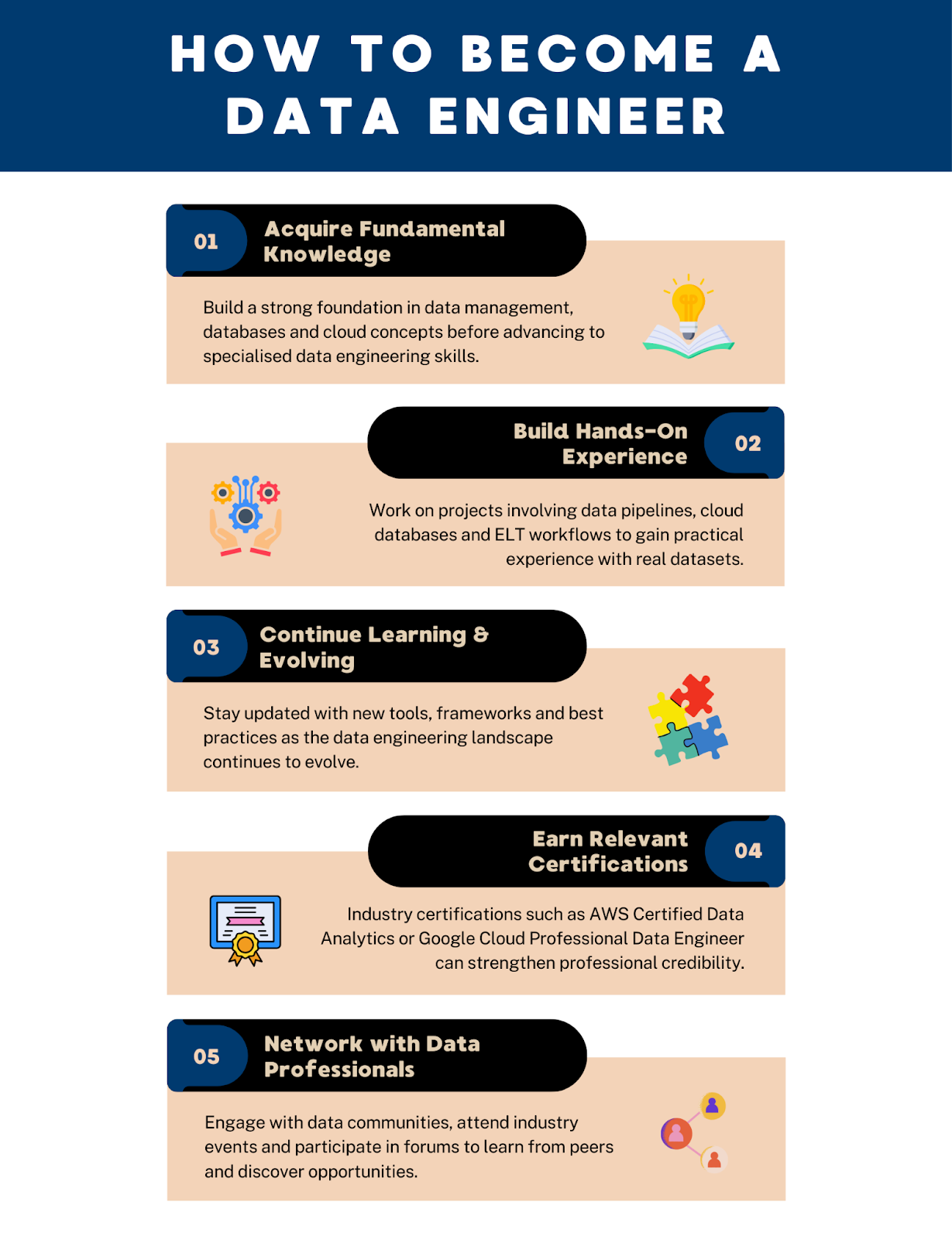
1. Acquire Fundamental Knowledge
A strong foundation in data management and cloud basics prepares you for specialised learning. SMU Academy offers courses such as Introduction to Data Management, AWS Cloud Practitioner Essentials, and the Advanced Certificate in Applied Data Analytics, which provide essential knowledge on data management before progressing to advanced data engineering topics.
2. Build Hands-On Experience
Work on projects that involve building data pipelines, working with cloud databases, and experimenting with ELT workflows. Practical experience with real datasets and toolchains is invaluable.
3. Continue Learning and Evolving
The data landscape changes rapidly, so keeping up with new tools, best practices, and methodologies is important for long-term success. Upskilling through professional training, industry certifications and hands-on projects helps data engineers stay relevant and adapt to new data engineering challenges.
4. Earn Relevant Certifications
Industry certifications, such as AWS Certified Data Analytics or Google Cloud Professional Data Engineer, demonstrate expertise and enhance credibility with employers.
5. Network with Data Professionals
Joining data communities, attending meetups, and engaging in forums help you learn from peers and discover opportunities.
How Much Do Data Engineers Make in Singapore?
Data engineers are among the highest paying jobs in Singapore due to specialised technical expertise and strong demand across sectors. Salaries reflect both skill level and years of experience in complex data systems.
Salary by Experience
- Entry-level: SGD $4,650 - S$7,000 per month
- Mid-level: SGD $7,000 - SGD$12,000 per month
- Senior level: SGD $15,000 and above per month
Factors Influencing Salary
- Experience level: Higher experience often commands higher compensation
- Industry sector: Finance and technology sectors frequently offer premiums
- Technical expertise: Skills in cloud platforms and big data tools enhance earning potential
- Certifications: Formal credentials can differentiate candidates in competitive markets
Forging a Future in Data Engineering
Becoming a data engineer offers a rewarding professional pathway for those who enjoy working at the intersection of technology, problem solving, and business impact. As organisations continue to adopt data-driven strategies, data engineers will remain central to enabling analysis, automation, and innovation. By developing both technical expertise and strong communication skills, aspiring professionals can position themselves for long-term success in this evolving field.
FAQs About Data Engineers
Is data engineering a good career?
Data engineering can be considered a good career because it combines strong demand in the job market with high earning potential and opportunities to work across sectors. As an in-demand job in the technology and analytics space, data engineers play a key role in helping organisations operationalise data for strategic use.
Is AI replacing data engineers?
It is not likely that AI will replace data engineers entirely. Instead, AI is expected to complement data engineering work by automating repetitive tasks, enhancing data quality checks, and generating code suggestions. Data engineers will still be needed to design and oversee complex data systems and ensure that AI-augmented tools are used ethically and effectively.
What are some challenges surrounding data engineering?
Challenges in data engineering include managing large and diverse datasets, maintaining data quality, and integrating systems while complying with data governance and privacy regulations. Data protection officers often collaborate with data engineering teams to ensure that compliance frameworks and privacy safeguards are upheld, which requires careful coordination and ongoing learning.
What is the career path for a data engineer?
Typical career progression may start from junior data engineer to mid-level and senior data engineer. From there, professionals may specialise as data architects, analytics engineers, or machine learning engineers, or move into leadership roles such as head of data engineering or chief data officer.