


Negotiation skills are the abilities that enable individuals to reach agreements through discussion, compromise, and problem-solving. In the workplace, negotiation goes far beyond salary conversations. It plays a role in managing expectations, resolving conflicts, securing resources, aligning stakeholders, and building long-term professional relationships.
Employers consistently rank negotiation among the most important workplace soft skills. LinkedIn’s Workplace Learning Report highlights negotiation as a critical capability, particularly for leadership, sales, and client-facing roles. Roles that frequently rely on negotiation skills include managers, sales professionals, procurement specialists, HR practitioners, consultants, project managers, legal professionals, business development professionals and business owners.
This article explains why negotiation skills matter, outlines the best negotiation skills every professional should know, highlights common mistakes to avoid, and shares practical ways to develop and demonstrate negotiation skills, including how to showcase them effectively on a resume.
Key Takeaways
- Negotiation skills help professionals influence outcomes, manage conflict, and build trust at work.
- Effective negotiators rely on preparation, listening, and value creation rather than pressure tactics.
- Avoiding common mistakes such as poor preparation and emotional reactions improves negotiation outcomes.
- Negotiation skills can be learned, practised, and clearly demonstrated on a resume with evidence.
Why Are Negotiation Skills Important?
Negotiation skills are important because they shape how professionals collaborate, make decisions, and resolve differences. Strong negotiation skills allow individuals to balance competing interests while maintaining productive working relationships.
In the long run, negotiation skills support career growth, leadership effectiveness, and organisational success.
Improves Business Outcomes
In commercial or operational roles, effective negotiation can directly impact costs, efficiency, and long-term value.
Improves Workplace Relationships
Negotiation encourages open dialogue and mutual understanding. When professionals focus on shared interests rather than rigid positions, relationships are strengthened rather than strained.
Increases Professional Influence
As a soft skill, negotiation plays a key role in leadership development, influencing how professionals communicate ideas, manage conflict, and work with others.
Leads to Better Decision-Making
Negotiation involves evaluating options, priorities, and trade-offs. This structured approach supports more thoughtful and balanced decisions.
Reduces Conflict and Misalignment
Clear negotiation helps align expectations early, reducing misunderstandings and workplace friction.
Supports Career Progression
Negotiation skills are essential during performance reviews, role discussions, and promotion conversations, helping professionals advocate for themselves constructively.
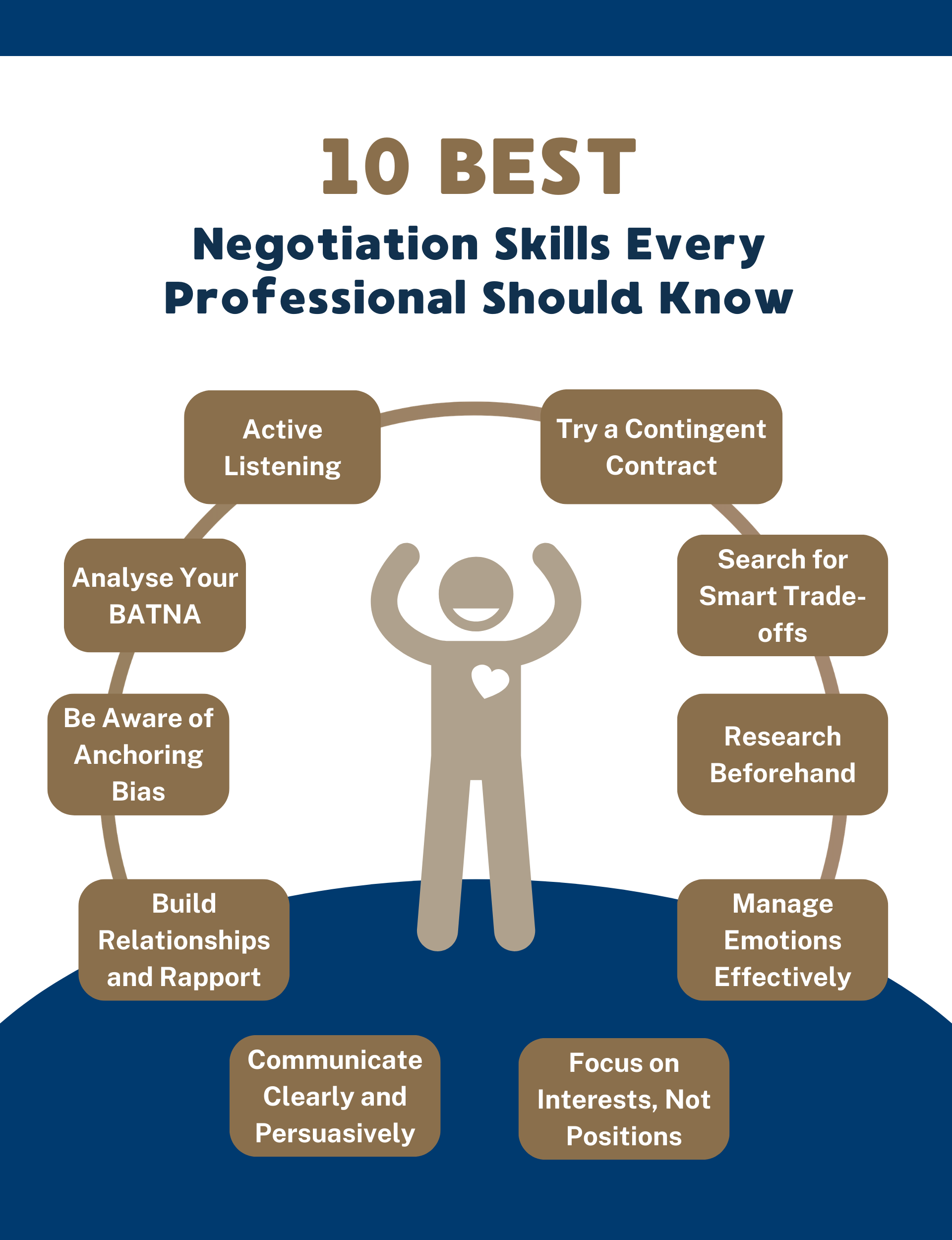
10 Best Negotiation Skills Every Professional Should Know
The following skills form the foundation of effective negotiation. They are grounded in established negotiation theory and widely applicable across industries and roles.
1. Active Listening
Active listening is a critical negotiation skill and is often explained using the 70/30 rule. Skilled negotiators aim to listen 70 percent of the time and speak 30 percent.
This approach helps uncover underlying interests, concerns, and opportunities for compromise. For example, listening carefully to a client’s priorities may reveal flexibility on timelines even if budgets are fixed.
2. Analyse Your BATNA
BATNA, or Best Alternative to a Negotiated Agreement, was introduced by Roger Fisher and William Ury in their seminal work Getting to Yes. It refers to the best outcome you can achieve if the negotiation fails.
Understanding your BATNA gives you clarity and confidence. For example, when negotiating a job offer, knowing you have another offer allows you to negotiate more assertively and avoid accepting unfavourable terms.
3. Be Aware of Anchoring Bias
Anchoring bias was introduced by psychologists Daniel Kahneman and Amos Tversky. It refers to the tendency to rely too heavily on the first piece of information offered.
For example, if a salary negotiation begins with an unrealistically low figure, subsequent discussions often revolve around that anchor. Being aware of this bias allows negotiators to counter with data-backed anchors or reframe the discussion.
4. Build Relationships and Rapport
Negotiations are more effective when there is trust. Building rapport helps create a collaborative tone and reduces defensiveness.
This can involve finding common ground, acknowledging the other party’s perspective, or showing genuine interest. For instance, in customer-facing roles, effective negotiation supports a smoother customer journey by aligning expectations at different touchpoints, from initial engagement to post-sale support.
5. Communicate Clearly and Persuasively
Clear communication helps prevent misunderstandings and builds credibility. In many organisations, negotiation forms part of broader corporate communications, particularly when engaging senior stakeholders, partners, or external parties.
6. Focus on Interests, Not Positions
This principle, also from Getting to Yes, encourages negotiators to look beyond stated demands and understand underlying motivations. This often reveals more flexible solutions
7. Manage Emotions Effectively
Negotiation often involves tension. Being aware of emotions and responding calmly helps maintain professionalism and clarity.
For example, pausing before responding to a challenging comment can prevent reactive decisions.
8. Research Beforehand
Preparation is one of the strongest predictors of negotiation success. Research includes understanding the other party’s interests, constraints, industry benchmarks, and potential alternatives.
For example, a procurement professional who researches market pricing and supplier capacity is better positioned to justify proposals and counteroffers.
9. Search for Smart Trade-offs
Effective negotiators look beyond single-issue discussions. Instead of focusing only on price or scope, they explore multiple variables.
For example, one party may accept a longer contract duration in exchange for lower costs, creating value for both sides.
10. Try a Contingent Contract
Contingent contracts link outcomes to future performance. They are useful when parties disagree about forecasts or expectations.
For example, a bonus tied to project milestones allows both parties to move forward despite uncertainty.
Common Negotiation Mistakes to Avoid
Even experienced professionals make negotiation mistakes that weaken outcomes or damage relationships. Many of these errors stem from lack of preparation, emotional reactions, or overly rigid thinking. Understanding these mistakes and knowing what to do instead helps negotiators approach discussions more strategically and confidently.
Ignoring Non-Verbal Signals
Body language and tone provide valuable insight. Pay attention to cues and adjust your approach accordingly.
Letting Emotions Take Over
Strong emotions can cloud judgement. Managing emotions through preparation and pausing helps maintain objectivity.
Poor Preparation
Failing to prepare leads to unclear goals and weak arguments. Instead, define objectives, research alternatives, and identify your BATNA before entering discussions.
Revealing Your Bottom Line Too Early
Sharing limits too soon reduces flexibility. It is more effective to explore options and interests before discussing boundaries.
Taking a Win-Lose Approach
Viewing negotiation as a competition often damages long-term relationships. Focus instead on collaboration and value creation.
Talking More Than Listening
Over-talking can cause you to miss important information. Aim to ask open-ended questions and listen actively to uncover priorities and constraints.
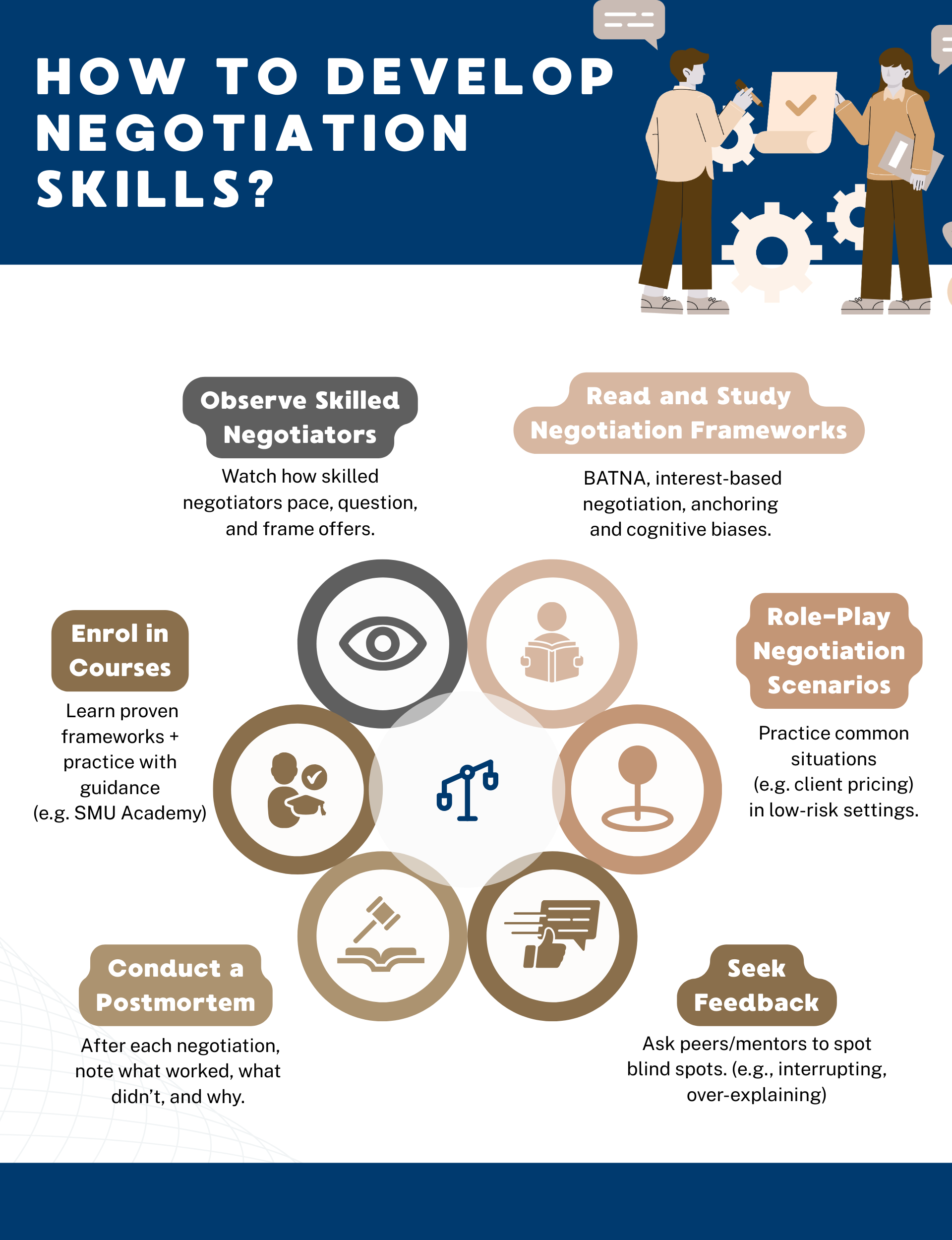
How to Develop Negotiation Skills?
Negotiation skills improve through deliberate practice, reflection, and learning. The following methods focus on building capability over time rather than following a rigid process.
Conduct a Postmortem
After each negotiation, reflect on what worked and what did not. Consider how preparation, communication, and emotional control influenced the outcome.
Enrol in Courses
Formal training provides proven frameworks and guided practice. SMU Academy offers courses such as Team Leadership: Achieving Win-Win in Negotiations, Service Management: Strategies for Negotiation and Communication, and Transforming Enterprises Module 2: Negotiate (English & Mandarin) which focus on practical application in workplace settings.
Observe Skilled Negotiators
Watching experienced negotiators helps identify effective techniques such as pacing, questioning strategies, and framing proposals.
Read and Study Negotiation Frameworks
Useful frameworks include BATNA and interest-based negotiation from Getting to Yes, anchoring and cognitive bias research by Kahneman, and case studies from Harvard’s Program on Negotiation.
Role-Play Negotiation Scenarios
Role-playing allows individuals to practise techniques in a low-risk environment. For example, simulating a client negotiation helps build confidence before real discussions.
Seek Feedback
Feedback from peers or mentors highlights blind spots and areas for improvement. For instance, feedback may reveal habits such as interrupting or over-explaining.
How to Demonstrate Good Negotiation Skills on a Resume?
Demonstrating negotiation skills on a resume is important as it provides insight into how the skill has been applied in professional settings. This is best conveyed through clear, deliberate wording of responsibilities, achievements, and skills.
Combine Negotiation with Technical Skills
Demonstrate balance between technical skills and soft skills.
| Less Effective Example | More Effective Example |
| “Used my negotiation and technical skills in meetings.” | “Applied financial modelling technical skills to support data-driven negotiations with investors.” |
Highlight Negotiation-Heavy Responsibilities
Include roles involving stakeholders, vendors, or clients.
| Less Effective Example | More Effective Example |
| “Worked with different departments on projects.” | “Led cross-functional negotiations between finance and operations teams to align project scope and budget.” |
Include Training or Certifications
Formal learning supports credibility.
| Less Effective Example | More Effective Example |
| “Attended negotiation course.” | “Completed Team Leadership: Achieving Win-Win in Negotiations at SMU Academy” |
Show Conflict Resolution Experience
Link negotiation to problem-solving and corporate communications.
| Less Effective Example | More Effective Example |
| “Handled client issues.” | “Resolved client contract disputes through structured negotiation, preserving long-term customer relationships.” |
Use Results-Based Statements
Show outcomes rather than responsibilities.
| Less Effective Example | More Effective Example |
| “Responsible for negotiating with suppliers.” | “Negotiated supplier contracts, achieving 15% annual cost savings and improved delivery timelines.” |
Use Strong Action Verbs
Action verbs signal capability and confidence.
| Less Effective Example | More Effective Example |
| “Helped with contract discussions.” | “Secured multi-year partnership agreements through strategic stakeholder negotiation.” |
Why Negotiation Skills Matter at Every Career Stage
Negotiation skills are essential workplace capabilities that influence outcomes, relationships, and long-term professional success. Whether navigating salary discussions, managing stakeholders, resolving conflict, or securing resources, strong negotiation skills help professionals communicate clearly, think strategically, and create value for all parties involved.
By developing and applying effective negotiation skills, individuals can improve decision-making, strengthen collaboration, and position themselves for career growth in an increasingly complex and competitive workplace.
To support professionals in building these capabilities, SMU Academy provides courses and programmes designed to hone negotiation skills through practical frameworks and real-world application.
Frequently Asked Questions About Negotiation Skills
How does improving your negotiation skills benefit you?
Improving negotiation skills leads to better outcomes, stronger professional relationships, and increased confidence. It helps individuals advocate effectively, manage conflict constructively, and progress in their careers.
What are the 5Cs of negotiation?
The 5Cs of negotiation are often attributed to negotiation and communication practitioners and refer to Clarity, Confidence, Communication, Collaboration, and Creativity. Together, they emphasise clear objectives, credible presence, effective dialogue, cooperative problem-solving, and flexible thinking.
How can I manage emotions during a negotiation?
Managing emotions starts with preparation. Knowing your goals and alternatives reduces anxiety. During negotiations, pausing before responding, acknowledging emotions without reacting impulsively, and focusing on facts help maintain objectivity.
What should I do if the negotiation stalls?
If negotiations stall, revisit shared goals and interests. Introducing new options, reframing issues, or suggesting a short break can help reset the discussion. Using objective criteria such as benchmarks or data often helps move conversations forward.