

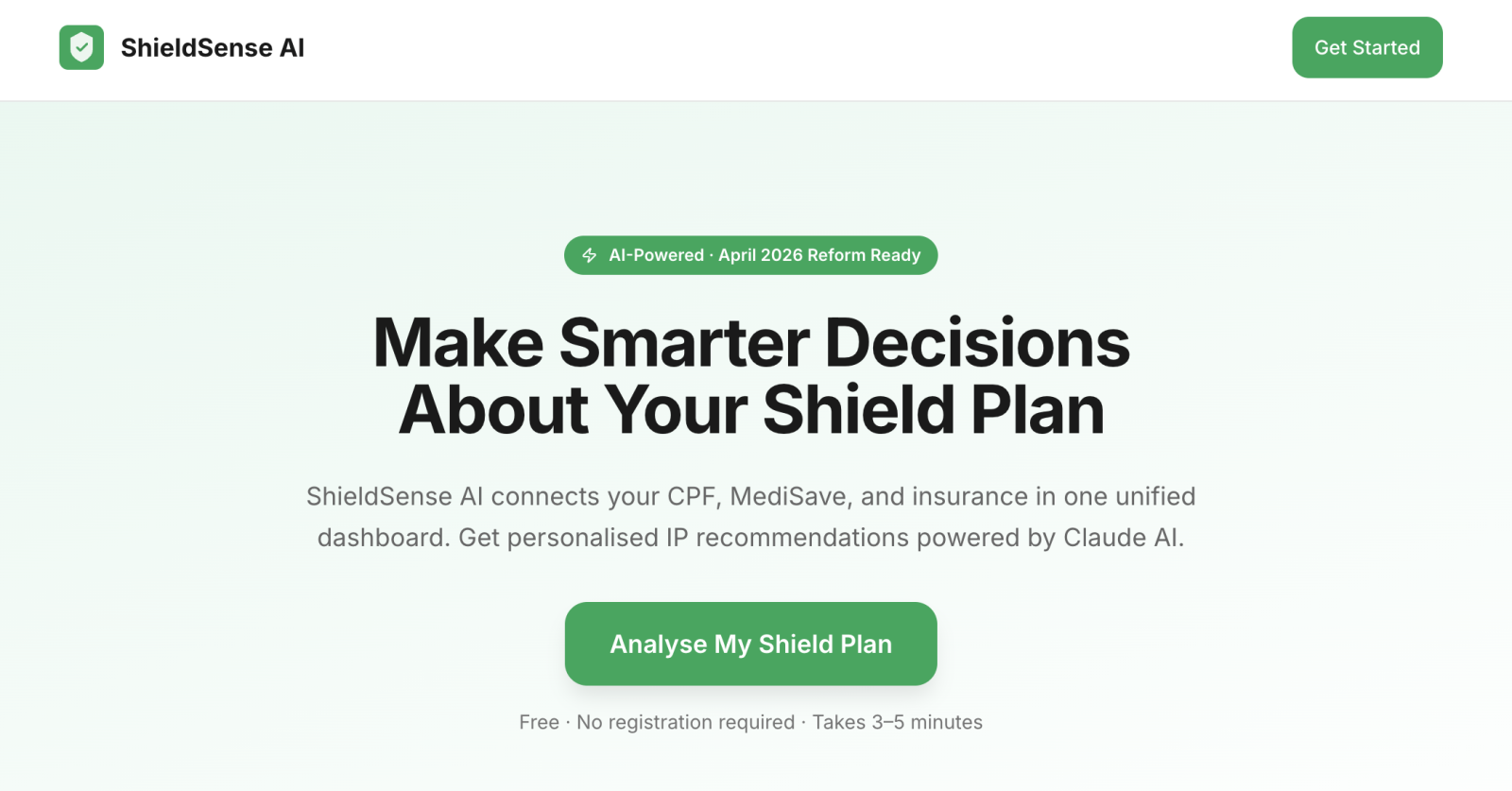
ShieldSense AI is an AI-powered web application developed to help Singapore Citizens and Permanent Residents navigate Singapore's evolving health insurance landscape following the Ministry of Health's April 2026 Integrated Shield Plan reforms.
The platform guides users through a structured assessment of their financial circumstances, health profile, and coverage preferences before generating personalised Integrated Shield Plan recommendations using a proprietary scoring engine, complemented by AI-generated explanations in plain English. By combining data-driven analysis with intuitive decision support, ShieldSense AI simplifies complex insurance comparisons and empowers users to make more informed healthcare insurance decisions.
Following the Ministry of Health's April 2026 reforms to Integrated Shield Plans, many Singaporeans faced uncertainty over changing rider rules, revised premiums, and the implications of switching insurance plans. ShieldSense AI was developed to address this challenge by providing personalised, data-driven recommendations tailored to each user's financial profile, health status, and coverage preferences.
Built using React, TypeScript, Python, Supabase, and Claude AI, the platform combines a proprietary scoring engine with natural language generation to deliver personalised recommendations, premium comparisons, savings projections, and easy-to-understand explanations.
Overall, the project demonstrates how AI can responsibly support complex healthcare insurance decision-making by combining data-driven recommendations with clear, personalised explanations. As an informational decision-support tool, ShieldSense AI simplifies insurance comparisons, improves transparency, and empowers consumers to make more informed coverage choices while complementing, rather than replacing, professional financial advice.
While the prototype demonstrates the potential to improve efficiency, consistency, and transparency in case management, these benefits have not yet been validated in a live Town Council environment. Overall, the project showcases how AI can be responsibly integrated into public service workflows by enhancing, rather than replacing, human decision-making.