


Business analysts are crucial in helping organisations bridge the gap between business needs and technological solutions. By analysing data, improving processes, and collaborating with stakeholders, they support organisations in making smarter, data-driven decisions and improving performance.
In this article, we explore what business analysts do, the top 10 different career pathways in this field, and how you can build the skills and experience needed to succeed in this in-demand profession.
Key Takeaways
- Business analysis involves using data, processes, and stakeholder insights to support organisational decision-making.
- Business analysts can progress into both technical and strategic positions, depending on skills and career interests.
- Progression is supported by developing technical skills, gaining practical experience, and obtaining relevant certifications.
What Does a Business Analyst Do?
A business analyst supports organisations in improving processes and decision-making by identifying process gaps, analysing data, and recommending practical solutions aligned with business goals. They work closely with stakeholders to understand organisational needs and translate them into clear, functional and technical requirements.
Key responsibilities include:
- Understanding business strategies, goals, and operational requirements
- Identifying and prioritising business and technical needs
- Analysing datasets using tools such as SQL and Excel
- Creating charts, tables, and data visualisations to present insights
- Developing financial models to support business decisions
- Conducting forecasting, budgeting, variance analysis, and financial analysis
- Supporting enterprise architecture planning
Top 10 Business Analyst Career Pathways

The salary figures provided below are based on recent data from the Robert Walters’ Singapore Salary Survey and Hays Asia Salary Guide. They are included for informational purposes only and should not be interpreted as salary benchmarks set, verified, or guaranteed by SMU Academy. Actual compensation may vary depending on experience, qualifications, company size, and industry.
1. Business Intelligence (BI) Analyst
Salary range: $6,667 – $12,500
Business Intelligence (BI) Analyst roles involve developing expertise in dashboard design, data visualisation, and reporting practices used to monitor and evaluate organisational performance. It centres on transforming data into clear, actionable insights through BI tools such as Tableau or Power BI to support business decisions.
A background in fields such as business, analytics, information systems, finance, or computer science can be helpful. In particular, familiarity with data handling, basic statistics, or reporting tools will provide a strong starting point.
Learn how to use these data visualisation tools through modules such as Advanced Certificate in Visual Analytics Using Tableau and Data Analytics Using Power BI.
2. Business Systems Analyst
Salary range: $6,500 – $10,000
Professionals who develop stronger technical capabilities may transition into a Business Systems Analyst position. This typically involves gaining experience in system implementation projects and building a deeper understanding of how technology supports business operations.
Having prior internship or job experience in computer science, information systems, or related fields is often beneficial, alongside proficiency in SQL and database management. These capabilities focus on aligning system functionality with business requirements.
Business Systems Analysts who are keen to upskill can consider courses such as the Advanced Certificate in Applied Data Analytics Module 2: Relational Databases with Structured Query Language (SQL).
3. Data Analyst
Salary range: $6,000 – $10,000
Those with a strong interest in analysis may choose a Data Analyst role. This pathway often involves developing skills in statistical analysis, programming, and data visualisation to interpret large datasets. Data analysts focus on extracting insights from data, identifying trends, and presenting findings in a structured way to guide decision-making.
Exposure to areas such as statistics, mathematics, business, or computing can provide a useful foundation when starting as a data analyst. For those exploring this role, being comfortable with data handling, basic programming, or analytical thinking can also make transitioning smoother.
4. Domain-Specific Analyst
Salary range: Varies per industry
A Domain-Specific Analyst focuses on a particular industry, such as finance, healthcare, or retail, and combines data analysis skills with deep sector knowledge. Rather than analysing data in isolation, they interpret it within the context of industry rules, trends, and challenges. For example:
- In finance, this might involve risk modelling or regulatory compliance
- In healthcare, analysing patient outcomes or operational efficiency
- In retail, understanding customer behaviour and inventory trends
Prior career experience in the specific industry before transitioning to becoming an analyst can be beneficial. This builds a greater understanding of industry regulations, operations, or market trends, which can help with more accurate analysis and forecasting.
5. Entrepreneur / Startup Founder
Salary range: Varies per company
Some business analysts may apply their analytical and problem-solving skills to pursue Entrepreneurship. This involves identifying market opportunities, validating ideas, and acquiring knowledge in business operations, funding, and management.
Anyone can become an entrepreneur, but business analysts who have previously worked in finance or management can provide useful insights into strategy, operations, and risk assessment. Skills in problem-solving and decision-making are particularly valuable, as they support the ability to assess risks, adapt to changing conditions, and build sustainable ventures.
6. Management Consultant
Salary range: $6,000 – $10,000
Transitioning into Management Consulting is often supported by experience across diverse projects and the development of strong strategic and analytical capabilities. Management consultants usually advise stakeholders on business strategy, operational efficiency, and process optimisation, often within fast-paced and client-facing environments.
Exposure to cross-functional projects or working with multiple industries can help develop the critical strategic and analytical skills needed for consulting.
7. Process Improvement Analyst
Salary range: $5,833 – $12,000
Process Improvement Analysts develop expertise in workflow analysis, performance measurement, and continuous improvement methodologies such as Lean Six Sigma. Process improvement analysts tend to focus on streamlining workflows, reducing waste, and supporting more efficient and consistent business operations.
Business analysts considering a process improvement role should focus on enhancing skills such as workflow analysis and interpreting performance metrics.
Obtaining credentials like the Lean Six Sigma Green Belt Certification can also highlight your ability to analyse workflows, identify problems, and implement effective solutions.
8. Product Manager
Salary range: $6,667 – $15,000
Business analysts interested in product development may specialise in Product Management by gaining experience in requirements gathering, market research, and stakeholder communication.
Understanding customer needs and prioritising product features are important aspects of this career pathway. Analytical and problem-solving skills, combined with knowledge of project management or user experience, can also be highly beneficial.
9. Project Manager
Salary range: $7,000 – $15,000
Individuals may progress into Project Management by taking on responsibilities related to team coordination, timeline planning, and delivery oversight. Experience in managing stakeholders and requirements provides a strong foundation for handling project scope, resources, and execution.
Progression is often supported by attending specialised courses, getting professional certifications, and hands-on experience in leading projects across different stages.
10. Senior Business Analyst
Salary range: $11,667 – $15,000
A Senior Business Analyst typically progresses from a business analyst role after gaining several years of experience managing complex projects and stakeholder requirements. This position involves a higher level of responsibility in overseeing activities, guiding project direction, and ensuring alignment with organisational objectives.
Progression into this role is often supported by developing leadership skills, mentoring junior analysts, and obtaining certifications such as the Certified Business Analysis Professional (CBAP).
Attending leadership courses can help business analysts in developing key management skills as they progress to senior roles, such as the Industry Graduate Diploma in Leadership and People Management.
How to Pursue a Business Analyst Career
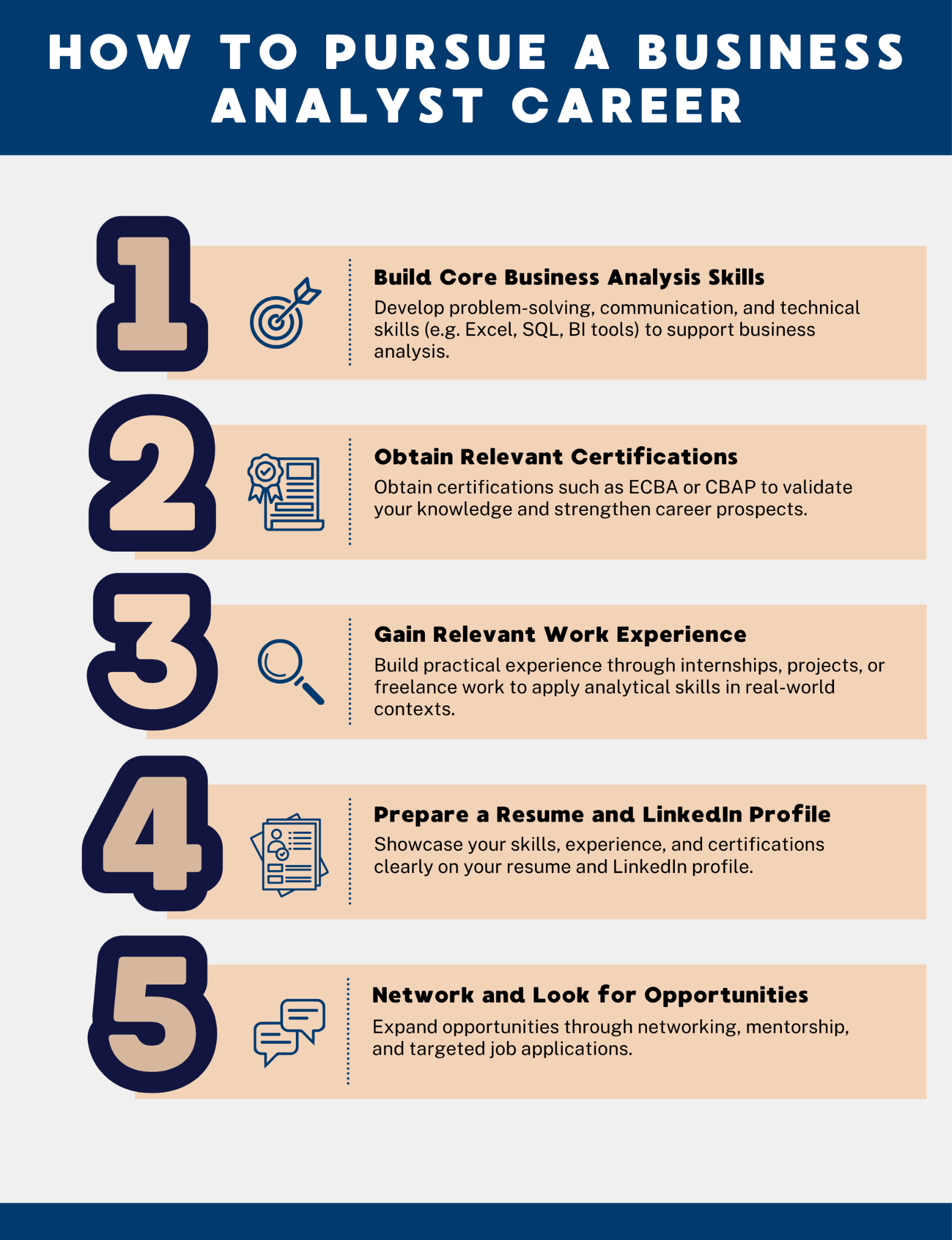
Starting a business analyst career requires a combination of technical skills, practical experience, and the right certifications to stand out in the field.
1. Build Core Business Analysis Skills
Early-career professionals can begin developing capabilities that support entry into business analyst jobs, even without extensive industry experience. Success in this field requires a strong combination of soft skills and technical skills.
Soft skills:
- Communication and stakeholder management (gathering requirements, presenting insights)
- Teamwork and collaboration across functions
- Adaptability to changing project needs
- Critical thinking and decision-making
- Time management and prioritisation
Hard skills:
- Problem-solving and analytical thinking to break down complex problems, identify patterns, and propose actionable solutions
- Data analysis and interpretation
- Familiarity with tools such as Excel, SQL, Python, R, Tableau, Power BI, JIRA, Trello, Lucidchart, and Visio, which are commonly used in workflows
2. Obtain Relevant Certifications
Certifications can help validate foundational knowledge and signal readiness for business analyst roles. Common certifications include Entry Certificate in Business Analysis (ECBA) or Certified Business Analysis Professional (CBAP), which is suitable for those with more experience. These can be further strengthened by training in areas such as business analytics, Python, or Generative AI.
3. Gain Relevant Work Experience
Gaining relevant experience is key to becoming a business analyst. This can be achieved through internships or junior roles, freelancing opportunities, and personal or academic projects, all of which provide hands-on exposure to real-world business problems and help demonstrate applied skills.
4. Prepare a Resume and LinkedIn Profile
Your resume and LinkedIn profile should clearly highlight your education, experience, and technical skills to stand out to recruiters. Focus on:
- Education: Background in business, information technology, finance, analytics, or additional business analytics courses
- Experience: Internships, academic projects, or part-time responsibilities involving data analysis, problem-solving, or Agile project execution
- Certifications and training: Relevant certifications and courses in Python, Generative AI, business analytics, SQL, Tableau, or Power BI.
5. Network and Look for Opportunities
Building connections in the business analysis field can improve your chances of landing a job. Networking through LinkedIn, events, or mentorship helps expand your opportunities, while applying for entry-level roles with a tailored resume can better position you for success.
Take the Next Step in Your Business Analyst Career
Pursuing a career as a business analyst offers diverse opportunities to grow, specialise, and make a meaningful impact in organisations across industries. By developing key skills, gaining practical experience, and exploring the right career path, you can progress further in your business analyst career.
SMU Academy’s business analytics courses equip professionals with practical skills to stay relevant across industries.
FAQs About Business Analyst Career Paths
How can I advance from an entry-level business analyst role?
Advancement from an entry-level business analyst role typically involves building stronger technical skills, handling more complex projects, and taking on greater responsibility in analysis and stakeholder management. As these capabilities develop, individuals may take on senior business analyst roles or transition into project management, product management, or business consulting.
What degree does a business analyst need?
Business analysts commonly hold a bachelor’s degree in relevant areas such as business, accounting, finance, economics, or information technology. These disciplines provide foundational knowledge in data analysis, business processes, and decision-making.
In addition to formal education, professional certifications can further strengthen technical capabilities and support career progression. According to IIBA in 2020, certified professionals tend to earn around 13% more than non-certified peers, reflecting the value placed on recognised credentials.
Why choose a career in business analytics?
A career in business analytics is ideal for professionals who want a dynamic, rewarding experience that combines problem-solving and real-world impact. Key reasons to pursue this career include:
- Above-average salaries: Competitive pay and bonuses make this a financially rewarding career.
- Cross-department collaboration: Work with diverse teams, learn from different perspectives, and build connections.
- Growth opportunities: Continuous learning and skill development can lead to senior management titles.
- High demand: Demand for business analysts continues to grow as organisations become more data-driven.
What courses should a business analyst take?
Business analysts can benefit from courses in data analytics, Python, SQL, generative AI, and business process management, which support tasks such as analysing data, automating workflows, and improving organisational processes. Additionally, courses in project management, Agile methodologies, and stakeholder communication can also strengthen collaboration and project delivery skills.
Which business analyst role should I choose?
Choosing the right business analyst role depends on your interests, strengths and long-term career growth. Consider opportunities that offer strong stakeholder engagement, opportunities for professional development and a competitive salary aligned with your skills and experience.
What is the difference between a business analyst, data analyst, and project manager?
Business analysts, data analysts, and project managers have very distinct roles within a company. Here is a breakdown of their differences:
- Business analyst: Identifies business problems, recommends solutions, and uses data to guide decisions.
- Data analyst: Works directly with data by collecting, cleaning, analysing, and visualising it to find patterns and insights.
- Project manager: Oversees projects from start to finish, managing timelines, budgets, and resources.
Despite their differences, these roles work closely together to turn insights into action and help organisations achieve their goals effectively.