


Customer experience (CX) refers to the overall perception a customer has of a brand based on every interaction across the entire customer journey. This includes everything from initial awareness and marketing touchpoints to purchasing, service delivery and post-sale support. In an increasingly digital and customer-driven business environment, organisations must place greater emphasis on how customers feel at every stage of their journey.
According to PwC, close to 80% of consumers mentioned speed, convenience, knowledgeable assistance and friendly service as the most important elements of a positive customer experience. This highlights that customer expectations extend beyond just the product or service itself. Businesses that meet these expectations are more likely to build trust, strengthen relationships and encourage repeat engagement.
This article explores why customer experience matters, the key elements that define strong CX, how businesses can improve it, and the role of emerging technologies such as artificial intelligence in shaping customer expectations.
Key Takeaways
- Customer experience encompasses every interaction a customer has with a business across the entire journey.
- Strong CX drives customer loyalty, retention and revenue growth.
- Businesses must adopt a structured and data-driven approach to improve and measure CX.
- Artificial intelligence is increasingly shaping customer expectations and service delivery in Singapore.
Why is Customer Experience Important for Businesses?
Customer experience plays a critical role in shaping how customers perceive a brand and influences whether they choose to return, recommend or disengage. Positive experiences build trust and emotional connection, while poor experiences can quickly drive customers to competitors. As customer expectations continue to rise, delivering a seamless and satisfying experience is no longer optional but essential for sustainable business growth.
Differentiates Businesses in Competitive Markets
In saturated industries such as retail, telecommunications and banking, products and pricing are often similar. In such cases, customer experience becomes a key differentiator. For example, 2 banks may offer similar interest rates, but the one with faster service and better digital experience is more likely to retain customers.
Drives Customer Loyalty and Retention
Research by Zendesk indicates that over 50% of customers are willing to go out of their way to purchase from brands they feel loyal to. This demonstrates that strong customer experiences foster emotional connections, making customers more likely to return even when alternatives are available.
Builds Brand Advocacy and Reputation
Word of mouth is a powerful driver of customer perception. Nielsen’s Trust in Advertising study reports that 88% of consumers trust recommendations from people they know. When customers have positive experiences, they are more likely to share them with others, both online and offline. This helps attract new customers and strengthens brand reputation, as peer recommendations are often seen as more credible than traditional advertising.
Improves Operational Efficiency
By understanding customer needs and common pain points, businesses can streamline internal processes and reduce inefficiencies. For example, analysing frequent customer complaints may highlight recurring issues in delivery or support workflows.
Organisations can then use project management tools to coordinate teams, track service requests and ensure that issues are resolved promptly. This not only improves operational efficiency but also enhances the overall customer experience.
Increases Revenue and Profitability
Companies that excel in customer experience achieved revenue growth 80% faster compared to their competitors. This is because positive experiences encourage repeat purchases, increase customer lifetime value and turn satisfied customers into advocates who promote the brand at little to no cost.
Key Aspects of Good Customer Experience
A strong customer experience is shaped by multiple factors that work together to create a seamless and satisfying journey. Customers today expect interactions to be efficient, personalised and consistent across all touchpoints.
These expectations are particularly important for any online business, where the entire customer journey often takes place digitally without face-to-face interaction. Businesses that understand these expectations are better positioned to deliver meaningful and memorable experiences.
Consistent Omnichannel Experience
Customers expect a smooth and consistent experience across all touchpoints, including websites, mobile apps and physical stores. An integrated omnichannel approach ensures that messaging and service quality remain aligned.
For example, customers should be able to switch between channels without repeating information, creating a more seamless and convenient experience.
Clear Communication
Transparent and timely communication helps manage customer expectations. For instance, providing real-time updates on delivery status or service delays reduces uncertainty and builds confidence.
Personalisation
Customers increasingly expect experiences tailored to their preferences and behaviours. For example, streaming platforms recommend content based on viewing history, while online retailers suggest products aligned with past purchases. Personalisation enhances relevance and engagement.
Reliability and Quality
Delivering consistent quality is fundamental to customer satisfaction. Customers expect products and services to meet expectations every time, reinforcing trust and credibility.
Speed and Convenience
Fast and frictionless experiences are highly valued. Features such as quick checkout processes, responsive customer support and simplified navigation reduce effort and improve satisfaction.
How to Improve Customer Experience?
Improving customer experience requires a deliberate and continuous effort that combines data insights, technology and organisational alignment. Businesses must understand customer expectations, identify gaps in the journey and implement targeted improvements that enhance satisfaction and loyalty over time.
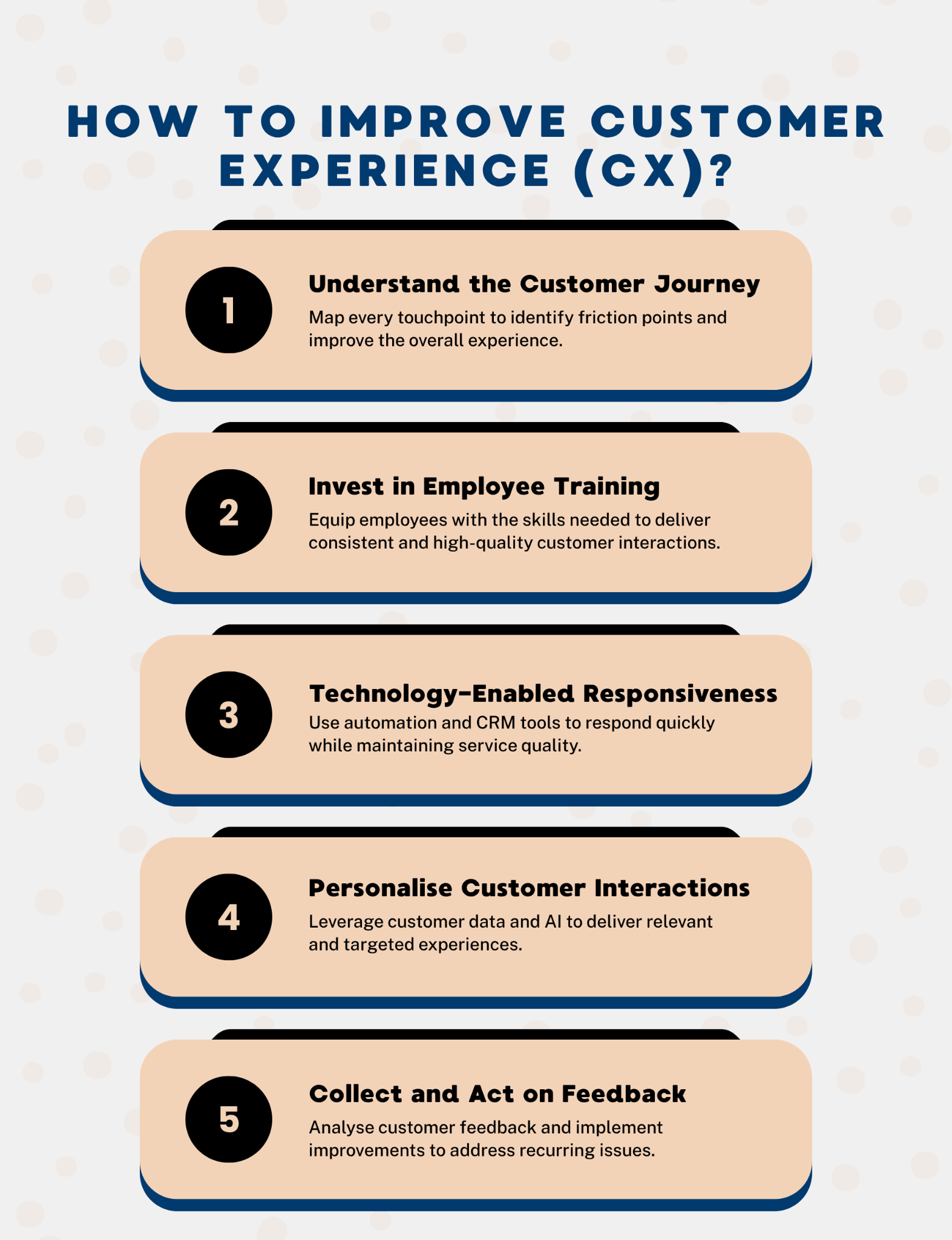
Understand the Customer Journey
Mapping the customer journey allows businesses to visualise every touchpoint and identify friction areas. For example, frequent cart abandonment suggests that the checkout process may need to be simplified.
Invest in Employee Training
Employees are at the forefront of customer interactions. Providing training in technical skills such as communication, problem-solving and product knowledge ensures that they can deliver high-quality service consistently.
SMU Academy offers customer experience programmes that support professionals in developing relevant capabilities in this area, including but not limited to:
- Customer Experience (CX) & Survey Design: Quantifying CX and User Sentiment
- Essential Thinking: Adopting A Growth Mindset for Critical Thinking and Problem Solving in the Digital Age
- Lean Six Sigma Green Belt Certification
Technology-Enabled Responsiveness
Timely responses are essential for maintaining customer satisfaction. By using tools such as chatbots, automated workflows and CRM systems, businesses can handle enquiries more efficiently. Routine queries can be resolved instantly, while more complex issues are escalated to human agents, ensuring both speed and service quality.
Personalise Customer Interactions
Using customer data to tailor interactions helps improve relevance and engagement. For instance, personalised email campaigns based on purchase history can increase conversion rates.
Businesses can also leverage AI in marketing to analyse customer behaviour, predict preferences and deliver highly targeted content, ensuring that interactions remain relevant and timely.
Collect and Act on Feedback
Gathering feedback through surveys and reviews is essential, but acting on it is equally important. Businesses should analyse feedback trends and implement changes that address recurring issues.
How to Measure Customer Experience?

Measuring customer experience requires a structured approach that combines quantitative metrics and qualitative insights. By tracking key indicators and analysing customer feedback, businesses can better understand how customers perceive their brand and identify areas for improvement.
Key Metrics to Measure Customer Experience
To evaluate customer experience effectively, businesses rely on a combination of widely used metrics that capture different aspects of customer perception and behaviour.
- Net Promoter Score (NPS): Measures customer willingness to recommend a brand, indicating overall loyalty
- Customer Satisfaction Score (CSAT): Assesses satisfaction with a specific interaction or experience
- Customer Effort Score (CES): Evaluates how easy it is for customers to complete a task or resolve an issue
- Customer Retention Rate: Tracks the percentage of customers who continue to engage with the business over time
- Churn Rate: Measures the rate at which customers stop doing business with a company
How to Collect Customer Experience Data?
Collecting accurate and relevant data is essential for understanding customer experience. Businesses can use multiple methods to gather insights across different touchpoints.
- Customer surveys: Gather direct feedback after interactions or transactions
- Customer interviews: Provide deeper qualitative insights into customer perceptions
- Website and app analytics: Track user behaviour to identify friction points
- Social media monitoring: Analyse customer sentiment and feedback in real time
- Customer support data: Review complaints and queries to identify recurring issues
How is AI Changing Customer Experience in Singapore?
Artificial intelligence is reshaping customer experience by enabling faster, more personalised and data-driven interactions. As Singapore continues to advance within the digital economy, businesses are increasingly adopting AI to improve efficiency and meet evolving customer expectations, particularly in digital services and support functions.
Trends in Singapore's AI-driven Customer Experience
AI adoption in customer experience is accelerating across industries, driven by the need for efficiency and personalisation.
AI-Powered Chatbots and Virtual Assistants
Many organisations are deploying chatbots to provide round-the-clock support. These tools can handle high volumes of enquiries, reducing wait times and improving accessibility for customers.
Automation of Customer Support Processes
Routine processes such as ticket routing and basic enquiries are automated, allowing human agents to focus on complex cases and improving overall efficiency.
Hyper-Personalisation Using Data Analytics
AI enables businesses to analyse large volumes of customer data and deliver highly targeted recommendations. This enhances relevance and improves customer engagement.
Voice and Conversational AI
Voice-enabled technologies and natural language processing tools are enhancing how customers interact with businesses, making interactions more intuitive and accessible.
Challenges in Adoption of AI in Customer Experience
While AI offers significant benefits, businesses must also address several challenges to ensure effective implementation.
- Data privacy concerns: Customers are increasingly cautious about how their data is used, requiring organisations to implement strong data protection practices
- Implementation costs: Deploying AI solutions can require significant investment, particularly for smaller businesses
- Skills gap: Organisations may lack the expertise needed to manage AI systems effectively, highlighting the need for upskilling
Customer Experience as a Strategic Business Priority
Customer experience has become a defining factor in how businesses compete and grow. Organisations that deliver consistent, personalised and efficient experiences are more likely to build strong relationships, enhance brand reputation and achieve long-term success. By understanding customer expectations, leveraging data, and continuously improving interactions, businesses can create meaningful experiences that drive both loyalty and performance.
FAQs About Customer Experience
What is the difference between CX and customer service?
Customer experience refers to the overall perception of a brand across all interactions, while customer service focuses specifically on support provided before, during or after a purchase. Here is a summary of the differences:
| Aspect | Customer Experience (CX) | Customer Service |
|---|---|---|
| Definition | Overall perception of a brand across all interactions | Support provided during specific interactions |
| Scope | Covers the entire customer journey | Focuses on resolving issues or enquiries |
| Focus | Long-term relationship and perception | Immediate problem-solving |
| Touchpoints | Includes all interactions across marketing, sales, product and support | Primarily customer support channels |
| Objective | Build loyalty and satisfaction over time | Address customer needs efficiently |
What is customer experience management?
Customer experience management refers to the processes, tools and strategies used to monitor, analyse and improve customer experience. Customer experience is the outcome of interactions, while customer experience management focuses on how businesses design and manage those interactions.
What can cause a bad customer experience?
Poor communication, slow response times, lack of personalisation, inconsistent service and unresolved issues can all lead to negative experiences. These factors often result in dissatisfaction and reduced trust.
What is a customer experience strategy?
A customer experience strategy is a structured plan that outlines how a business will deliver consistent, high-quality experiences across all customer touchpoints, aligned with customer needs and organisational goals.