


What if technology could help businesses draft reports, design visuals, generate code, or analyse information in seconds? This is the power of generative AI, a rapidly evolving branch of artificial intelligence that is changing how organisations create content, automate tasks, and make decisions.
As these technologies continue to develop, organisations are exploring how generative AI can support tasks such as content creation, product design, data analysis and workflow automation to improve productivity.
In this article, we explore how generative AI works, its key use cases, and the benefits it offers for businesses and individuals.
Key Takeaways
- Generative AI enables the creation of original content, including text, images, videos, audio, code, and synthetic datasets.
- Industries leverage it for tasks such as content generation, design, software development, simulations, personalisation, and cybersecurity.
- By automating repetitive tasks and generating insights quickly, generative AI improves productivity and supports faster, smarter decision-making.
- Responsible use is critical to address risks related to ethics, privacy, misinformation, and intellectual property.
- It differs from traditional AI, AI agents, and agentic AI in terms of autonomy, learning ability, and functionality.
What Is Generative AI?
Generative AI, or gen AI, is a type of artificial intelligence that creates original content from a prompt, such as text, images, videos, audio, or code. It uses advanced deep learning models trained on large datasets. These models recognise patterns, understand natural language, and produce relevant outputs.
While AI has existed for years, generative AI has recently gained global attention. Its ability to boost productivity and creativity has made it widely adopted across industries. Today, individuals and organisations use generative AI to streamline workflows, enhance products, and improve services.
How Does Generative AI Work?
Generative AI works by learning patterns from large datasets and using those patterns to create new content. Most generative AI systems operate in 3 main stages: training, tuning, and generation with continuous improvement.
Stage 1: Training
Generative AI starts with a foundation model. This is a deep learning model trained on massive datasets like text, images, audio, or code.
During training, the model learns patterns by predicting what comes next. For example:
- In text: It predicts the next word in a sentence.
- In images: It predicts the next pixel pattern.
- In code: It predicts the next logical line.
Over time, the model adjusts its parameters to improve accuracy. This process is resource-intensive and requires large datasets, powerful GPUs, and significant computing time.
Stage 2: Tuning
A foundation model is trained on broad data and is designed to handle a wide range of tasks. Tuning helps it perform specific tasks more accurately. Common tuning methods include:
- Fine-tuning: The model is trained with labelled examples, such as real questions and correct responses.
- Reinforcement learning with human feedback (RLHF): Humans evaluate outputs and provide structured feedback. The model then learns from this feedback to improve relevance, tone, and accuracy.
Stage 3: Generation and Continuous Improvement
Once deployed, the AI system generates content based on user prompts and predicts the most relevant output based on patterns learned during training. This performance data provides valuable feedback to developers, allowing them to fine-tune the model.
Understanding how generative AI systems are trained, tuned, and deployed often requires knowledge of machine learning architectures and large language models.
Programmes such as the Industry Graduate Diploma in Generative AI, Large Language Models and AI Governance explore the technical foundations behind these systems and their practical applications in industry.
What Can Generative AI Create?
Generative AI can produce content such as text, images, video, audio, software code, designs, and synthetic data. These capabilities support applications across industries, from creative and commercial to scientific and technical. Some of the outputs generative AI can create include:
- Text: Generates written content such as emails, articles, reports, summaries, and marketing copy based on user prompts.
- Images and videos: Creates visuals or short-form videos from text descriptions or reference images.
- Audio and speech: Produces natural-sounding speech for voice assistants, narration, and audiobooks.
- Software code: Assists developers by generating and refining code across multiple programming languages.
- Design and digital art: Supports creative workflows by generating graphics, characters, and visual concepts.
- Simulations and synthetic data: Generates artificial datasets that replicate real-world data for research, testing and AI model training.
Examples of Generative AI Tools
Here are five of the most popular Generative AI tools and what they can do:
ChatGPT
ChatGPT is a versatile AI tool for text generation and conversational tasks. Using ChatGPT, you can streamline content creation, email drafting, social media posts, and customer support. With Custom GPTs, you can tailor the AI to match your brand voice, ensuring consistency across all your content.
Midjourney
Midjourney is an AI-powered image generator that turns text prompts into unique visuals. It is commonly used for marketing campaigns, concept art, or creative brainstorming to facilitate idea generation.
Lumen5
Lumen5 simplifies video creation by turning blog posts, scripts, or other text-based content into engaging videos. It is a user-friendly tool with access to stock media and AI-generated storyboards, making video production faster and more efficient.
ElevenLabs
ElevenLabs specialises in text-to-speech and voice generation. It can produce high-quality, natural-sounding audio in multiple languages, ideal for voiceovers, podcasts, videos, and localisation of marketing content.
IntentGPT
IntentGPT leverages AI to enhance performance marketing through hyper-precise contextual targeting. Understanding real user intent ensures ads reach the right audience, improving engagement and campaign effectiveness without relying solely on broad demographic targeting.
Real-World Applications of Generative AI
Organisations are increasingly using generative AI to automate complex tasks, analyse large datasets, and improve decision-making. By generating natural language responses and insights, these systems help businesses improve operational efficiency and deliver personalised services. The following examples illustrate how generative AI is applied in different industries.
Mercedes-Benz: Conversational AI in Vehicles
Mercedes-Benz has integrated generative AI into its MBUX Virtual Assistant using Google’s Gemini models. The system allows drivers to interact with their vehicles through natural conversations rather than fixed voice commands.
Drivers can ask questions about navigation, nearby places, or vehicle features, and the assistant generates contextual responses. This approach improves usability, enabling drivers to access information and vehicle features more intuitively.
Freshfields: AI-Assisted Legal Review
International law firm Freshfields has adopted generative AI tools, including systems powered by Google’s Gemini models, to support legal research and due diligence. These tools can summarise lengthy documents, identify key clauses, and highlight potential legal risks.
By assisting with large-scale document analysis, generative AI enables businesses to review complex legal materials more efficiently, allowing legal teams to focus on higher-level interpretation and strategic decision-making.
What Are the Benefits of Generative AI?
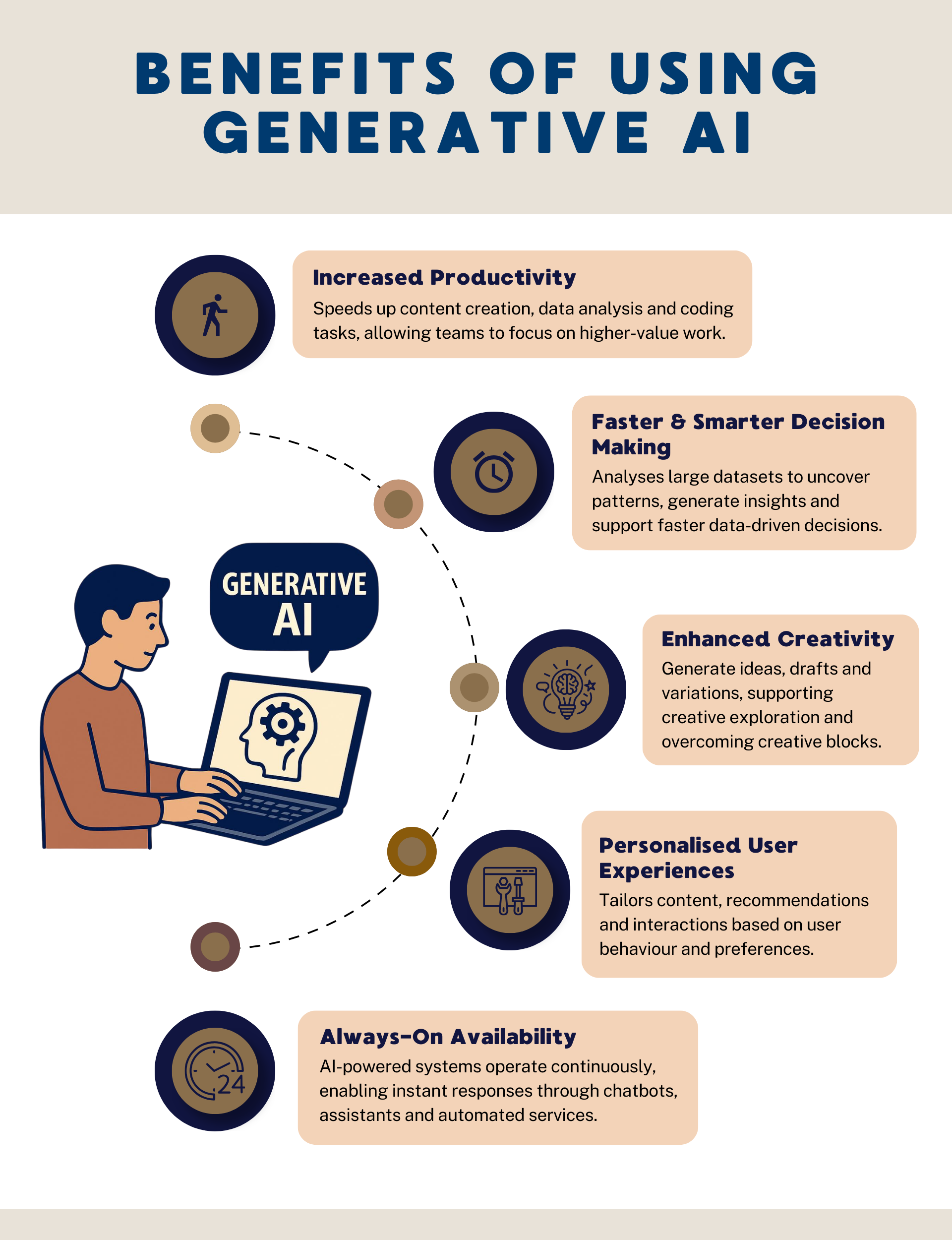
The main benefits of generative AI include increased productivity, faster decision-making, enhanced creativity, personalised user experiences, and continuous availability.
Increased Productivity
One of the biggest benefits of generative AI is speed. It can generate content, summaries, insights, and code within seconds. Automating repetitive or labour-intensive tasks reduces costs and allows people to focus on higher-value work.
Faster and Smarter Decision Making
Generative AI can quickly analyse large volumes of data, uncovering patterns and generating actionable insights. For example, it can highlight emerging investment opportunities or flag potential risks faster than traditional analysis. This enables professionals to make smarter, data-driven decisions with less manual work.
Relevant programmes such as Building a Step-by-Step Plan for Smarter Investment Decisions Using Generative AI explore how generative AI can be applied to analyse financial data and support more informed investment decisions.
Enhanced Creativity
Generative AI acts as a creative assistant. It can generate ideas, drafts, and variations instantly. These outputs help writers and designers overcome creative blocks and explore new possibilities more easily.
Personalised User Experiences
Generative AI creates content tailored to individual preferences and behaviour. This enables real-time personalisation across recommendations, marketing, and digital platforms, leading to more relevant and engaging user experiences.
Always-On Availability
Generative AI operates continuously without fatigue. Chatbots, virtual assistants, and automated systems can deliver instant responses at any time. Continuous operation improves responsiveness and ensures consistent, reliable support.
What Are the Challenges of Using Generative AI?
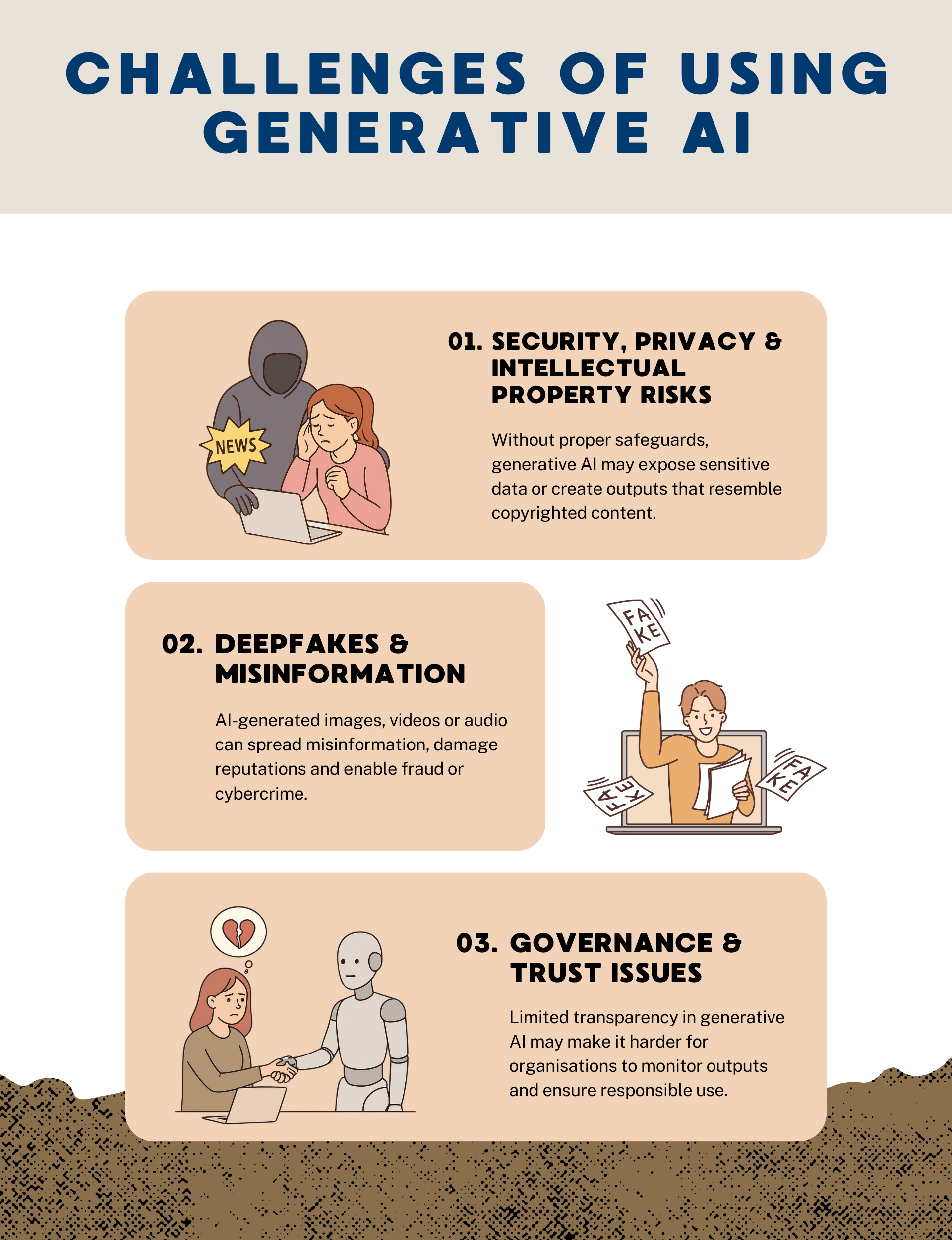
Key challenges of generative AI include cybersecurity threats, data privacy risks, misinformation, deepfakes, and limited regulatory oversight.
Security, Privacy, and Intellectual Property Risks
Generative AI systems are typically trained on large datasets that may include publicly available content, proprietary materials, or user-generated inputs. Without proper safeguards, the use of training data or user prompts may expose sensitive or confidential information, increasing the risk of intellectual property leakage or copyright violations.
Careful data handling and monitoring of outputs are essential to reduce these risks. Addressing these risks often requires technical understanding of how generative models are trained and deployed.
Programmes such as the Advanced Certificate in Deep Learning and Generative AI explore the underlying technologies behind generative models and their practical applications in industry.
Deepfakes and Misinformation
Deepfakes are AI-generated or manipulated images, videos, or audio designed to mislead users into believing false events or statements. Beyond reputation damage and misinformation, deepfakes are increasingly used in cybercrime, including voice phishing and financial fraud. While detection technologies are improving, user awareness and responsible content sharing remain critical safeguards.
Governance and Trust Issues
Many generative AI models lack transparency and explainability, making it difficult to identify potential errors, bias, or misuse. These limitations may raise concerns around accountability, oversight, and the responsible use of AI systems, particularly when generative tools are used in business operations or decision-making.
To address these challenges, organisations are establishing clearer governance frameworks to manage risks related to data privacy, model reliability, and regulatory compliance. Some companies are strengthening oversight by appointing Data Protection Officers (DPOs) to manage privacy risks and ensure compliance with data protection regulations.
As the adoption of generative AI expands, professionals may require deeper knowledge of AI governance, risk management, and responsible deployment. Programmes such as the Practitioner Certificate in Personal Data Protection (Singapore) 2020 (WSQ) and the Advanced Certificate in Data Protection Principles can help to build these capabilities.
Gen AI vs AI Agents vs Agentic AI
While terms like generative AI, AI Agents, and Agentic AI are often used interchangeably, each represents a distinct stage of AI capability and serves different purposes. The table below breaks down their key differences, how they work, and when to use each type.
| Feature | Generative AI | AI Agents | Agentic AI |
|---|---|---|---|
| Primary Function | Creates content such as text, images, videos, or code. | Performs specific tasks automatically based on predefined rules. | Plans, reasons, and acts independently toward a goal. |
| How It Works | Predicts and generates outputs based on patterns learned from training data. | Connects to APIs or tools, filters results according to rules, and executes predefined tasks. | Understands objectives, plans strategies, adapts to context, and executes actions automatically. |
| Data Dependency | Trained on historical data; no real-time updates. | Relies on rules and external tools; limited flexibility. | Combines reasoning with real-time data and feedback loops. |
| Tool & API Access | None; works only from learned data. | Limited to specific tools or APIs for tasks. | Dynamic access to multiple tools and APIs for decision-making. |
| Learning & Adaptation | Does not learn from ongoing interactions. | No continuous learning; follows instructions. | Continuously adapts strategies based on context and results. |
| Autonomy Level | Low | Medium | High |
| Example Use Cases | Writing articles, creating designs, composing music or code. | Fetching flight data, sending alerts, scheduling meetings. | Planning and booking trips, managing complex workflows, and automating multi-step goals. |
| Example Tools/Models | ChatGPT, DALL·E, Midjourney | Customer service bots, automation systems | AutoGPT, Devin AI, Gemini 2.0 with planning capabilities |
Master Generative AI with Confidence
Learning to harness generative AI opens doors to smarter decision-making, faster content creation, and enhanced problem-solving. By experimenting with AI tools, understanding how models interpret data, and applying insights effectively, individuals gain practical skills that make them better at problem-solving in the current digital age.
SMU Academy offers generative AI programmes designed to help professionals build practical skills and gain real-world experience with AI tools.
FAQs About Generative AI
What is the difference between Generative AI and AI?
Artificial Intelligence (AI) refers to systems that perform tasks requiring human-like intelligence, such as analysing data, recognising patterns, or making predictions. Traditional AI is commonly used in tools like voice assistants, recommendation systems, and search engines.
Generative AI, a subset of AI, goes further by producing original content based on learned patterns. It can generate text, images, music, videos, or code. While traditional AI recognises patterns, generative AI creates new patterns, unlocking opportunities for creativity, marketing, and personalised content.
What Generative AI courses are available for beginners?
Beginner-friendly generative AI courses include programmes that introduce core concepts such as prompt engineering, conversational AI and practical applications of tools like ChatGPT. For example, courses such as Generative AI: Applications, Prompt Engineering and the Power of ChatGPT explore how generative AI can be used in everyday business and communication tasks.
For learners seeking a broader introduction, programmes such as the Advanced Certificate in Generative AI, Ethics and Data Protection provide modular coverage of AI fundamentals, governance considerations and responsible AI use.
What is LLM in Generative AI?
A Large Language Model (LLM) is an AI model that understands and generates human-like text. Built on transformer networks, LLMs learn patterns, grammar, and context from massive datasets, allowing them to process text efficiently and at scale.
LLMs power generative AI, enabling tasks like answering questions, summarising text, translating languages, and creating content from prompts. Popular examples include GPT-3 and ChatGPT, Jurassic-1, and Cohere’s Command, which developers can use to build AI applications for content creation, chatbots, and more.
What is a text-to-text model in Generative AI?
A text-to-text model is a type of generative AI that produces text based on a text prompt. It uses machine learning, existing data, and previous inputs to generate responses that are relevant and context-aware. Examples include tools like ChatGPT, which can assist with tasks such as writing, answering questions, coding, research, translation, and virtual assistance.
How can Generative AI be used in cybersecurity?
Generative AI enhances cybersecurity by detecting threats more quickly, automating repetitive tasks, and generating actionable insights from complex data. It helps security teams respond faster, analyse large volumes of information, and improve overall efficiency. While it will not replace cybersecurity professionals, generative AI strengthens decision-making, reduces human error, and supports proactive defence against evolving threats.