


A marketing funnel is a framework that illustrates the path potential customers take from first discovering a brand to becoming loyal advocates. Rather than focusing solely on generating sales, it helps businesses understand how people move through different decision-making stages and what information, experiences, or interactions encourage them to take the next step.
For businesses operating in today's digital economy, a well-designed marketing funnel provides a structured approach to attracting the right audience, nurturing relationships, improving conversions, and increasing long-term customer value. It also enables marketers to measure performance at every stage, identify areas for improvement, and allocate resources more effectively.
This guide explains what a marketing funnel is, explores its key stages, compares popular marketing funnel models, outlines practical steps for building one and discusses how professionals can develop transferable skills for modern marketing.
What Is Marketing Funnel
A marketing funnel is a strategic model that maps how prospective customers progress from becoming aware of a business to making a purchase and remaining loyal afterwards. Marketers use it to plan campaigns, deliver relevant content at different stages, and improve the overall customer journey by guiding prospects towards meaningful actions.
Stages of The Marketing Funnel
Every marketing funnel consists of several stages that reflect a customer's level of interest and readiness to buy. While the terminology may vary, the overall objective remains the same: move prospects through each stage by delivering the right message at the right time.
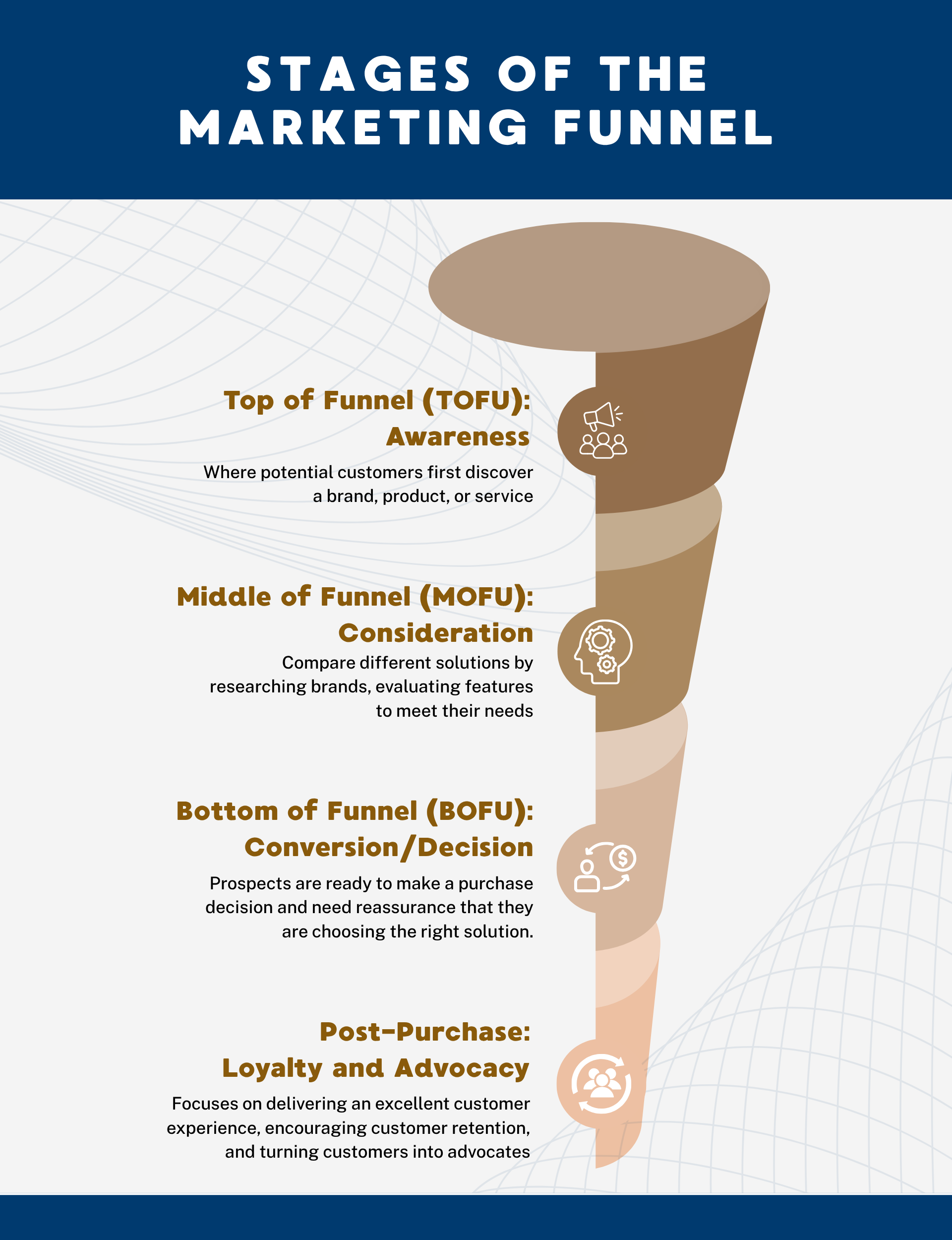
Top of Funnel (TOFU): Awareness
The awareness stage is where potential customers first discover a brand, product, or service. At this point, they may not even realise they have a problem or know that a solution exists.
The goal is to increase visibility, educate audiences, and generate interest instead of making an immediate sale.
| Common marketing activities |
|
| Metrics |
|
Example:
A university publishes an SEO-optimised article answering common career questions and promotes it through LinkedIn. The campaign attracts 15,000 website visitors and 5,000 new users in one month, indicating that it is successfully increasing brand awareness.
Middle of Funnel (MOFU): Consideration
Once prospects recognise their problem, they begin comparing different solutions. They research brands, evaluate features, and seek evidence that a business can meet their needs.
The objective is to educate prospects further while building trust and credibility.
| Common marketing activities |
|
| Metrics |
|
Example:
A software company offers a free webinar on improving workplace productivity and follows up attendees with an email series. The campaign generates 800 webinar registrations, a 45% email open rate, and 250 qualified leads, showing strong audience engagement and interest.
Bottom of Funnel (BOFU): Conversion/Decision
At the bottom of the funnel, prospects are ready to make a purchase decision. They simply need reassurance that they are choosing the right solution.
The focus shifts towards reducing hesitation and making it easy to convert.
| Common marketing activities |
|
| Metrics |
|
Example:
A cybersecurity provider offers personalised product demonstrations to qualified leads. During the campaign, 40% of demo attendees purchase a subscription, while the company reduces its cost per acquisition by 15%, demonstrating improved conversion performance.
Post-Purchase: Loyalty and Advocacy
The customer relationship should continue after a purchase. Existing customers are often more valuable than constantly acquiring new ones because they are more likely to make repeat purchases and recommend the brand to others.
This stage focuses on delivering an excellent customer experience, encouraging customer retention, and turning satisfied customers into advocates.
| Common marketing activities |
|
| Metrics |
|
Example:
An online business launches a loyalty programme that rewards repeat purchases and customer referrals. Within six months, repeat purchases increase by 28%, referral sign-ups grow by 18%, and the NPS rises from 45 to 58, indicating stronger customer loyalty and advocacy.
Marketing Funnel Models
Marketing funnel models provide different ways of understanding customer behaviour and planning marketing activities. While every model shares the same objective of guiding customers towards conversion, each offers a different perspective depending on business goals and customer behaviour.
AIDA
AIDA stands for Attention, Interest, Desire, and Action. One of the oldest marketing frameworks, AIDA focuses on capturing attention before gradually building emotional interest and desire that eventually leads to action.
Businesses commonly apply AIDA when creating advertising campaigns, landing pages, and product launches. It is particularly useful because it aligns marketing messages with how customers naturally make purchasing decisions.
TOFU, MOFU and BOFU
The TOFU, MOFU and BOFU model divides the marketing funnel into awareness, consideration and conversion. Its simplicity makes it one of the most widely used frameworks in digital marketing.
Each stage has its own objectives, content strategy, performance metrics and marketing channels, making campaign planning more structured and measurable.
AARRR (Pirate Metrics)
AARRR consists of:
- Acquisition
- Activation
- Retention
- Revenue
- Referral
Originally developed for startups, this framework focuses heavily on growth by measuring how users first discover a product, begin using it, remain engaged, generate revenue, and recommend it to others. It works especially well for subscription businesses, SaaS companies, and digital products that rely on recurring customers.
Full-Funnel Marketing Strategy
Rather than concentrating on only one stage, a full-funnel marketing strategy coordinates marketing efforts across the entire customer lifecycle.
For example, a retailer may simultaneously:
- Publish educational content to generate awareness
- Send nurturing emails to interested prospects
- Run remarketing advertisements for high-intent visitors
- Launch loyalty campaigns for existing customers
This integrated approach creates a consistent experience while improving long-term business growth.
See, Think, Do, Care (STDC)
Developed by Avinash Kaushik, the STDC framework categorises audiences according to their purchase readiness.
- See: Broad audience with potential interest
- Think: Considering possible solutions
- Do: Ready to purchase
- Care: Existing customers who deserve continued engagement
Unlike traditional funnels, STDC emphasises maintaining relationships even after customers have purchased, making it particularly suitable for brands seeking long-term loyalty.
Flywheel Model
Unlike the traditional funnel, the Flywheel Model views customers as the driving force behind business growth. Rather than ending with a sale, satisfied customers generate referrals, reviews, and repeat purchases that continuously attract new prospects.
Businesses strengthen the flywheel by delivering excellent service, removing friction throughout the buying process, and encouraging advocacy. This customer-centric approach is increasingly popular among organisations that prioritise sustainable growth and long-term relationships.
How To Build A Marketing Funnel
Building a successful marketing funnel requires understanding your audience, creating relevant content, measuring results, and continuously refining your strategy. The following steps provide a practical framework for getting started.
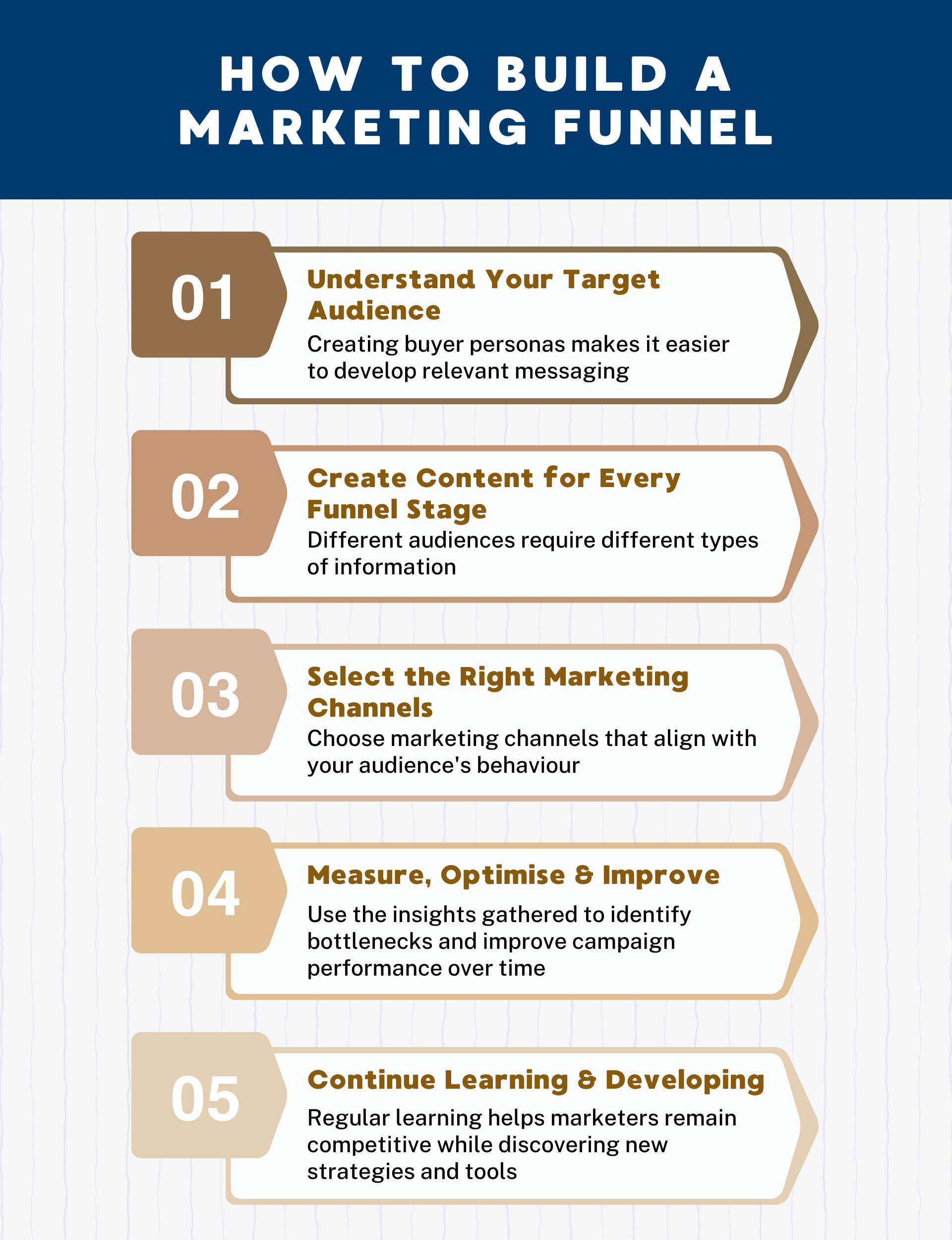
Step 1: Understand Your Target Audience
Begin by identifying your ideal customers. Research factors such as:
- Demographics
- Pain points
- Goals
- Buying behaviours
- Preferred communication channels
For example, professionals seeking career development may respond well to educational webinars, while younger consumers may engage more actively with short-form videos.
Creating buyer personas makes it easier to develop relevant messaging throughout the funnel.
Step 2: Create Content for Every Funnel Stage
Different audiences require different types of information depending on where they are in the funnel.
Examples include:
| Funnel Stage | Suitable Content |
| Awareness | Blog articles, videos, infographics |
| Consideration | Guides, webinars, case studies |
| Decision | Testimonials, consultations, free trials |
| Loyalty | Newsletters, customer events, loyalty rewards |
Using AI in marketing can also help marketers personalise recommendations, optimise campaigns, and automate content delivery more efficiently.
Step 3: Select the Right Marketing Channels
Choose marketing channels that align with your audience's behaviour. These may include:
- Search engines
- Social media
- Paid advertising
- Events
- Referral programmes
- Influencer collaborations
For example, a B2B software company may generate awareness through LinkedIn articles before nurturing leads through webinars and personalised email campaigns.
Step 4: Measure, Optimise and Improve
An effective marketing funnel should continuously evolve. Track important metrics such as:
- Website traffic
- Conversion rate
- Cost per lead
- Customer acquisition cost
- Customer lifetime value
- Email open rates
Use the insights gathered to identify bottlenecks and improve campaign performance over time.
Step 5: Continue Learning and Developing Your Marketing Expertise
Marketing continues to evolve alongside technology, consumer behaviour, and business expectations. Regular learning helps marketers remain competitive while discovering new strategies and tools.
SMU Academy offers programmes that can strengthen marketing knowledge, including:
- Content Marketing and Search Engine Optimisation (SEO)
- Digital Marketing Strategy, Planning and Analytics
- Growth Hacking Strategies for Product Managers
- Professional Certificate in Digital Marketing
- (SCTP) Advanced Certificate in Digital Marketing
These programmes help professionals strengthen analytical thinking, campaign planning, data interpretation, and modern digital marketing practices.
Building Better Results with a Marketing Funnel
A marketing funnel provides a structured way to attract prospects, nurture relationships, convert customers, and encourage long-term loyalty. By understanding each stage, selecting the right marketing funnel model, and continuously refining campaigns through data, businesses can improve marketing performance and deliver more meaningful customer experiences.
As marketing continues to evolve, professionals who invest in continuous learning and transferable skills will be better equipped to build effective funnels that support sustainable business growth.
FAQs About Marketing Funnel
What is the difference between a marketing funnel and a sales funnel?
A marketing funnel focuses on attracting, educating, and nurturing potential customers before they are ready to purchase. A sales funnel begins when qualified leads are handed to the sales team and focuses on converting those prospects into paying customers. Marketing builds demand, while sales closes opportunities.
How do I know if there is a gap in my marketing funnel?
Review your funnel metrics to identify where prospects are dropping off. For example, high website traffic but few email sign-ups may indicate weak awareness content or ineffective calls to action. Strong lead generation but low conversions could suggest pricing concerns, insufficient trust signals, or poor follow-up. Analysing performance at each stage helps pinpoint improvement opportunities.
What is the most common mistake marketers make?
One of the most common mistakes is focusing too heavily on generating awareness while neglecting the consideration and post-purchase stages. Without lead nurturing, personalised communication, and customer retention efforts, businesses risk losing qualified prospects and reducing long-term customer value.
Can a marketing funnel be used by small businesses?
Yes. A marketing funnel is valuable for businesses of all sizes. Small businesses can begin with a simple funnel using channels such as SEO, social media, email marketing, and customer referrals. As the business grows, the funnel can be expanded with automation, personalisation, and more advanced analytics to improve marketing effectiveness.