


Last updated: June 2026. Grant details, funding quantum and eligibility criteria are verified against Enterprise Singapore and GoBusiness as at the date above. We recommend confirming current figures directly on the Business Grants Portal before applying, as scheme details are subject to change.
Small and medium-sized enterprises (SMEs) form the backbone of Singapore’s economy, making up the vast majority of local businesses and employing a significant portion of the workforce.
With SMEs continually adapting to new growth opportunities and operational challenges, many turn to financial support schemes like grants to enhance capabilities and scale effectively. These grants typically support areas such as digitalisation, capability development, sustainability, productivity enhancement, and market expansion.
This article provides a practical guide to the SME grants available in Singapore in 2026. You will learn about the main types of grants, common eligibility criteria, how to apply, and how SMEs can strategically position themselves for success. We also explore how upskilling and capability building can help strengthen your application and ensure long-term business growth.
Types of SME Grants in Singapore
Government grants for SMEs come in various forms, supporting different business objectives such as innovation, digitalisation, workforce development, sustainability, and overseas expansion. Below is an overview of some of the most commonly used funding schemes categorised by their purpose.
| Administered by | Best for | Funding quantum | |
| Productivity Solutions Grant (PSG) | IMDA/ EnterpriseSG | Adoption of pre-approved IT solutions, equipment, and productivity tools | Up to 50% of qualifying costs |
| Advanced Digital Solutions (ADS) | IMDA | Advanced digital transformation projects involving AI, data analytics, automation and integrated solutions | Up to 70% of qualifying costs (depending on solution category) |
| Enterprise Development Grant (EDG) | EnterpriseSG | Capability upgrading, innovation, overseas expansion | Up to 50% of qualifying project costs for SMEs |
| SkillsFuture Enterprise Credit (SFEC) | SSG & WSG | Workforce training and enterprise transformation | Up to $10,000 (one time) |
| Energy Efficiency Grant (EEG) | EnterpriseSG & NEA | Adoption of energy-efficient equipment in sectors such as F&B, retail, manufacturing, and logistics | Up to 70% support for pre-approved equipment |
| Resource Efficiency Grant for Emissions (REG(E)) | NEA | Emissions reduction and energy efficiency projects in the manufacturing sector | Support level varies based on project scope and emissions reduction outcome |
| Market Readiness Assistance (MRA) | EnterpriseSG | Overseas market expansion, overseas marketing, business matching, and market setup activities | Up to 50%, capped at $100,000 per new market |
| Global Innovation Alliance (GIA) Programmes | EnterpriseSG | Overseas innovation, partnerships, business matching, and market immersion opportunities | Support varies by programme and overseas market |
| Startup SG Founder Grant | EnterpriseSG | First-time entrepreneurs | $50,000 (with $10,000 founder co-investment) |
| Startup SG Tech | EnterpriseSG | Deep tech commercialisation | Varies (POC / POV funding) |
Digitalisation and Technology Adoption
Productivity Solutions Grant (PSG)
The PSG supports SMEs in adopting pre-approved digital solutions and productivity tools across sectors such as retail, logistics, F&B, construction, and more. Eligible companies must be registered and operating in Singapore, with at least 30% local shareholding. Funding typically covers a percentage of the cost of software, equipment, or IT solutions.
What it funds: Pre-approved software, IT solutions, and equipment from IMDA-endorsed vendors, covering areas such as accounting, HR, inventory management, e-commerce, and cybersecurity
Funding quantum: Up to 50% of qualifying costs
Eligibility: Registered and operating in Singapore; at least 30% local shareholding; annual sales turnover not exceeding S$100 million or employing no more than 200 workers
The PSG is often the first digital step for SMEs, but technology alone does not drive transformation. SMU Academy's Advanced Certificate in Business Innovation for SMEs equips business leaders with the strategic thinking to select the right digital solutions, embed them into operations, and sustain the productivity gains that grant assessors look for.
Advanced Digital Solutions (ADS)
ADS supports SMEs in adopting integrated, sector-specific digital solutions requiring more advanced technology. Projects often involve technologies such as AI, data analytics, and automation. Companies must demonstrate how the solution enhances productivity or competitiveness.
What it funds: Adoption of advanced digital solutions that leverage technologies such as Artificial Intelligence (AI), data analytics, automation, cloud technologies, and integrated business systems
Funding quantum: Up to 70% of qualifying costs, depending on the solution category and project scope
Eligibility: Singapore-registered SMEs with at least 30% local shareholding that are looking to implement an approved Advanced Digital Solution and can demonstrate how the project will enhance productivity, competitiveness, or business growth
Capability Development and Business Growth
Enterprise Development Grant (EDG)
The EDG helps businesses upgrade, innovate and venture overseas. It supports three main areas: Core Capabilities, Innovation and Productivity, and Market Access. SMEs must be financially ready to begin the project and be registered in Singapore with a minimum of 30% local shareholding.
What it funds: Business strategy development, process improvement, product development, intellectual property, branding, and overseas market preparation
Funding quantum: Up to 50% of qualifying costs. SMEs that are Start-Ups, Scale-Ups, or High-Growth companies may qualify for up to 70%
Eligibility: Registered in Singapore; at least 30% local shareholding; financially ready to begin the project
The EDG rewards businesses with a clear strategic vision and strong organisational leadership. SMU Academy's Enterprise Leadership for Transformation (ELT) programme is specifically designed for SME leaders preparing for transformation projects, developing the business strategy, leadership capability, and innovation frameworks that EDG assessors look for. Our Executive Certificate in Driving Business Growth through Linking Theory and Practice further equips leaders to translate strategy into measurable project outcomes.
SkillsFuture Enterprise Credit (SFEC)
SFEC encourages employers to invest in enterprise transformation and workforce training, by providing additional support for eligible expenses. To qualify, companies must meet specific workforce and CPF contribution criteria.
What it funds: Workforce training, skills development, and enterprise transformation initiatives, including eligible courses, capability-building programmes, and productivity projects supported by participating government schemes
Funding quantum: A one-time credit of up to S$10,000, which can be used to offset up to 90% of qualifying out-of-pocket expenses
Eligibility: Companies must have employed at least three Singaporean or PR employees who have made CPF contributions for at least six months in the qualifying period, and not have previously claimed SFEC
Note: Unused credits under the current SFEC will expire on 30 November 2026. For training to be eligible for the current SFEC, the last day of training must be completed on or before 30 November 2026, subject to SWDA’s approval. Read here for more information.
Sustainability and Green Transformation
Energy Efficiency Grant (EEG)
Aimed at sectors with high energy usage, the EEG supports investments in more energy-efficient equipment. Eligible SMEs must operate within targeted industries such as food services, manufacturing or retail.
What it funds: Eligible energy-efficient equipment in targeted sectors including food services, food manufacturing, retail, and hospitality
Funding quantum: Up to 50% of qualifying equipment costs
Eligibility: Must be an SME operating in one of the eligible sectors; equipment must meet minimum energy efficiency standards as specified by EnterpriseSG and NEA
Sustainability is increasingly a business imperative, not just a regulatory checkbox. The Transforming Small and Medium Enterprises: Strategic Sustainable Development course helps SME leaders integrate sustainability frameworks into operations.
Resource Efficiency Grant for Emissions (REG(E))
This grant helps businesses implement resource efficiency projects that reduce greenhouse gas emissions. Companies must undertake an approved project and demonstrate measurable environmental impact.
What it funds: Resource efficiency and emissions reduction projects that help businesses reduce energy consumption, improve operational efficiency, and lower greenhouse gas emissions through the adoption of cleaner technologies and processes
Funding quantum: Varies depending on the project scope, emissions reduction potential, and assessment by the relevant authorities
Eligibility: Manufacturing and industrial companies undertaking approved resource efficiency projects that can demonstrate measurable reductions in greenhouse gas emissions and improvements in environmental performance
Market Expansion and Internationalisation
Market Readiness Assistance (MRA)
The MRA grant supports SMEs taking their first steps overseas. Funding covers areas such as overseas marketing, market set-up and in-market business development. Eligible companies must be Singapore-registered with at least 30% local shareholding and group annual sales not exceeding S$100 million.
What it funds: Overseas market promotion, set-up of overseas business entities, and in-market business development activities
Funding quantum: Up to 50% of eligible costs, capped at S$100,000 per company per new market over five years
Eligibility: Singapore-registered company; at least 30% local shareholding; group annual sales not exceeding S$100 million
Successful overseas expansion requires more than market entry funding. It demands a clear internationalisation strategy, strong digital presence, and the ability to adapt your brand to new audiences. The Advanced Certificate in Online Reputation Management for Business equips SME leaders to build and protect their brand's digital reputation across markets.
Global Innovation Alliance (GIA) Programmes
The GIA helps SMEs expand through overseas innovation partnerships, market immersion programmes and collaborations with global partners.
What it funds: Overseas market access programmes, innovation partnerships, business matching opportunities, overseas immersion programmes, and collaborations with global partners, startups, research institutions, and innovation ecosystems
Funding quantum: Varies depending on the specific GIA programme, destination market, and activities undertaken
Eligibility: May differ across individual GIA programmes and participating markets
Start-up and Innovation Support
Startup SG Founder Grant
The Startup SG Founder Grant offers startup funding and mentorship support for first-time entrepreneurs with innovative business ideas. Applicants must apply through an Accredited Mentor Partner and meet criteria related to founder shareholding and involvement in the business.
What it funds: Startup costs associated with launching an innovative business, including product development, market validation, business operations, and early-stage growth activities. The programme also provides structured mentorship and business guidance through an Accredited Mentor Partner
Funding quantum: $50,000, with a co-investment of S$10,000 required from the founding team
Eligibility: First-time entrepreneur; must apply through an Accredited Mentor Partner (AMP); at least 30% founder shareholding; founder must be actively involved in the business
Startup SG Tech
Startup SG Tech provides early-stage funding for the commercialisation of deep tech solutions. It supports Proof-of-Concept and Proof-of-Value projects and is open to Singapore-based companies developing proprietary technology.
What it funds: Research and development, prototyping, testing, and commercialisation of innovative and proprietary technology solutions. The programme supports both Proof-of-Concept (POC) and Proof-of-Value (POV) projects
Funding quantum: Up to S$500,000 for Proof-of-Concept projects and up to S$1 million for Proof-of-Value projects
Eligibility: Singapore-incorporated company; developing proprietary technology with clear commercialisation potential
Eligibility Criteria for SME Grants in Singapore
Most grants share common baseline requirements. Businesses should consider applying when they are ready to invest in growth, digitalisation or capability building, with clear project goals and financial stability.
General eligibility criteria commonly include:
- Registered and operating in Singapore
- At least 30% local shareholding
- Annual sales turnover or employment size within SME thresholds
- Financial capability to complete the project
- Project outcomes that align with the grant’s objectives
It is essential to check the detailed requirements on the Enterprise Singapore or GoBusiness portals, as criteria such as project scope, funding caps and application documents vary across grants.
How to Apply for SME Grants
Applying for an SME grant usually involves several key steps. These ensure that your business needs align with the scheme’s objectives and that your application is well-supported.
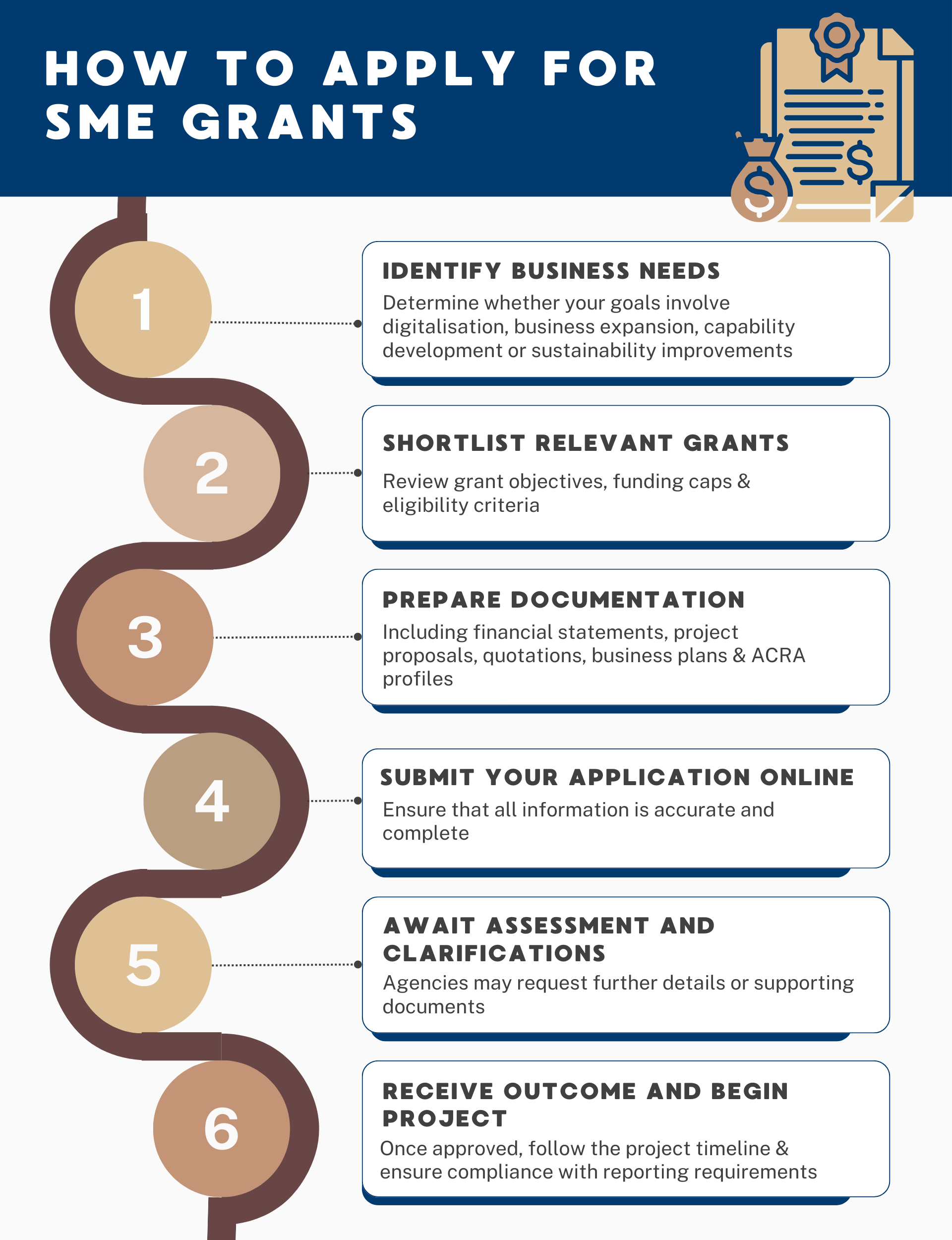
Step 1: Identify Business Needs
Determine whether your goals involve digitalisation, business expansion, capability development or sustainability improvements.
Step 2: Shortlist Relevant Grants
Review grant objectives, funding caps and eligibility criteria through Enterprise Singapore, GoBusiness or IMDA.
Step 3: Prepare Documentation
Gather required documents such as financial statements, project proposals, quotations, business plans and ACRA profiles.
Step 4: Submit Your Application Online
Applications are typically submitted via the Business Grants Portal (BGP). Ensure that all information is accurate and complete.
Step 5: Await Assessment and Clarifications
Agencies may request further details or supporting documents. Respond promptly to avoid delays.
Step 6: Receive Outcome and Begin Project
Once approved, follow the project timeline, track expenses and ensure compliance with reporting requirements.
Aligning Business Strategy with Grant Objectives
To maximise your chances of approval, it is important to align your business strategy with broader national priorities and the specific aims of the grant. This demonstrates purpose, readiness and long-term commitment, all of which are qualities funding bodies look for. Here is how to align your business strategy with grant objectives:
- Conduct a Strategic Business Review: Assess your current capabilities, challenges and long-term plans to determine where grants can provide the most value.
- Map Grant Objectives to Business Goals: Ensure the grant supports measurable outcomes such as improved productivity, enhanced sustainability or expanded market presence. For instance, an SME planning to grow its online business can align its strategy with grants that support e-commerce development, digital marketing or customer engagement technologies.
- Develop Clear Project Plans: Outline milestones, resources, timelines and implementation steps to show preparedness.
- Build Organisational Readiness: Strengthen internal processes, assign project owners and ensure your team can execute the funded initiative.
- Demonstrate Financial Responsibility: Show that the business has adequate financial health and can complete the project even with partial funding.
- Establish Measurable KPIs: Track quantifiable results such as productivity gains, cost savings or revenue growth to support post-project reporting.
- Document Long-Term Impact: Explain how the project contributes to sustained capability development beyond the funding period.
Strengthening Business Growth Through SME Grants in Singapore
SME grants in Singapore provide valuable support for digitalisation, capability development, sustainability and market expansion. By understanding the available schemes, ensuring eligibility and aligning projects with grant objectives, businesses can accelerate transformation and strengthen long-term competitiveness. Training and upskilling further reinforce these efforts by equipping SME leaders with the knowledge and capabilities required to execute successful projects.
SMU Academy provides a selection of programmes designed to support SMEs in building capabilities, driving transformation and strengthening readiness for grant applications.