


Sustainability in business refers to operating in a way that balances economic growth with environmental protection and social responsibility. Rather than focusing solely on short-term profits, sustainable businesses aim to create long-term value for stakeholders while minimising negative impacts on the planet and society.
At the core of sustainability are 3 key pillars: environmental, social and governance (ESG). The environmental pillar focuses on reducing carbon emissions, managing resources responsibly and protecting ecosystems. The social pillar emphasises fair labour practices, community engagement and employee wellbeing. Governance relates to ethical leadership, transparency and responsible decision-making.
Sustainability has become a strategic priority for organisations worldwide. Investors, regulators and consumers increasingly expect companies to demonstrate responsible practices and measurable ESG performance. In fact, 87% of C-suite executives believe that sustainability initiatives are vital to the long-term success of their businesses.
This article explains why sustainability matters for businesses today, explores practical sustainable business practices, highlights Singapore-based case studies and outlines how organisations can develop effective sustainability strategies.
Key Takeaways
- Sustainability in business integrates environmental, social and governance (ESG) considerations into organisational strategy and operations.
- Sustainable practices can strengthen brand reputation, improve risk management and create long-term financial value.
- Businesses can adopt initiatives such as renewable energy adoption, ethical supply chains and sustainable product design.
- Developing a sustainability strategy requires clear goal setting, ESG reporting, stakeholder engagement and continuous monitoring.
Why Is Sustainability Critical for Business Success?
Sustainability has evolved from a corporate responsibility initiative into a strategic driver of long-term business performance. Companies that integrate sustainability into their operations are often better positioned to manage risks, build stakeholder trust and identify new growth opportunities.
Attracts and Retains Talent
Employees increasingly prefer to work for organisations that demonstrate purpose and responsibility. Companies with strong sustainability commitments often attract skilled professionals who want their work to contribute to positive social impact.
In addition, organisations that prioritise social responsibility and employee wellbeing tend to experience lower staff turnover and improved engagement.
Drives Innovation and Long-Term Growth
Sustainability challenges often encourage businesses to innovate. Companies may develop new technologies, products or services that address environmental and social issues.
Innovation in areas such as renewable energy, sustainable materials and green technologies can open new markets and create competitive advantages for forward-thinking organisations.
Enhances Operational Efficiency and Cost Savings
Many sustainability initiatives improve how efficiently businesses use energy, materials and other resources. Over time, these improvements can translate into meaningful cost savings.
Research by Grant Thornton International found that 85.9% of mid-market firms worldwide plan to increase or maintain their sustainability investments in 2025, while 54% believe such investments will improve long-term profitability.
Examples include adopting energy-efficient equipment, reducing material waste or optimising logistics operations. These initiatives can lower operating costs while also reducing environmental impact.
Improves Access to Investment and Capital
Sustainability performance is increasingly influencing investment decisions. Investors and financial institutions are paying closer attention to ESG performance when evaluating companies.
According to the Monetary Authority of Singapore (MAS), green, social, sustainability and transition bond issuances in Singapore increased by almost 80% in 2024, reaching SGD $13.3 billion. Combined with sustainability-linked loans, Singapore currently accounts for more than half of ASEAN’s sustainable debt market.
This growth demonstrates how capital markets are shifting towards sustainable finance. Companies that integrate ESG considerations into their strategies may therefore gain improved access to funding, green financing instruments and investor confidence.
Strengthens Brand Reputation and Customer Trust
Consumers are becoming increasingly conscious of the environmental and social impact of their purchasing decisions. Businesses that demonstrate responsible practices often gain stronger customer trust and long-term brand loyalty.
Recent research indicates that sustainability plays an important role in purchasing behaviour. About 65% of consumers in Singapore consider sustainability practices important when making buying decisions, particularly among individuals under the age of 40. In addition, Deloitte’s 2024 Gen Z and Millennial Survey found that almost 60% of Gen Z consumers and over 75% of millennials in Singapore are willing to pay a premium for sustainable products or services.
These trends highlight how sustainability commitments can influence customer perception and strengthen brand positioning in competitive markets.
Sustainable Business Practices and Examples
Sustainable business practices integrate ESG considerations into everyday operations. The primary objective is to create long-term value while reducing environmental impact, improving social outcomes and strengthening corporate governance.
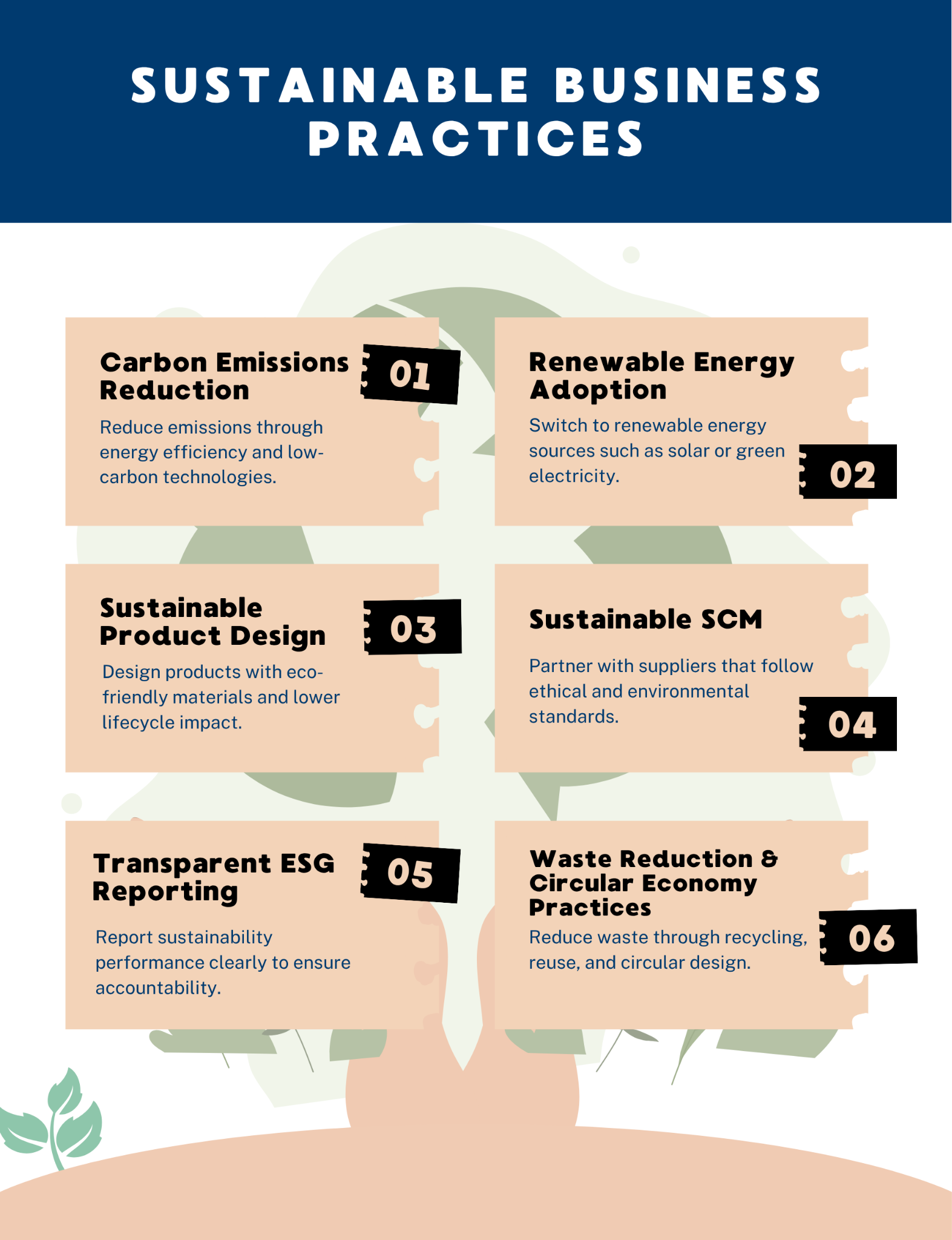
Carbon Emissions Reduction
Reducing greenhouse gas emissions is central to most corporate sustainability strategies. Businesses may improve energy efficiency, electrify vehicle fleets or invest in low-carbon technologies.
Some companies also measure emissions across their value chains and set science-based targets to reduce their carbon footprint over time.
Renewable Energy Adoption
Switching to renewable energy sources is one of the most effective ways businesses can reduce carbon emissions. Companies may install solar panels on facilities, purchase renewable energy through power purchase agreements, or invest in off-site renewable energy projects.
For example, large corporations often install rooftop solar systems at warehouses or manufacturing plants to generate clean electricity. Others purchase renewable energy certificates to offset emissions associated with electricity consumption.
Sustainable Product Design
Product design decisions can significantly influence environmental impact across a product’s lifecycle. Sustainable product design focuses on using environmentally friendly materials, improving energy efficiency during product use and reducing waste generated during production.
Companies may reduce packaging materials, replace single-use plastics with recyclable alternatives or design products that last longer and require fewer resources to maintain.
Sustainable Supply Chain Management
Supply chains can account for a significant portion of a company’s environmental and social impact. Sustainable supply chain management focuses on working with suppliers that follow ethical labour standards, responsible sourcing practices and environmental compliance.
Companies may conduct supplier audits, introduce sustainability criteria during procurement, or collaborate with suppliers to reduce emissions and waste across production processes. The Advanced Certificate in Digital Supply Chain and Advanced Certificate in Sustainability and Sustainable Business by SMU Academy are some of the courses that can empower companies to implement sustainable supply chain management.
Transparent ESG Reporting
Transparent ESG reporting allows organisations to communicate their sustainability performance to stakeholders such as investors, regulators and customers. Many companies publish sustainability reports annually, outlining their environmental impact, social initiatives and governance practices.
Businesses often align their disclosures with recognised frameworks such as the Global Reporting Initiative (GRI), Task Force on Climate-related Financial Disclosures (TCFD) or emerging international sustainability standards. Regular reporting helps companies track progress towards sustainability goals and demonstrate accountability.
Waste Reduction and Circular Economy Practices
Waste reduction initiatives aim to minimise the amount of material sent to landfills. Businesses may adopt recycling programmes, redesign packaging or introduce product take-back schemes.
Circular economy strategies go further by designing products that can be reused, refurbished or recycled. For example, electronics manufacturers may refurbish returned devices for resale, while fashion companies may implement textile recycling programmes.
Case Studies of Sustainability in Business in Singapore
Many businesses in Singapore are actively integrating sustainability into their corporate strategies in response to regulatory expectations, investor interest and national climate targets. The following examples illustrate how major organisations are implementing measurable sustainability initiatives.
CapitaLand: Advancing Green Buildings Through the 2030 Sustainability Master Plan
CapitaLand has implemented its 2030 Sustainability Master Plan, which focuses on achieving significant improvements in energy efficiency, carbon reduction and sustainable real estate development.
Under this plan, the company aims to reduce Scope 1 and Scope 2 carbon emissions by 46% by 2030 from a 2019 baseline. CapitaLand also targets increasing the proportion of its portfolio that achieves green building certification.
As of 2024, 63% of CapitaLand’s global portfolio has achieved at least one green building certification, reflecting progress towards its sustainability targets.
The company also invests in innovative green building technologies and energy-efficient building management systems to reduce operational emissions and improve environmental performance across its properties.
DBS Bank: Driving Sustainable Finance
DBS Bank has placed sustainability at the centre of its long-term strategy through initiatives such as Responsible Financing and Sustainable and Transition Finance frameworks.
In 2020, DBS committed to achieving net-zero financed emissions by 2050 and has set interim sector-specific decarbonisation targets for industries such as power, oil and gas, aviation and real estate. The bank has also pledged to mobilise SGD $50 billion in sustainable financing by 2024, a target it achieved in June 2022, way ahead of schedule.
By 2023, DBS had facilitated more than SGD $70 billion in sustainable finance, supporting projects related to renewable energy, green buildings and sustainable infrastructure across Asia. These initiatives position DBS as a key financial partner supporting the transition to a low-carbon economy.
Grab: Accelerating Electric Mobility and Sustainable Deliveries
Grab has introduced several initiatives to reduce emissions from urban mobility and delivery services across Southeast Asia.
Through its Carbon Neutral programme, Grab offsets carbon emissions from rides and deliveries by supporting climate projects such as forest conservation and renewable energy. The company is also encouraging the adoption of electric vehicles (EVs) by partnering with EV providers and expanding charging infrastructure. In Singapore, Grab aims to support the transition of drivers to electric vehicles and reduce emissions from ride-hailing fleets.
Grab has also introduced eco-friendly delivery options, allowing users to choose more sustainable delivery methods. These initiatives contribute to reducing the environmental footprint of urban transport and logistics.
How to Create a Strategy for Sustainability in Business
Developing a sustainability strategy requires a structured approach that aligns environmental and social goals with business priorities. Although strategies may vary across industries, most organisations follow a series of steps to integrate sustainability into operations and long-term planning.
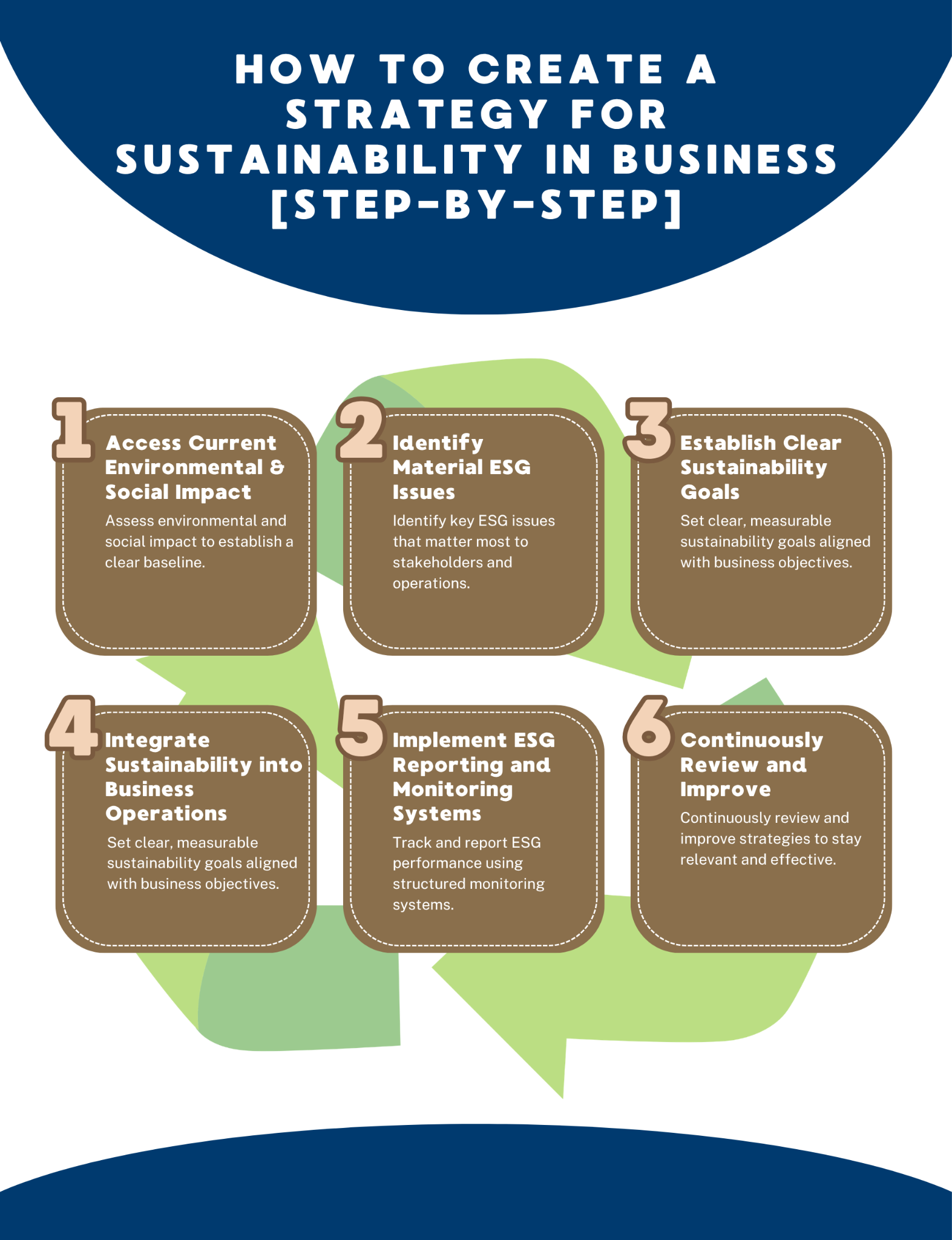
Step 1: Assess Current Environmental and Social Impact
The first step involves conducting a detailed assessment of the organisation’s environmental and social footprint. This may include measuring carbon emissions, energy consumption, water usage and waste generation across operations.
Companies often perform carbon accounting or sustainability audits to establish a baseline. Understanding current impact allows businesses to identify the most significant areas for improvement.
Step 2: Identify Material ESG Issues
A materiality assessment helps organisations identify which ESG issues are most relevant to their stakeholders and industry.
This process typically involves consulting employees, investors, regulators and customers to determine which sustainability topics matter most. For example, a manufacturing company may prioritise emissions reduction and resource efficiency, while a financial institution may focus on responsible investment and governance.
Step 3: Establish Clear Sustainability Goals
Goal setting ensures that sustainability initiatives are measurable and aligned with business objectives. Many organisations use SMART goals, which are:
- Specific
- Measurable
- Achievable
- Relevant
- Time-bound
For example, a SMART sustainability goal could be:
Reduce Scope 1 and Scope 2 carbon emissions by 30% by 2030 through renewable energy adoption and energy efficiency improvements.
Clear goals provide direction and allow organisations to track progress effectively.
Step 4: Integrate Sustainability into Business Operations
Sustainability initiatives should be embedded across business functions rather than treated as separate projects.
For instance, procurement teams may prioritise suppliers with strong sustainability credentials, while product development teams may design more energy-efficient products. Leadership support and internal training also play an important role in ensuring sustainability becomes part of organisational culture.
Step 5: Implement ESG Reporting and Monitoring Systems
Transparent ESG reporting allows businesses to monitor progress and communicate sustainability performance to stakeholders.
Companies often publish annual sustainability reports that track metrics such as emissions, diversity and resource use. Reporting frameworks such as GRI or TCFD help organisations standardise disclosures and ensure credibility. Learn how to do ESG reporting the right way by attending these ESG Reporting and Communication and Environment, Social and Governance (ESG) and Materiality Reporting courses.
Step 6: Continuously Review and Improve
Sustainability strategies must evolve as regulations, technologies and market expectations change.
Businesses should regularly evaluate progress, update targets and refine initiatives. Continuous improvement ensures that sustainability strategies remain relevant and effective over the long term.
Challenges with Sustainability in Business
Although sustainability initiatives offer many benefits, businesses often encounter several obstacles when attempting to implement them. These challenges can arise from financial limitations, operational complexity or gaps in knowledge and resources.
Balancing Profitability and Sustainability Goals
Some organisations struggle to align sustainability initiatives with short-term financial targets.
However, many businesses are increasingly recognising that sustainability can support long-term growth, risk management and resilience when integrated strategically into business planning.
Complex Supply Chains
Global supply chains can involve numerous suppliers operating across different countries and regulatory environments.
Ensuring that suppliers comply with sustainability standards can therefore be challenging. Businesses often need to introduce supplier codes of conduct, audits and collaboration programmes to improve sustainability across the supply chain.
High Initial Implementation Costs
Many sustainability initiatives require upfront investment. Installing renewable energy systems, upgrading facilities, or redesigning supply chains can involve significant capital expenditure.
While these investments may deliver long-term savings and environmental benefits, organisations must carefully balance immediate financial constraints with future returns.
Lack of Expertise and Resources
Sustainability initiatives often require specialised expertise in areas such as carbon accounting, ESG reporting and environmental management.
Companies that lack internal knowledge may find it difficult to design effective sustainability strategies. Many organisations address this challenge by engaging external consultants or investing in staff training.
Regulatory Uncertainty
Sustainability regulations continue to evolve as governments introduce new climate policies and reporting requirements.
For businesses operating internationally, keeping up with changing rules across different jurisdictions can be difficult. Organisations must therefore maintain strong compliance capabilities and monitor regulatory developments closely.
Future of Sustainability in Business
Sustainability is becoming a defining factor in modern business strategy. As environmental concerns intensify and stakeholder expectations grow, organisations are increasingly integrating ESG considerations into decision-making processes. Sustainable practices can improve operational efficiency, strengthen risk management and support innovation.
Businesses that proactively adopt sustainability strategies are likely to gain competitive advantages in emerging markets, sustainable finance and green technologies. At the same time, transparency through ESG reporting and responsible governance will remain essential for maintaining stakeholder trust.
SMU Academy offers sustainability courses such as Energy Sustainability and Renewable Energy Adoption: Enhancing Social Responsibility in Business and Sustainability Project Management, which support professionals in developing knowledge and practical capabilities related to sustainability and responsible business practices.
FAQs About Sustainability in Business
What is the goal of sustainability in business?
The goal of sustainability in business is to create long-term economic value while minimising negative environmental and social impacts. This involves balancing profitability with responsible resource use, ethical governance and positive contributions to communities and stakeholders.
What is the difference between carbon-neutral and net-zero?
Carbon-neutral refers to balancing carbon emissions by offsetting them through initiatives such as carbon credits or reforestation. Net-zero is a broader concept that involves significantly reducing emissions across operations and supply chains before offsetting any remaining emissions. Net-zero strategies, therefore, prioritise emission reduction rather than relying primarily on offsets.
How does sustainability affect international business?
Sustainability influences international business through regulations, investor expectations and supply chain standards. Many countries require companies to disclose environmental and social performance, while global investors increasingly prioritise ESG considerations. Businesses that meet sustainability standards may gain better access to international markets, partnerships and investment opportunities.