


Growth is a critical driver of long-term competitiveness, yet many organisations struggle to expand in a sustainable way, particularly in rapidly evolving market conditions. Without a clear strategy, efforts to increase revenue or enter new markets can become fragmented, inefficient, and difficult to scale.
This article explores the main types of business growth strategies, key factors that influence growth decisions, common challenges organisations face, and practical steps to choose the right strategy for sustainable growth.
Key Takeaways
- Business growth depends on aligning strategy with market conditions, internal capabilities, and long-term objectives.
- Structured frameworks help organisations evaluate growth opportunities while balancing potential risks and returns.
- Successful growth requires more than selecting a strategy; it depends on execution, resource allocation, and the ability to adapt to changing conditions.
- Organisations that approach growth deliberately are better positioned to scale sustainably and remain competitive over time.
What Is a Business Growth Strategy?
A business growth strategy outlines how a company expands its operations in a structured and sustainable way. It defines how organisations identify growth opportunities, allocate resources, and make decisions that strengthen overall performance and competitiveness.
Growth extends beyond increasing revenue. It may include expanding market share, entering new markets, developing new products or services, or strengthening relationships across the customer journey to support value creation over time.
Why Are Business Growth Strategies Important?

Business growth strategies provide a clear framework for how organisations expand while managing risk and resource constraints. Without a defined approach, growth initiatives may become reactive, resulting in inefficient resource allocation, fragmented execution, and missed opportunities.
A clear strategy helps organisations prioritise the right opportunities and scale operations more effectively. This is particularly important in competitive and rapidly changing markets, where timely decisions are essential to respond effectively.
This need is especially relevant for small and medium-sized enterprises (SMEs). According to the Ministry of Trade and Industry, SMEs account for 99% of enterprises and employ about two-thirds of the workforce. Given their limited resources and capacity, these businesses rely on structured growth strategies to allocate resources effectively, focus on the most viable opportunities, and scale in a controlled manner.
What Are the 4 Major Business Growth Strategies?
The 4 major business growth strategies are market penetration, market development, product development, and diversification. These approaches outline how organisations expand based on whether they focus on existing or new products and markets.
They are commonly grouped using the Ansoff Matrix, which categorises growth options based on product and market combinations.
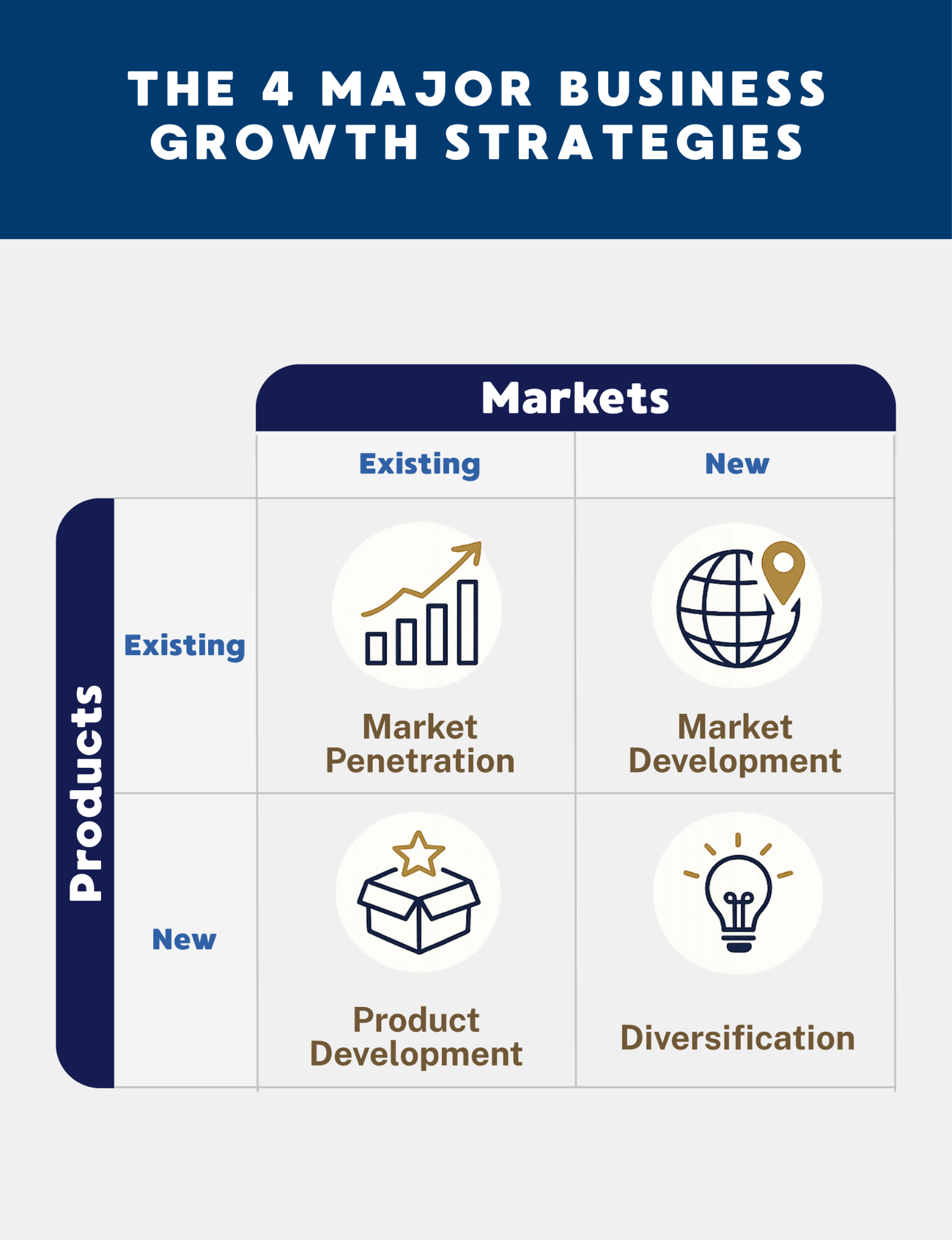
The table below summarises the strategies and their key characteristics:
| Strategy | Core Focus | Risk Level | Best For |
| Market Penetration | Existing products, existing markets | Low | Increasing share in familiar markets |
| Market Development | Existing products, new markets | Medium | Expanding into new customer segments or regions |
| Product Development | New products, existing markets | Medium | Introducing new offerings to current customers |
| Diversification | New products, new markets | High | Entering entirely new areas for growth |
Market Penetration
Growth in established markets is often driven by increasing sales among existing customers. As organisations operate within familiar conditions, with known competitors and demand patterns, market penetration is typically considered the lowest-risk strategy.
This approach focuses on strengthening market position through pricing adjustments, targeted marketing, or initiatives that improve customer retention. For example, loyalty programmes or promotional offers can encourage repeat purchases and deepen engagement.
Market Development
Expanding beyond the current customer base requires entering new markets. Market development provides a structured way to reach new geographic regions or target different customer segments using existing products.
While the offering remains unchanged, organisations must navigate unfamiliar market conditions, regulatory requirements, and customer preferences. As a result, this strategy carries moderate risk. For instance, Singapore-based brands often expand into Southeast Asia to access new customer segments.
Product Development
Product development involves introducing new products or services to the current customer base. This strategy builds on established relationships, allowing organisations to extend their offerings within familiar markets.
Although it requires investment in innovation, it can strengthen customer engagement and increase lifetime value. For example, financial institutions such as DBS continue to enhance their services by introducing new digital banking features for their current clients.
Diversification
Diversification involves expanding into entirely new markets with new products or services. Unlike the other strategies, it requires organisations to operate beyond their existing capabilities and customer base, making it the highest-risk approach.
However, it also offers opportunities to create new revenue streams and reduce reliance on a single market. For example, Grab moved beyond ride-hailing into financial services such as digital payments and loans, entering a different industry.
Key Factors That Drive Successful Business Growth
Successful business growth depends on how well organisations align their strategies with internal capabilities and external market conditions. Several factors influence the ability to execute and sustain growth initiatives effectively:
Market Demand and Timing
Growth strategies are more effective when they align with clear customer demand and evolving market needs. For example, the rise in digital adoption among consumers has pushed many SMEs to accelerate their digital transformation. Initiatives such as Singapore’s SMEs Go Digital programme support this shift, enabling businesses to respond more effectively to changing market expectations and stay competitive.
Organisational Capabilities
A growth strategy must be supported by the organisation’s available talent, technology, and operational capacity. Strengthening capabilities in areas such as innovation, digital marketing, and technical skills can improve execution and scalability.
Financial Resources
Adequate financial resources are required to support expansion, product development, and market entry. Without sufficient capital, organisations may struggle to sustain growth initiatives over time.
Competitive Landscape
Market conditions play an important role in strategy selection, particularly in saturated industries where differentiation becomes critical. Organisations should assess competitor positioning to identify viable opportunities for growth.
Risk Tolerance and Strategic Objectives
Growth decisions should align with the organisation’s goals and acceptable level of risk. A clear understanding of risk tolerance helps ensure that expansion strategies remain sustainable and aligned with overall business priorities.
Developing these capabilities often requires strong strategic, innovative, and analytical skills. Professionals looking to strengthen their ability to plan and execute growth strategies may consider programmes such as SMU Academy’s Executive Certificate in Driving Business Growth through Linking Theory and Practice and the Advanced Certificate in Business Innovation for Small and Medium-sized Enterprises (SMEs).
How to Build a Business Growth Strategy?
Building a business growth strategy involves evaluating your current position, identifying opportunities, and selecting a path that aligns with your organisation’s capabilities and objectives. A well-defined approach helps ensure that growth initiatives are both feasible and sustainable.
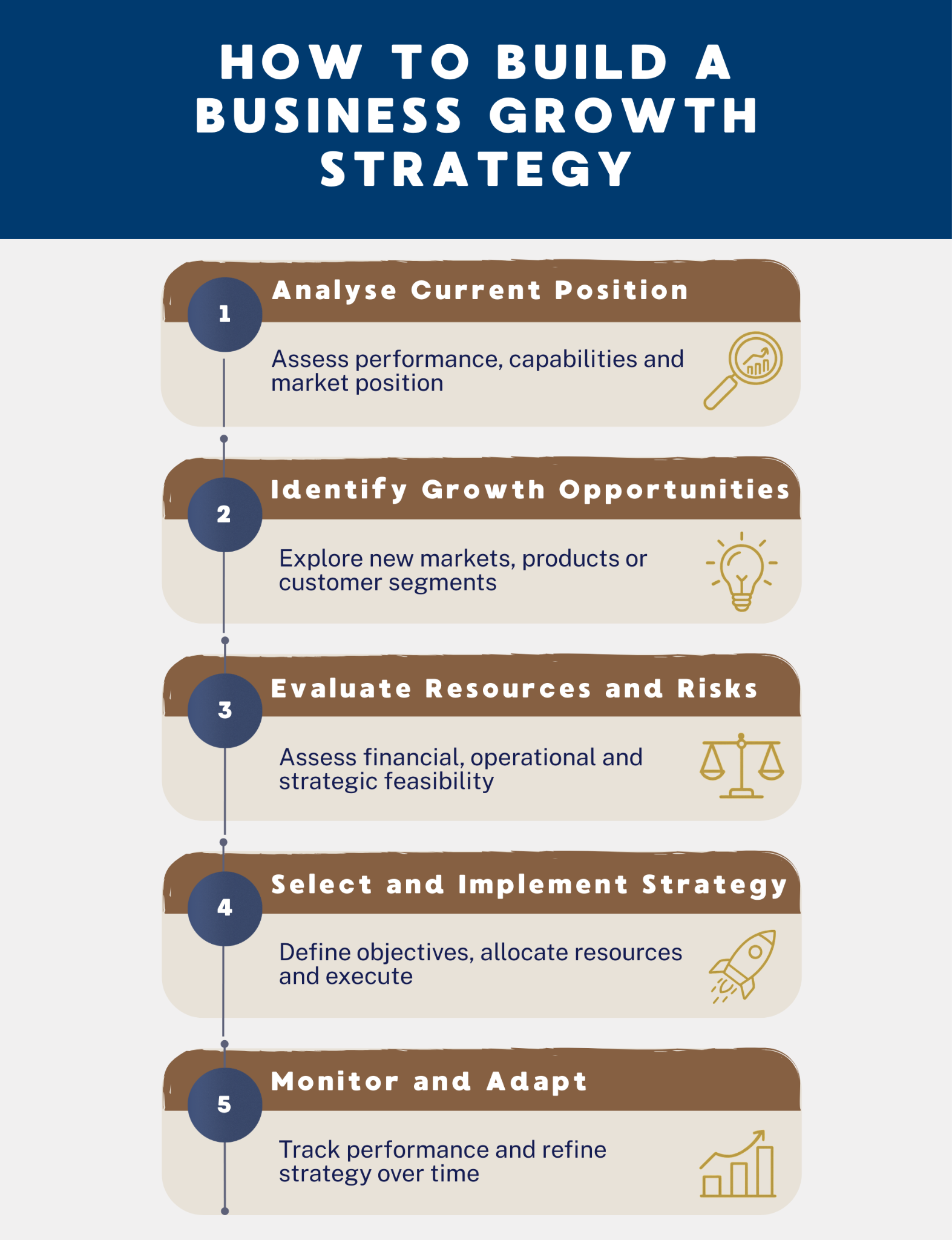
Step 1: Analyse Current Position
The first step is to assess your organisation’s current performance, capabilities, and market position. This includes reviewing financial results, customer segments, competitive positioning, and operational strengths.
Frameworks such as SWOT analysis can support this process by identifying internal strengths and weaknesses alongside external opportunities and threats, providing a clear baseline for evaluating growth options.
Step 2: Identify Growth Opportunities
Once the starting point is clear, organisations can identify potential areas for growth, such as entering new markets, launching new products, or increasing share within existing segments. Each opportunity should be assessed based on factors such as market demand, competitive intensity, and alignment with core strategic objectives.
Step 3: Evaluate Resources and Risks
Different growth options require varying levels of investment and carry different levels of risk. Organisations therefore need to assess whether they have the financial resources, talent, and operational capacity to support the strategy. For instance, diversification typically involves greater uncertainty compared to market penetration, making careful evaluation of trade-offs essential before proceeding.
Step 4: Select and Implement Strategy
After evaluating the available options, organisations can select the most appropriate growth strategy. This decision should align with market opportunities, internal capabilities, and overall business objectives.
Once a strategy has been selected, implementation involves setting clear objectives, allocating resources, and defining key performance indicators (KPIs) to track progress. Effective execution requires translating strategy into action, particularly in areas such as customer acquisition, scaling operations, and commercial execution.
Step 5: Monitor Performance and Adapt
Growth strategies require continuous monitoring and refinement. Organisations should track performance against defined KPIs to assess whether objectives are being met.
Where results fall short, adjustments such as refining the target market, reallocating resources, or modifying the value proposition may be needed to respond to changing conditions. As business environments become increasingly digital, organisations must also adapt their strategies to leverage new technologies, data insights, and evolving customer behaviours. Professionals seeking to strengthen these capabilities may explore programmes such as SMU Academy’s Maximising Organisational Performance and Driving Business Growth in the Digital Age and the Advanced Certificate in Generative AI for Business Growth and Innovation.
Common Challenges in Business Growth
While growth presents opportunities, organisations often encounter practical challenges when implementing and sustaining their strategies. These challenges typically arise from execution gaps, coordination issues, and market shifts.
Strategy Execution Gaps
Organisations may define clear growth objectives but lack the operational processes or internal coordination required to execute them effectively. As a result, initiatives may face delays, inconsistencies, or fail to deliver the intended outcomes.
Operational Scalability
As businesses expand, maintaining service quality, operational efficiency, and customer experience becomes more complex. Without scalable systems and processes, rapid growth may strain resources and lead to inefficiencies.
Market Uncertainty
Changing customer preferences and shifting competitive dynamics can affect the effectiveness of growth strategies over time. Organisations must continuously monitor market conditions and adjust their approach to remain relevant and responsive.
Internal Resistance to Change
Introducing new technologies, processes, or business models can create resistance within the organisation. Overcoming this requires clear communication, leadership alignment, and a culture that supports change and continuous improvement.
For business leaders, managing change and aligning teams are critical capabilities when driving growth initiatives. Programmes such as Personal Leadership and Business Success Series support leaders in developing the skills needed to lead transformation and sustain business growth.
Choosing the Right Business Growth Strategy
Choosing the right business growth strategy requires organisations to continuously evaluate opportunities in response to changing market conditions, competitive pressures, and internal capabilities. Rather than relying on a single approach, businesses often adapt and refine their strategies over time to sustain growth.
This makes execution capability just as important as strategy. As organisations place greater emphasis on career development, building skills in areas such as strategy, innovation, and digital transformation becomes increasingly relevant. SMU Academy offers business growth programmes that support professionals in developing these capabilities.
FAQs About Business Growth Strategies
What is the most common growth strategy for businesses?
Market penetration is often the most commonly used growth strategy, as it focuses on increasing sales within existing markets using familiar products or services. It is generally preferred because it involves lower risk and requires fewer new capabilities compared to entering new markets or developing new offerings.
What are effective strategies for growing a small business?
Effective growth strategies for small businesses often focus on strengthening existing customer relationships and identifying niche market opportunities, particularly when exploring new business ideas or models. Rather than pursuing large-scale expansion, smaller organisations typically prioritise sustainable growth aligned with their available resources and capabilities.
How can technology contribute to business growth?
Technology supports business growth by improving operational efficiency, enabling data-driven decision-making, and enhancing customer experience. For example, digital platforms, automation tools, and artificial intelligence can help organisations streamline operations, improve customer experience, and identify new growth opportunities. In particular, areas such as e-commerce and digital marketing play an important role in enabling businesses to scale and access new markets. Professionals seeking to develop capabilities in these areas may explore programmes such as E-commerce Ecosystem Content and Social Media Marketing Strategies for Business Growth.
What are the challenges of rapid business growth?
Rapid growth can create pressure on operations, resources, and organisational structure. Businesses may face challenges such as maintaining service quality, scaling processes effectively, and ensuring internal alignment as they expand. Without proper planning, accelerated growth can lead to inefficiencies and reduced performance.