


For decades, businesses have sought to develop or adopt various practices to optimise resources, boost profits, and build effective teams. Lean Six Sigma is a process improvement methodology that helps organisations reduce waste, minimise defects, and improve operational efficiency. By combining Lean’s focus on eliminating non-value-adding activities with Six Sigma’s data-driven approach to reducing process variation, it gives businesses a systematic way to solve recurring performance and quality issues.
These capabilities remain relevant as companies face pressure to do more with available resources while meeting higher customer expectations. According to the Economic Survey of Singapore 2025, real value-added per actual hour worked grew by 3.4% for the full year, while real value-added per worker rose by 3.5%. These figures reinforce why productivity and quality management remain important business priorities. This article explains how Lean Six Sigma works, where it is applied, and what professionals should know before using it.
What is Lean Six Sigma?
Lean Six Sigma is an approach that aims to improve performance and quality through the elimination of waste and defects. It helps organisations identify the causes of inefficiency or inconsistency, then make evidence-based changes that can be sustained. In business settings, it is commonly applied to operational, quality control, and customer-facing work.
How Does Lean Six Sigma Work?
Lean Six Sigma works by identifying inefficiencies, waste, and defects within a process and implementing improvements to optimise performance. It combines Lean’s focus on reducing waste and improving efficiency with Six Sigma’s emphasis on quality and consistency. By analysing workflows and using data to identify root causes, businesses can develop targeted solutions that improve productivity, reduce costs, and enhance customer satisfaction through continuous improvement.
The Lean Six Sigma Methodology
One of the most widely used frameworks in Lean Six Sigma is the DMAIC methodology, which stands for Define, Measure, Analyse, Improve, and Control. This five-phase approach moves a project from problem identification to measurable change and long-term monitoring.
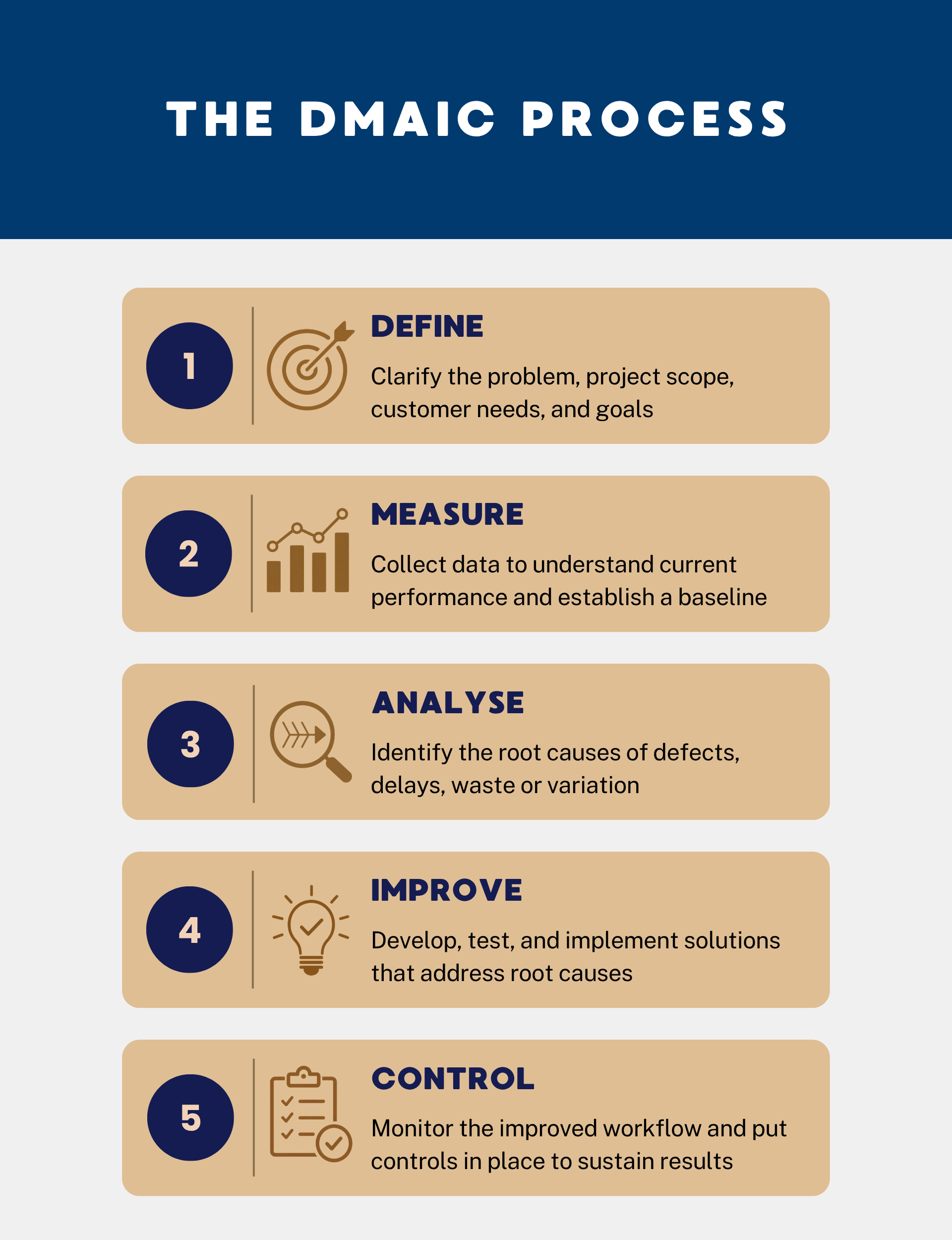
The table below summarises the five DMAIC phases and how each stage supports structured problem-solving:
| DMAIC Phase | What It Involves |
| Define | Clarify the problem, project scope, customer needs, and improvement goals |
| Measure | Collect data to understand current performance and establish a baseline |
| Analyse | Identify the root causes of defects, delays, waste, or process variation |
| Improve | Develop, test, and implement solutions that address the root causes |
| Control | Monitor the improved process and put controls in place to sustain results |
Key Principles of Lean Six Sigma
Lean Six Sigma principles focus on measurable change instead of one-off fixes. They also emphasise customer value, employee involvement, and sustained ways of working.
Focus on Customer Value
Every Lean Six Sigma project begins by identifying what matters to the intended customer or stakeholder. This distinction clarifies which activities create value and which add avoidable friction.
Identify and Eliminate Waste
Waste refers to work that consumes resources without adding value to the final outcome. In Lean Six Sigma, this is often explained through the DOWNTIME framework: defects, overproduction, waiting, non-utilised talent, transportation, inventory, motion, and extra processing.
Reduce Variation and Defects
Consistent outcomes are central to quality management. Lean Six Sigma uses data to understand why performance varies, then refines the process so results become more predictable.
Involve and Empower Employees
Employees who work directly with a process often understand where issues occur in practice. Their involvement can surface practical solutions and support stronger adoption when changes are introduced.
Pursue Continuous Improvement
Lean Six Sigma treats process refinement as an ongoing discipline rather than a one-time project. Teams continue to monitor performance and adjust controls so that changes remain effective.
Lean Six Sigma Tools and Techniques
Practitioners use different tools depending on whether they need to diagnose a problem, refine a workflow, or monitor results. The choice depends on the issue, available data, and project stage.
Process Mapping Tools
Value stream mapping visualises each step in a workflow to show where time or effort is being wasted. Kanban supports workflow visibility by showing how tasks move from request to completion, making bottlenecks easier to manage.
Root Cause Analysis Tools
Fishbone diagrams, also known as cause-and-effect diagrams, help teams organise possible causes of a problem by category. The 5 Whys technique complements this by asking “why” repeatedly until the underlying cause becomes clearer.
Quality and Data Analysis Tools
Pareto analysis identifies the few causes that contribute most to recurring problems. Control charts track performance over time, making it easier to distinguish normal variation from unusual changes that require investigation.
Workplace Improvement Tools
5S is a workplace organisation method that focuses on sorting, setting in order, shining, standardising, and sustaining, often to improve safety, efficiency, and consistency. Kaizen refers to continuous, incremental improvement, where teams make small practical changes to improve daily workflows over time.
Lean Six Sigma Belt Levels
Belt levels indicate a practitioner’s depth of training, project responsibility, and ability to lead process initiatives. The table below summarises the main Lean Six Sigma belt levels, their focus areas, and the types of professionals they are suited for:
| Belt Level | Focus | Suitable For |
| White Belt | Understanding basic Lean Six Sigma concepts, terms, and principles | Professionals seeking a general introduction to Lean Six Sigma |
| Yellow Belt | Supporting improvement projects through foundational Lean Six Sigma tools and methods | Team members contributing to operational projects |
| Green Belt | Applying Lean Six Sigma tools to analyse problems and refine workflows within a function | Managers, analysts, team leads, and professionals in business analyst roles working with operational data or workflow change |
| Black Belt | Leading complex projects, coaching teams, and driving measurable business outcomes | Senior practitioners, project leads, transformation teams, and operational excellence professionals |
| Master Black Belt | Guiding organisation-wide deployment, mentoring Black Belts, and managing project portfolios | Senior leaders responsible for enterprise-level Lean Six Sigma adoption |
Professionals who wish to develop formal Lean Six Sigma capabilities can consider training such as SMU Academy’s Lean Six Sigma Green Belt Certification and Lean Six Sigma Black Belt Certification.
Benefits of Lean Six Sigma

When applied to measurable business problems, Lean Six Sigma can help teams address poor performance and sustain better ways of working.
Benefits of Lean Six Sigma include:
- Enhancing operational efficiency: Identifies where work slows down so teams can complete tasks with less wasted effort.
- Reducing defects and rework: Uses data to understand where errors occur, lowering the time and cost spent correcting repeated mistakes.
- Strengthening decision-making: Gives teams a clearer basis for deciding which problems to prioritise.
- Improving customer satisfaction: Supports more consistent processes, which can lead to more reliable customer outcomes.
- Building a culture of continuous improvement: Makes process refinement part of daily work rather than a one-off project.
Applications of Lean Six Sigma Across Industries
Although Lean Six Sigma originated in manufacturing, it is now used in industries where work follows repeatable patterns and outcomes can be measured.
Manufacturing
Across production environments, Lean Six Sigma is often applied to production planning, quality control, equipment-related workflows, inventory movement, and defect management.
Healthcare
Healthcare organisations apply Lean Six Sigma to patient-facing and administrative workflows, including areas where delays affect care coordination. In a 2023 private hospital study, Lean Six Sigma interventions reduced the mean wait time between an emergency department visit and a trauma orthopaedic appointment from 17.6 days to 11.6 days. The study also reported a 34% reduction in total wait time and a 51% reduction in registration process steps.
Banking and Finance
Lean Six Sigma is often applied to approval, rework, and risk assessment workflows in banking and finance. Bain & Company reported that a commercial bank achieved a 30% reduction in time required to approve credit applications, a 25% reduction in applications requiring rework, and a 10% to 15% reduction in deals requiring central credit head approval after applying Lean Six Sigma changes.
Logistics and Supply Chain
Within logistics and supply chain operations, Lean Six Sigma is often used where inventory and delivery workflows require tighter coordination. This makes it relevant to broader supply chain management practices, especially in settings with multiple handoffs or time-sensitive tasks.
Service Operations and Customer Experience
In service-based environments, Lean Six Sigma can be applied to customer experience workflows where wait times, complaints, or onboarding processes affect service quality. SMU Academy’s Business Processes: Service Excellence in Operations Strategy covers how customer insights, process design, service capacity, and Lean Six Sigma principles support service operations.
Public Sector and Education
Administrative teams in public sector and education settings may use the methodology to simplify high-volume workflows that involve approvals, enquiries, or service requests.
Limitations of Lean Six Sigma
Lean Six Sigma is most effective when problems are measurable and supported by reliable data. It may be less suitable for early-stage experimentation or major strategic transformation. Common limitations include:
- Data dependency: Lean Six Sigma relies on accurate data to measure performance and identify root causes. Poor or incomplete data can lead to weak analysis and ineffective solutions.
- Implementation time: Projects can take time to scope and validate, especially when they involve complex workflows or multiple teams.
- Change resistance: Employees may be hesitant to adopt new processes if they do not understand the purpose of the improvement effort or feel excluded from decision-making.
- Limited fit for highly uncertain problems: Lean Six Sigma works best when a stable workflow already exists. Early-stage innovation may require faster experimentation before formal process analysis is useful.
- Risk of overcomplication: If teams apply too many tools without a clear problem statement, the methodology can become procedural rather than practical.
Is Lean Six Sigma Still Relevant Today?
Lean Six Sigma remains relevant because organisations still need structured ways to strengthen efficiency and consistency. As operations become more data-driven, the methodology provides a practical framework for turning process issues into measurable changes.
Its role has also evolved alongside Agile, digital transformation, and AI-enabled analytics. While newer tools can help teams analyse data faster, Lean Six Sigma provides the problem-solving structure needed to turn those insights into practical operational changes.
SMU Academy offers Lean Six Sigma programmes that help professionals analyse processes and implement measurable improvements effectively.
FAQs About Lean Six Sigma
What is the difference between Lean Six Sigma and Six Sigma?
Six Sigma focuses mainly on reducing defects and process variation through data analysis. Lean Six Sigma combines this with Lean principles, which focus on reducing waste and removing non-value-adding activities from a process..
Is Lean Six Sigma the same as Kaizen?
No. Kaizen refers to continuous, incremental improvement, while Lean Six Sigma is a broader methodology that uses structured tools and data analysis. Kaizen can be used within Lean Six Sigma projects, but the two are not the same.
Which Lean Six Sigma belt should I start with?
Beginners may start with White Belt or Yellow Belt to understand the basic concepts. Professionals who want to lead projects or apply Lean Six Sigma tools at work often begin with Green Belt training, while Black Belt is more suitable for those leading complex projects or coaching teams.
SMU Academy’s Lean Six Sigma Green Belt Certification is designed for professionals applying Lean Six Sigma tools within their functional areas, while its Lean Six Sigma Black Belt Certification supports those leading more complex improvement projects.
How long does it take to get Lean Six Sigma certified?
The time needed depends on the belt level, course provider, and whether project submission is required. Introductory belts may take a shorter time to complete, while Green Belt and Black Belt certifications usually require more training, practical application, and assessment.
Will AI replace Lean Six Sigma?
AI is unlikely to replace Lean Six Sigma entirely. Tools such as generative AI can support analysis and workflow automation, but Lean Six Sigma still provides the problem-solving framework needed to define issues, involve stakeholders, and implement practical changes.