



Public speaking is the ability to communicate ideas clearly and confidently to an audience, whether during meetings, presentations, conferences, or public events. In today’s workplace, it is a critical communication skill that reflects how well a professional can articulate ideas, influence others, and represent their organisation.
According to research by the National Association of Colleges and Employers (NACE), 69.3% of employers actively look for presentation and verbal communication skills on a candidate’s resume, underscoring the importance of public speaking in hiring decisions.
Public speaking skills are especially valuable in roles such as managers, consultants, sales professionals, educators, executives, and trainers. Despite its relevance, confidence does not come easily to most people. As of 2025, around 75% of individuals experience fear when speaking in front of others, making it one of the most common social fears worldwide.
This article explores why public speaking feels intimidating, its benefits, practical public speaking tips, common mistakes to avoid, and how to demonstrate this skill professionally.
Key Takeaways
- Public speaking is a highly valued workplace skill, with employers actively looking for strong verbal and presentation abilities when hiring.
- Fear of public speaking is common but manageable, driven by psychological and biological responses that improve with practice and exposure.
- Confidence comes from preparation, real-world practice, and feedback, not from natural talent alone.
- Public speaking skills can be developed and demonstrated, through structured practice, training courses, and clear evidence on your resume.
What Are the Benefits of Developing Public Speaking Skills?
Strong public speaking skills go beyond giving speeches. They influence how confidently and clearly you communicate in meetings, interviews, and leadership situations. Below are key benefits, grouped by category, to show their broad impact.
Career and Professional Benefits
- Improved leadership presence: Clear and confident speakers are often perceived as credible and authoritative leaders
- Better career opportunities: Roles involving presentations, client interactions, or leadership often favour strong communicators
Communication and Relationship Benefits
- Clearer message delivery: Public speaking helps you organise thoughts and communicate ideas more effectively
- Stronger persuasion skills: You learn how to influence opinions and inspire action through structured messaging
Personal Development Benefits
- Increased self-confidence: Regular speaking builds self-belief both on and off the stage
- Reduced communication anxiety: Exposure gradually lowers fear in social and professional settings
Cognitive and Emotional Benefits
- Improved critical thinking: Preparing speeches sharpens reasoning and logical structuring
- Greater emotional resilience: Managing nerves strengthens emotional control under pressure
Why Does Public Speaking Feel Scary?

Public speaking anxiety often stems from both mental and situational factors. Common physical reactions include sweaty palms, a racing heart, shaky hands, dry mouth, or mental blanks. Understanding the reasons behind this fear makes it easier to manage and overcome.
Psychological Reasons
- Fear of negative judgement: Many worry about being criticised, embarrassed, or seen as incompetent
- Perfectionism: Unrealistic expectations increase pressure and anxiety
- Loss of control: Speaking live leaves little room for editing or correction, heightening stress
Contributing Factors
- Limited experience: Lack of exposure makes unfamiliar situations feel threatening
- Past negative experiences: Previous poor presentations can reinforce fear
- Biological fear response: According to Asteroid Health, when speaking publicly, fear-processing areas of the brain become highly active, sometimes causing “brain freezes” and heightened anxiety, as the body reacts as if facing a social threat
What Are the Best Public Speaking Tips?
Improving public speaking requires a combination of preparation, exposure, and self-awareness. The following tips focus on practical actions that gradually build confidence and delivery quality.
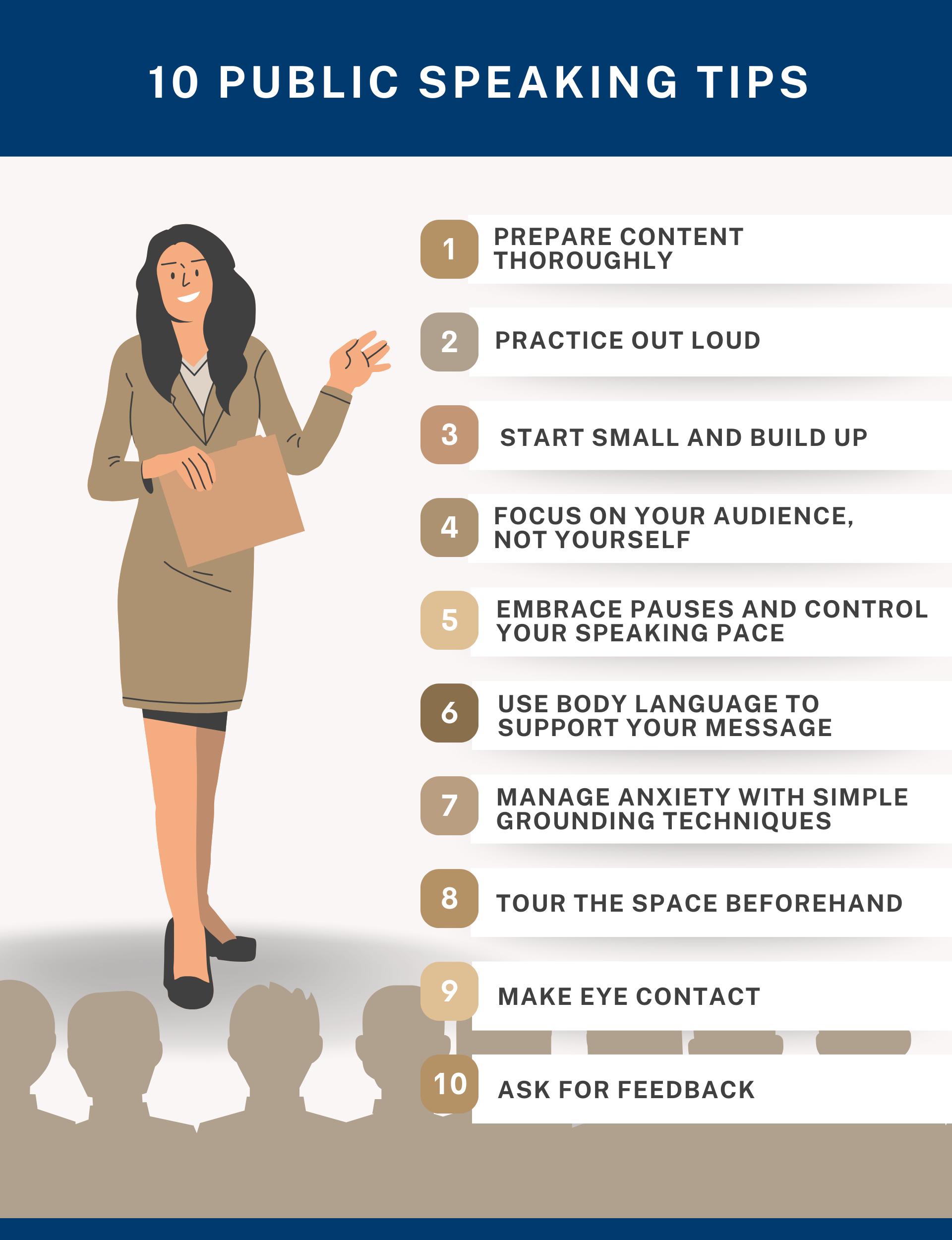
Tip #1: Prepare Content Thoroughly
Structure your message clearly with a strong opening, key points, and conclusion. Knowing your content well reduces uncertainty and boosts confidence.
Tip #2: Practice Out Loud
Speaking aloud helps you refine phrasing, timing, and tone. It also makes your delivery sound more natural and conversational.
Tip #3: Start Small and Build Up
Begin by practising in low-pressure settings such as small group discussions, team meetings, or informal presentations.
A study done by Smith and Frymier shows that speakers who practise in front of a live audience, even a small one, tend to perform better and receive stronger evaluations than those who rehearse alone. Gradual exposure builds confidence more effectively than avoiding audiences altogether.
Tip #4: Focus on Your Audience, Not Yourself
Shift attention to how your message benefits listeners. This reduces self-consciousness and improves engagement.
Tip #5: Embrace Pauses and Control Your Speaking Pace
Strategic pauses enhance clarity and allow audiences to absorb key points. Speaking slowly also signals confidence.
Tip #6: Use Body Language to Support Your Message
Maintain open posture, purposeful gestures, and controlled movement to reinforce credibility.
Tip #7: Manage Anxiety With Simple Grounding Techniques
Deep breathing, slow exhalations, or grounding through physical sensations help calm the nervous system.
Tip #8: Tour the Space Beforehand
Familiarity with the room, stage, or technology reduces uncertainty and stress.
Tip #9: Make Eye Contact
Natural eye contact builds trust and helps you connect with individuals in the audience.
Tip #10: Ask for Feedback
Constructive feedback highlights strengths and identifies areas for improvement, accelerating progress.
What Are Some Common Public Speaking Mistakes to Avoid?
Even confident speakers can weaken their delivery through avoidable mistakes. Knowing what to adjust helps you communicate more clearly and confidently.
Preparation and Structure
- Overloading slides: Too much information overwhelms audiences. Focus on key points and use slides as visual support, not a script
- Unclear structure: A lack of clear introduction or conclusion confuses listeners. Use a simple structure that guides the audience from start to finish
Delivery and Content
- Reading word-for-word: This reduces authenticity. Instead, use bullet points and speak naturally around them
- Monotone delivery: Flat vocal delivery disengages listeners. Vary your tone, pace, and emphasis to maintain interest
Body Language and Engagement
- Avoiding eye contact: This can signal discomfort. Make brief eye contact with different parts of the audience to build rapport
- Distracting movements: Fidgeting draws attention away from your message. Use intentional gestures and grounded posture
How to Build Confidence in Public Speaking?
Confidence grows through consistent effort and intentional practice. Rather than focusing solely on technique, these strategies strengthen mindset and self-belief over time.
- Reframe nerves as excitement: Anxiety and excitement feel similar physically; changing interpretation reduces fear
- Build subject-matter mastery: Deep knowledge increases confidence in handling questions
- Record and review yourself: Watching recordings helps identify progress and areas to improve
- Join speaking communities: Supportive environments encourage practice without judgement
- Take presentation skills courses: Structured training accelerates development. Programmes such as “Clearly Speak: A Course on Effective Speaking for Corporate Leaders, Professionals and Executives” by SMU Academy provide guided practice, expert feedback, and real-world application
How to Demonstrate Public Speaking Skills on a Resume?

Employers value evidence-based communication skills. Demonstrating public speaking effectively on your resume helps differentiate you from other candidates.
Highlight Presentation Achievements
Describe specific presentations, workshops, or briefings you have delivered. For example, “Presented quarterly performance updates to senior leadership.”
Strengthen your presentation capabilities with Strategies for Persuasive Presentations.
Quantify Your Impact
Where possible, include measurable outcomes such as audience size, engagement levels, or business results. For example, “Delivered a product pitch to 50+ clients, contributing to a 20% increase in sales.”
Build measurable communication impact with Purpose Driven High Performance Organisation Module 4: Leadership Communication with Presence, Passion and Purpose.
Show Leadership and Facilitation Experience
Mention roles that required leading discussions, facilitating meetings, or representing stakeholders. This signals confidence in group communication.
Develop confident leadership and facilitation skills with Team Leadership: Achieving Win-Win in Negotiations.
Include Relevant Training and Courses
Formal training demonstrates commitment to skill development. Listing public speaking or communication courses strengthens credibility.
Build your public speaking and communication skills with Foundations Of Brand Storytelling.
Use Strong Action Verbs
Words such as “presented,” “facilitated,” “led,” or “moderated” clearly signal public speaking capability.
Sharpen how you describe impact and leadership with Business Storytelling Studio.
Practical Public Speaking Tips for Long-Term Confidence
Public speaking is a skill that improves with understanding, preparation, and consistent practice. By recognising why public speaking feels intimidating, applying practical public speaking tips, avoiding common mistakes, and actively building confidence, individuals can become clearer and more persuasive communicators. Investing time in developing public speaking strengthens professional credibility, leadership presence, and personal confidence across many aspects of work and life.
SMU Academy has public speaking programmes designed to help professionals strengthen their communication skills, build confidence and deliver clear, engaging presentations across a range of professional settings.





FAQs About Public Speaking
Public speaking generally serves three core purposes, depending on the speaker’s goal and audience:
- To inform: Share knowledge, data, or explanations clearly
- To persuade: Influence opinions, decisions, or behaviours
- To inspire: Motivate or encourage audiences emotionally
Public speaking enables ideas to reach and influence groups at scale. A clear and confident message can shape opinions, build trust, and drive collective action.
Public speaking can be learned through practice, feedback, observation, and structured training. Formal courses help accelerate development, and SMU Academy offers professional programmes tailored to working professionals.
Listen carefully, pause before responding, clarify questions if needed, and answer concisely. It is acceptable to acknowledge when you do not have an immediate answer and follow up later.

Hey, chat with me!