


Digital transformation is not simply about introducing new software or replacing manual processes. A digital transformation strategy provides a structured plan for using technology, data and organisational change to solve business problems, improve performance and create greater value for customers.
For Singapore businesses, this has become increasingly important. The Singapore Business Federation’s (SBF) National Business Survey 2025 Digitalisation Supplement found that four in five businesses are already undertaking digital transformation. While e-payments, cloud computing and cybersecurity are widely adopted, businesses are looking towards artificial intelligence (AI), data analytics and the Internet of Things (IoT) as important technologies for their next phase of transformation.
As Singapore’s digital economy continues to develop, having a clear strategy can help organisations invest more purposefully. This article explores what a digital transformation strategy involves, its benefits, emerging trends and practical steps businesses can take to build one.
What Is a Digital Transformation Strategy?
A digital transformation strategy outlines how an organisation uses technology, data and new ways of working to achieve business goals. It focuses on solving business problems rather than simply adopting new technology. Businesses use it to improve efficiency, enhance customer experience, create opportunities and align digital investments with measurable outcomes.
The core dimensions of digital transformation typically include:
- Strategy and leadership: Establish clear business objectives, priorities and leadership accountability for transformation
- People and culture: Develop employees’ technical skills and soft skills while encouraging openness to new ways of working
- Processes and operations: Redesign workflows to reduce inefficiencies and make better use of automation and digital systems
- Technology: Select technologies that address genuine business needs rather than adopting tools simply because they are new
- Data and analytics: Build reliable data foundations that allow teams to generate insights and make informed decisions
- Customers: Understand the customer journey, needs and behaviours to develop digital solutions that create meaningful value
Together, these dimensions help organisations approach transformation as a business-wide change rather than a standalone IT project.
Why Is a Digital Transformation Strategy Important?
A clear digital transformation strategy helps businesses prioritise investments, coordinate change and ensure that digital initiatives contribute to measurable business outcomes rather than becoming disconnected technology projects.
Builds Organisational Agility
Businesses with connected systems, adaptable processes and digitally capable employees can respond more quickly to market changes. This agility can support areas ranging from brand management to sustainability in business as priorities evolve.
Creates New Business Opportunities
Digital capabilities can enable new products, services and business models. An online business, for example, can use digital platforms to reach new markets, while established companies can develop additional digital revenue streams.
Enables Better Data-Driven Decisions
Quality data and analytics allow businesses to identify trends, monitor performance and make more informed decisions. Leaders can use dashboards and predictive insights to adjust strategies based on evidence rather than assumptions.
Improves Operational Efficiency
Digital systems can automate repetitive tasks, connect workflows and reduce manual errors. For example, integrated project management tools can give teams greater visibility over deadlines, resources and responsibilities.
Strengthens Customer Experience
Digital transformation helps businesses understand customer preferences and interactions more deeply. Customer data can reveal friction points, enabling organisations to personalise services, simplify processes and build stronger customer loyalty.
Key Trends for Digital Transformation
Digital transformation continues to evolve as technologies become more sophisticated and organisations seek greater value from their investments. These trends are shaping how businesses plan their next stage of digital development.

Artificial Intelligence and Intelligent Automation
Businesses are applying AI to automate processes, analyse information and support employees. Applications can range from AI-assisted customer service to AI in marketing, where technology supports content development, personalisation and campaign optimisation.
Data Analytics and Predictive Insights
Organisations are moving beyond collecting data towards using it strategically. Reliable, well-governed data can support forecasting, customer segmentation, operational planning and faster decision-making across different business functions.
For example, DBS Bank uses data analytics and AI to gain deeper insights into customer behaviour and preferences, enabling the bank to personalise products and services, improve decision-making and strengthen areas such as fraud detection.
Connected Technologies and IoT
Internet of Things technologies connect physical equipment and environments with digital systems. Manufacturers can monitor machinery in real time, while retailers and logistics businesses can use connected devices to improve inventory visibility.
Cybersecurity and Digital Trust
As organisations become increasingly connected, cybersecurity must form part of transformation planning. Strong security measures, employee awareness and oversight from a data protection officer can help safeguard sensitive information, manage data risks and maintain customer trust.
Omnichannel and Connected Customer Experiences
Businesses are integrating digital and physical channels to provide more seamless customer experiences. This allows customers to move between online and offline touchpoints while receiving consistent service and support.
For example, IKEA Singapore has evolved its stores alongside its e-commerce operations, retraining employees to support both digital and physical customer journeys. Its stores are increasingly positioned as experience centres where customers can access planning, product selection and fulfilment support in one place.
5 Steps to Build a Digital Transformation Strategy
Building a digital transformation strategy requires more than choosing technologies. Organisations need to understand their priorities, involve their people and establish a practical roadmap that allows initiatives to be tested and improved.
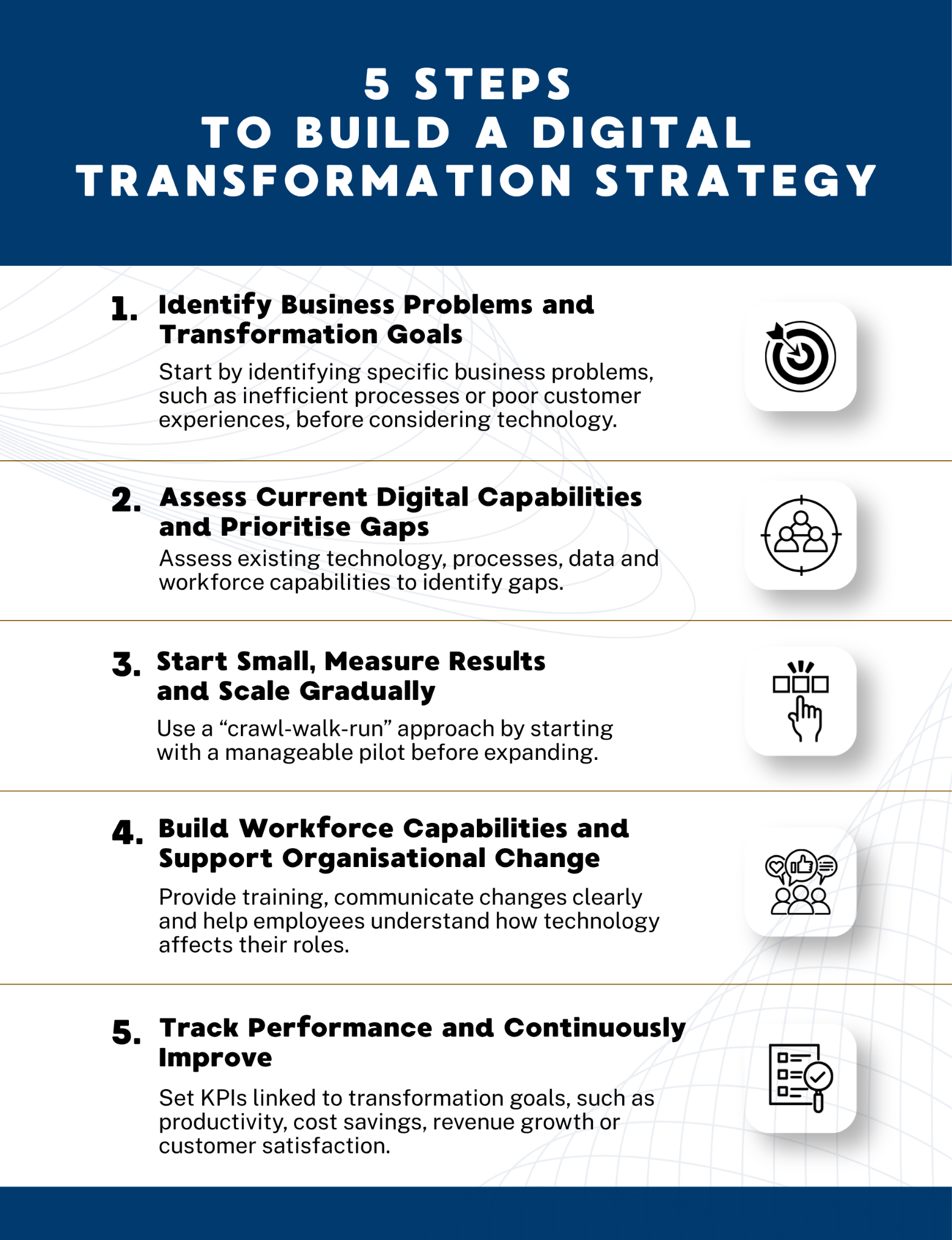
Step 1: Identify Business Problems and Transformation Goals
Start by identifying specific business problems, such as inefficient processes or poor customer experiences, before considering technology. Effective goal setting helps establish measurable objectives linked to these challenges. Use customer feedback and behavioural data to understand needs and develop solutions that create meaningful value.
Step 2: Assess Current Digital Capabilities and Prioritise Gaps
Assess existing technology, processes, data and workforce capabilities to identify gaps. For example, businesses planning to use advanced analytics may first need to improve data quality and governance. Prioritise initiatives based on business impact, feasibility, cost and alignment with organisational goals.
Step 3: Start Small, Measure Results and Scale Gradually
Use a “crawl-walk-run” approach by starting with a manageable pilot before expanding. For example, test an AI customer service tool for common enquiries, measure its performance and gather feedback. Successful initiatives can then be refined and gradually scaled across other channels or functions.
Step 4: Build Workforce Capabilities and Support Organisational Change
People are central to digital transformation. Provide training, communicate changes clearly and help employees understand how technology affects their roles. Developing technical skills, transferable skills and adaptability supports career development while helping organisations build a workforce that can respond effectively to digital change.
Businesses and professionals looking to strengthen their digital transformation capabilities can consider relevant SMU Academy courses, including:
- Artificial Intelligence (AI) & Digital Transformation - How to Think and Act Differently to Succeed?
- Advanced Certificate in Supply Chain Innovation and Transformation Module 2: Introduction to the Digital Transformation Toolkit and Project Management
- Advanced Certificate in Business Innovation for Small and Medium-sized Enterprises (SMEs) Module 1: Digital Transformation and Artificial Intelligence for SMEs
- Digital Transformation in Food and Beverage (F&B): A Course on Restaurant Tech
- Going Digital the Smart Way: The Right Approach to Digital Transformation
- Advanced Certificate in Digital Procurement Module 5: eProcurement System to Aid Digitalisation
Step 5: Track Performance and Continuously Improve
Set KPIs linked to transformation goals, such as productivity, cost savings, revenue growth or customer satisfaction. Regularly review performance to identify successful initiatives, address shortcomings and determine what to scale. This helps ensure digital transformation delivers measurable business value and evolves alongside organisational needs.
Build a Digital Transformation Strategy That Creates Lasting Value
A successful digital transformation strategy connects technology with business needs, people, customers and measurable outcomes. Organisations should focus on solving meaningful problems, develop reliable data foundations and equip employees with the capabilities needed to adapt.
Starting with smaller initiatives also allows businesses to learn before scaling their investments. With clear objectives and continuous measurement, digital transformation can become an ongoing capability that helps organisations improve efficiency, strengthen customer relationships and respond more confidently to future opportunities.
FAQs About Digital Transformation Strategy
There is no single universally accepted “4 Ps” framework for digital transformation, and different organisations use the term differently. One practical interpretation is People, Processes, Platforms and Performance.
- People: Build the skills, culture and leadership required for change
- Processes: Redesign workflows to improve efficiency and effectiveness
- Platforms: Use suitable technologies and digital infrastructure to enable transformation
- Performance: Measure whether digital initiatives are producing meaningful business outcomes
Together, these four areas reinforce an important principle: successful digital transformation is not defined by technology adoption alone.
Digital transformation typically requires support from senior leadership alongside technology, operations and functional leaders. Depending on the organisation, key roles may include the CEO, CIO, CTO, Chief Digital Officer and business unit leaders. More importantly, responsibilities should be clearly defined so that transformation does not become the responsibility of the IT department alone.
Businesses need a combination of technology expertise, data literacy, strategic thinking, change management and communication capabilities. Employees also require adaptability, problem-solving and collaboration skills so they can apply technology effectively rather than simply learn how individual tools work.
Businesses should measure outcomes against the objectives established at the beginning of their transformation. Relevant indicators may include cost savings, productivity improvements, revenue growth, digital adoption rates, employee engagement, customer satisfaction and return on investment. Metrics should focus on business impact rather than simply counting how many technologies have been implemented.
Common challenges include high implementation costs, outdated systems, poor data quality, cybersecurity concerns, employee resistance and insufficient digital expertise. SBF’s 2025 survey also identified employee upskilling and management expertise as human-factor barriers to technology adoption. Clear priorities, phased implementation, employee involvement and ongoing measurement can help businesses manage these challenges more effectively.